Showing posts with label 13 Days of First-Time Frights. Show all posts

Thursday, October 29, 2020

13 Days of First-Time Frights: Videodrome

13 Days of First-Time Frights is a series of reviews where Douglas Laman, in the spirit of Halloween, watches and writes about thirteen horror first-time watches These reviews will be posted each Tuesday and Thursday, as well as the three Wednesdays and a Friday, throughout October 2020.

Entry #26: Videodrome

Who better to close out this year's edition of 13 Days of First-Time Frights than David Cronenberg?

Cronenberg has left an undeniable stamp on the world of horror cinema. In particular, he's proven to be the architect of the body horror subgenre. In 2020, if you're doing any kind of pop culture that involves the horrors of the human body, whether you're an indie movie or Rick & Morty, Cronenberg's name is bound to come up. Cronenberg's contributions to this subgenre were solidified in his earliest directorial efforts like Scanners or the subject of this review, Videodrome.  With these projects, the tell-tale signs of Cronenberg were on full display and the world of horror would never be the same.

Videodrome's protagonist is Max Renn (James Woods), who works the terrifying job of being a slimy TV executive. He oversee's CIVIC-TV, a public broadcast station in Toronto, Canada, In order to grab any eyeballs whatsoever, CIVIC-TV plays programming with a fixation on sex and violence. It's not a pretty business but it is his. An obscure program called Videodrome is brought to Renn's attention and he immediately wants it. Videodrome consists of women being tortured by big burly men in an empty yellow room. It's perfect CIVIC-TV content! But going on the hunt for this footage leads Renn to discover that watching Videodrome instills hallucinations into the viewer. Now Renn must figure out if his grasp on reality is slipping away or if he's stumbled onto a new conspiracy...

Videodrome is one of those movies you just have to roll with. What starts out as a commentary on public television and lewd on-air programming quickly becomes...something else. In the final half-hour of Videodrome, I had to chuckle to myself as I realized that Videodrome's central metaphor seemed ot have vanished. The thing is, I don't think that's an accident on the part of screenwriter David Cronenberg. He establishes a world of rules for the character for Renn and a seemingly concrete thematic throughline for the audience to follow. As Renn becomes more and more immersed in the surreal visions of Videodrome, both of those things vanish.

It's an explicit way of telling the viewer that nothing can be trusted in this movie. Any potential social commentary will be sacrificed at the altar of gooey otherworldly visions. And when I say gooey, boy do I mean. Not just in regards to blood either. Renn's own hand, whilst it's a clutching a gun, is transformed into some kind of sticky gooey substance from another world. The HD transfer of Videodrome makes the gloopy texture of this and other substances to tangible. You wanna recoil back, yet your eyes are captivated by the sheer strangeness of the entity. Rick Baker's magnificent makeup effects have created the visual effect equiavelent of a traincrash, something horrendous you must stare at.

Of course, the makeup and visual effects are anything but a traincrash. They're still remarkable decades after Videodrome's release. The wizardry used to realize the opening of Renn's stomach is especially an impressive feat. It totally looks seamless and believable while still carrying an appropriate dream-like quality to it. The VFX in Videodrome constantly challenge you to imagine what could be real and what could be a nightmare, placing us squarely in the mind of Renn. Cronenberg's bravura direction further enhances this quality. He never holds back in filming the gross-out mayhem that's unleashed once Renn watches that fateful video tape. His camera never blinks and he encourages the audience to do the same.

Future Cronenberg efforts like The Fly and A History of Violence might be a touch more cohesive than Videodrome, but then again, Videodrome is going for anything but cohesive. This movies main aesthetic is that of a nightmare gone on the warpath. Since when do nightmares adhere to traditional story structures? Videodrome is all about upending what the viewer expects in the name of the gruesome and slimy. The result of those ambitions is something I couldn't turn away from. Cronenberg's imagination is so vivid, from his obsession with body horror to his own sexual proclivities peeking out of the margins. As seen with Videodrome, his warped creativity makes for totally idiosyncratic horror cinema.

13 Days of First-Time Frights: The Wicker Man

13 Days of First-Time Frights is a series of reviews where Douglas Laman, in the spirit of Halloween, watches and writes about thirteen horror first-time watches These reviews will be posted each Tuesday and Thursday, as well as the three Wednesdays and a Friday, throughout October 2020.

Entry #25: The Wicker Man

If you're a moviegoer of a certain age, you might know The Wicker Man only as a 2006 movie starring Nicolas Cage. More specifically, you might know The Wicker Man as a 2006 movie that spawned a GIF's of Nicolas Cage getting attacked by bee's Those GIF's are pretty fun, no question. The movie itself, meanwhile, is a disaster but the fun kind. It's one step above The Creeping Terror, just a totally miscalculated horror movie more capable of delivering unintentional laughs than anything resembling scares. But before all of that nonsense, there was the original Wicker Man, which is rightfully hailed as one of the all-time great horror movies.

Police Sergeant Neil Howie (Edward Woodward) has come to the remote island of Sumerisle to investigate something serious. He has received a note that a girl named Rowan Morrison has gone missing on this island. When he arrives, Howie's suspicious are immediately activated by how nobody on this island seems to believe Morrison even exists. Perturbed by the fact that nobody on this island cares a girl is missing, Howie becomes even more disturbed once he realizes that this island's inhabitants are worshipping Pagan Celtic Gods. As a Christian man, Howie is utterly appalled by this theological transgression and only becomes even more so after a talk with the island's leader, Lord Summerisle (Christopher Lee).

The 1973 Wicker Man made me dislike that new Wicker Man remake even more than I already! Now it's apparent that the remake goes the safe route in every place imaginable! Most notably, the musical numbers of the original Wicker Man and the theological quarrels are all gone. To make a generic 21st-century horror movie, The Wicker Man (2006) sucked all the personality out of its predecessor. Oh well, at least we'll always have this original movie, which really is an impressive feat. Screenwriter Anthony Shaffer's ambition with The Wicker Man to create a more "literate" horror movie has been fulfilled and then some! 

Much like modern-day horror movie Midsommar, Wicker Man realizes how much terrifying things can be when caught in broad daylight. Nighttime is heavily eschewed in favor of setting Howie's investigation in the middle of the day. With the sun pouring in, Wicker Man often conjures up images that are just as beautiful as they are unnerving. The first time Howie sees a group of naked women engaging in a pagan ritual, for instance, is framed and shot to look warm, inviting and even like something you'd seen in a classical painting. The reason this sight is so terrifying to Howie is that it goes against his beliefs, not because it's inherently an unnerving image.

All throughout Shaffer's script, he finds unique and specific ways to define what's "scary" in The Wicker Man. A prime example of this is how Howie takes it upon himself to barge into everybody's homes in the third act to investigate where Rowan could be. Suddenly, our supposed "protagonist" is carrying out more intrusive acts than Howie's antagonists. If someone did this in your own home, wouldn't it be chilling? The Wicker Man keeps fiddling around with what is scary and to whom and it makes for such a thrilling experience. All the while, director Robin Hardy delivers striking images that deliver equal levels of beauty and scares.

Nowhere is this more apparent than that iconic climax, which simultaneously rivets, unnerves, and leaves you in visual awe. Howie and the residents of Summerisle engaging in competing religious chants as Howie burns alive in a giant wooden man. The fact that The Wicker Man is keeping the religious elements of its story so apparent right down to its final scene is thoroughly impressive. Meanwhile, the shots of this wooden figure being engulfed in the flames are flat-out gorgeous. The Wicker Man closes out with the kind of craftsmanship and ambition that defines the entire production. Don't let that dreadful remake steer you away from the original Wicker Man, which remains a feat of horror filmmaking nearly fifty years later.


c

Wednesday, October 28, 2020

13 Days of First-Time Frights: Eyes Without a Face

13 Days of First-Time Frights is a series of reviews where Douglas Laman, in the spirit of Halloween, watches and writes about thirteen horror first-time watches These reviews will be posted each Tuesday and Thursday, as well as the three Wednesdays and a Friday, throughout October 2020.

Entry #24: Eyes Without a Face 

Doctor Génessier (Pierre Brassuer) would do anything for his daughter, Christiane (Édith Scob), whose face was hideously scarred in an automobile accident. This doesn't just mean bringing her soup or helping her with the mask she wears upon her face. Génessier is determined to make a new skin for his daughter's face. This task entails himself and his assistant Louise (Alida Valli) kidnapping women and peeling off their faces in the hopes of creating a new face for Christiane. Normal father stuff, ya know. As the experiments go on and the bodies pile up, Christiane is beginning to wish she was just dead rather than the reason so many deaths. Can anything stop her anguish or the rampage of her father?

Alright, let's dive right into the part of Eyes Without a Face everyone wants to talk about: its gruesomeness. Even though French films in 1962 weren't bound by the restrictive Hays Code that American films had to navigate, I still wasn't ready for just how grisly Eyes Without a Face was. My expectations for how horror films in the early 1960s operated was totally upended the moment Génessier began a procedure that consisted of him peeling off a ladies face entirely on-camera. No cutaways to imply the action rather than show it, no, director Georges Franju is just going for it. It's all on-screen to make your stomach retch and put your heart in your throat.

The sequence is truly remarkable even beyond the shock value of watching faces get peeled off in a mid-20th century movie. For one thing, the makeup effects used to make this hideous surgery possible still look great nearly sixty years later. I honestly doubt this would look any better if it were made today even with decades of VFX advancements. Also aiding this sequence is the restrained nature of the camera. Restraint may be a weird word to use for this kind of ghastly set-piece, but Franju keeps the camera at a distance for most of this scene. He doesn't shove the camera, and by proxy the viewer, into exposed blood vessels or anything like that. 

As a result, the scene is digestible while still visually coherent enough to allow us to appreciate the depravity. Even beyond this shocking sequence, though, Eyes Without a Face proves to be a great thriller. This is mostly because the movie isn't afraid to really look at things from Christiane's perspective. Intimate dialogue-free sequences just follow Christiane on what amounts to an average day in her life. Through such low-key scenes, we understand the horrors she has to go through on an everyday basis. The scares in Eye Without a Face don't just come from faces being peeled off. They're also derived from the psychology of Christiane. 

You know what else is chilling in Eye Without a Face? Composer Maurice Jarre's theme music for Louise. Whenever she's on the hunt for a new woman, she's accompanied by this foreboding music that's like some kind of precursor to the Jaws theme! Louise doesn't even need to approach her next victim to inspire chills up one's spine. The score as a whole does wonders for further enhancing the eerie ambiance of Eyes Without a Face as does George Franju's strong eye for visuals as a filmmaker. Those quiet scenes of Christiane alone wouldn't be half as effective without Franju's sense of blocking and staging.

Eyes Without a Face impresses on the most intimate technical level. But it's also a delight on the kind of surface-level pleasure we all go to horror movies for in the first place. I'm not just talking about that face-peeling surgery sequence either. Eyes Without a Face also features an incredibly cathartic ending involving Doctor Génessier being destroyed by the very dogs he's spent the whole movie abusing. Few things in all of art are as cathartic as watching people who abuse animals get their just desserts! Following that moment, Eyes Without a Face closes out with an evocative shot of Christiane wandering down a trail, her future unknown. It's a fittingly stirring ending to the equally stirring Eyes Without a Face.

Tuesday, October 27, 2020

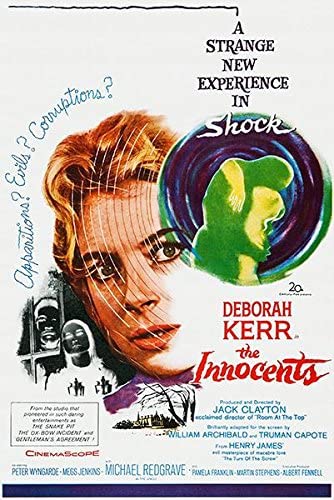
13 Days of First-Time Frights: The Innocents

13 Days of First-Time Frights is a series of reviews where Douglas Laman, in the spirit of Halloween, watches and writes about thirteen horror first-time watches These reviews will be posted each Tuesday and Thursday, as well as the three Wednesdays and a Friday, throughout October 2020.

Entry #23: The Innocents

Does anyone remember that movie from January of this year called The Turning? I can't blame you if you don't considering that feels like an entire lifetime ago. That horror movie directed by Floria Sigismondi didn't call attention to the fact that it was based on previously existing source material. But it's a major movie in 2020, so of course, it was! In this case, the 1898 Henry James horror novella The Turning of the Screw was the inspiration for The Turning. This new feature was not the first time the novel had made its way to the big screen. Decades earlier, it had been adapted into a Deborah Kerr vehicle entitled The Innocents.

Miss Giddens (Deborah Kerr) is very excited about her new job. She's been tasked with looking over the two kids, Miles (Martin Stephens) and Flora (Pamela Franklin), of a wealthy governor. The mansion the kids live at is just glamorous and apparently the youngsters are adorable too. Now, of course, The Innocents is a horror film, so you know this can't be as simple as just another nanny job. On the premises of this place are a pair of ghosts that keep appearing to Miss Giddens and seem to be connected to abnormal behavior in the children. Could there be some haunted secrets in this seemingly idyllic location? Miss Giddens is going to get to the bottom of that if it killers her.

Across The Innocents, there's this growing sense of something being wrong. While the audience see's recurring glimpses of the ghosts driving Miss Giddens mad, we're never certain if they're totally real. The Innocents challenges the viewer to question what is reality and what isn't. In the process, an eerie atmosphere is created even when nothing obstenisbly scary is even happening on-screen. Like so many great horror movies, The Innocents isn't about the horrors you see but the horrors in your mind. In this case, the uncertainty over what's real or not, as well as the stability of our lead character, ensure constant terror hangs over the proceedings.

Aiding the persistent ominous tone is the environment the lead characers inhabit. The lavish manor Miles and Flora inhabit certainly looks like a postcard snapshot of wealthy living. But in the hands of director Jack Clayton, this mansion and its grounds can go from looking scrumptious to being terrifying. Specifically, Miss Giddens is dwarfed by everything around her. Add a few shadows and the creepy tone of The Innocents and the expansive nature of this mansion suddenly goes from feeling spacious to terrifying. Every nook and cranny of this place, from a lovely lake to the attic, is mean to be a reflection of exorbinant wealth but The Innocents cunningly turns it into a perfect visual reflections of Miss Giddens' despair.

The Innocents is just as creepy on-screen as it is on paper. The latter achievemt is due to screenwriters William Archibald and Truman Capote not only committing to their grim story but hinging the whole thing on the troubles of refusing to confront the past. Everyone around Miss Giddens, from her employer to a maid she befriends, tells her to just forget about what happened to her predecessor (who now serves as one of the ghosts haunting her). They say to bury her head in the sand and just ignore reality. Of course, much as it does in real life, that only allows problems to build up rather than actually solve anything.

Grounding the scares in a very real phenomenon mirrors how Deborah Kerr does superb work in her lead performance grounding the plight of Miss Giddens in something tangible. Her depiction of Miss Gideens becoming more and more unraveled as the movie goes on really stirs something inside of you. Kerr lends authenticity to this depiction of madness...or is it determination? Much like with the slippery grasp The Innocents has on reality, it also lends a similar sense of ambiguity to the psychological state of Giddens. The lack of a concrete psychological state for her character just makes The Innocents all the more effective as an eerie piece of cinema. 

Thursday, October 22, 2020

13 Days of First-Time Frights: The Crazies


13 Days of First-Time Frights is a series of reviews where Douglas Laman, in the spirit of Halloween, watches and writes about thirteen horror first-time watches These reviews will be posted each Tuesday and Thursday, as well as the three Wednesdays and a Friday, throughout October 2020.

Entry #22: The Crazies

It's not exactly going to be a mind-blowing sentiment to observe modern-day parallels in The Crazies. This George A. Romero movie from 1973 is about a small American town that goes to pot after the governments' response to their water supply being tainted by a bioweapon. Watching it in 2020, one can't help but evoke the modern-day world and the COVID-19 pandemic that has consumed it. In particular, the very same government ineptitude that Romero was satirizing with The Crazies is still around today casting a blind eye to the very existence of this virus in America. It may not be an original observation but it is one that reflects how well Romero used a horror movie to reflect reality. Nearly fifty years later, The Crazies is a piece of satire that feels timely rather than dated.

The specifics of the plot for The Crazies see the townsfolk of Evans City, Pennsylvania being infected by a mysterious disease that causes them to act irrationally and violently. The primary focus remains on David (Will McMillian) and Judy (Lane Carroll) as they, along with a select few others, travel across the town hoping for some sort of escape. Meanwhile, Dr. Watts (Richard France) is called in to help develop a cure for this disease. While there, Watts informs Colonel Peckem (Lloyd Hollar) and the audience that what's actually going on here is that the water supply of Evans City has been tainted by a bioweapon. Now, time is running out for Evans City as the disease spreads and even more vicious behavior is enacted by government officials in hazmat suits looking to contain this contagion. 

Like all of Romero's early productions, The Crazies has its amateurish qualities. In this case, sound effects and vocal work tend to sound a bit off while the camerawork sometimes is too grimy for its own good. However, those cracks in the seams don't distract from the far more plentiful good qualities found in The Crazies, which demonstrates that quality writing and an evocative tone can overcome any budget limitations. In particular, Romero effectively handles executing the film's version of the age-old horror movie quandary "Whose the real monster?" While the infected townspeople would seem to be the easy answer to that, it quickly becomes apparent that the faceless government officials in hazmat suits are the ones providing more problems than answers.

Intriguingly, the faceless quality of the real antagonists in The Crazies even extends to the President of the United States, whose only seen from the back and openly endorses nuking a small town. The infected townspeople are acting like monsters because they have no choice. Their minds have been tainted by polluted drinking water. What's the excuse of the scientists, the clean-up crew and the POTUS? Their barbaric behavior is simply a byproduct of who they are. Much like with Night of the Living Dead, Romero commits to pondering the hostile tendencies of man all the way through the credits. There's no cop-out feel-good ending in The Crazies, only a scene depicting corrupt authority tossing aside their one hope of finding a cure.

Aiding the haunting grimness is the nature of the disease itself, which leaves no physical characteristics for either the characters or the audience to use to discern whose infected and whose not. In a typical zombie movie, you can figure out pretty quick whose undead and whose not by peeling skin or dangling jaws. But in The Crazies, it's a crapshoot. All your neighbors can look totally fine yet carry a newfound urge to set everything on fire. This quality is most hauntingly captured in a climactic shootout between David and other people he perceives to be infected. Turns out, though, they're just a couple of High School kids also looking for any kind of help.

One of these kids even calls out David by his last name, revealing that this was a student that David used to work with. Just a week ago, David saw this kid as a student, now, he almost shot this child without hesitation. It's a grim encapsulation of just how much uncertainty is always hovering around The Crazies. In this film, you can never tell who your enemy is while the people sent to protect you are just concerned with maintaining a good PR image. It's chaos all the way down. That makes The Crazies a harrowing experience for its characters, but another grim tour de force from George A. Romero for the viewer.

Wednesday, October 21, 2020

13 Days of First-Time Frights: The Orphanage

13 Days of First-Time Frights is a series of reviews where Douglas Laman, in the spirit of Halloween, watches and writes about thirteen horror first-time watches These reviews will be posted each Tuesday and Thursday, as well as the three Wednesdays and a Friday, throughout October 2020.

Entry #21: The Orphanage 

NOTE: SPOILERS AHEAD!

J.A. Bayona loves his broken families. In The Impossible, a tsunami wave threatens to tear a family apart. In A Monster Calls, the impending death of his mother leads to a boy lashing out. And in Jurassic World: Fallen Kingdom, family audiences were devastated by the films tedium. This trait goes right back to the very beginning of his feature film directorial career with The Orphanage. Released in 2007, Bayona's inaugural feature film also established other critical parts of his repertoire, such as an affinity for gothic locations and emotionally brutal sequences.

Laura (Belén Rueda) grew up as a child in an orphanage that she's now moved back into as an adult with her husband and their adopted son, Simón (Roger Príncep). As they move into their new domicile, Simón''s longtime fixation with imaginary friends gets taken to a new level as he befriends a bunch of imaginary kids that he swears are real. Laura dismisses it as childhood silliness until Simón goes missing shortly after discovering an elderly woman wandering around her property. Now, Lauren is realizing that there's something much more sinister at work from those adolescent imaginary friends. If she wants to see her son again, Laura will have to find out what happened in this orphanage and why the dead refuse to be at peace.

Props to The Orphanage alone for working so well as a campfire story that keeps you on your toes. There's an elegant simplicity to the movie that eschews the usual storytelling detours for these kind of movies, like absolutely nobody believing the protagonist when she starts talking about ghosts. Her husband is dubious, but our lead character is able to find some paranormal hunters in short order. In going this route, The Orphanage is able to spend less time spinning its wheel in a predictable manner and more time on exploring the psyche of Laura The sheer terror Laura feels over losing her son registers so vividly because The Orphanage makes sure there isn't anything to distract from her emotions.

These feelings effectively inform the various suspenseful set pieces of The Orphanage. An extended sequence where the medium Laura has hired has a haunting encounter with the children ghosts proves especially unnerving. Choosing to capture this interaction through security camera footage partially obscures what's happening to her and that's exceedingly frightening. The mind reels with what kind of horrors she's experiencing in that room. Meanwhile, the fact that an expert of the paranormal is being so overwhelmed by these spirits makes one petrified over how Laura could possibly stand up against these ghosts. 

Of course, by the end, The Orphanage pulls back the curtain to reveal that it's not really a straightforward spooky ghost tale. While the movie has been playing the ghost children as scary entities for so much of its runtime, the final scene of The Orphanage renders these deceased adolescents as tragic figures. Even the Tomas, who is adorned in an unnerving mask, turns out to be a victim of a prank gone awry rather than a slasher film villain. It's a bold move, one that gives The Orphanage the rare tearjerker ending in horror movies. Many of these films end on a note meant to unnerve the soul. The Orphanage, meanwhile, concludes on a brutally melancholy note.

The execution of this plot turn isn't quite flawless. Most notably, an early scene of Tomas attacking Laura and locking her in her bathroom feels out of place. It works for making the audience think Tomas will be a traditional slasher movie villain, sure. But such brutal actions don't fit in with the actual characterization of Tomas and the other kids. That particular scene feels like a ham-fisted red herring rather than an organic set-up in disguise. Still, the big about-face in Orphanage's final minutes mostly works quite well and wraps this tale up on a memorably creative note. It's interesting to see fragments of Bayona's work in The Orphanage but the film proves plenty intriguing on its own entriely divorced from Bayona's filmography.

Tuesday, October 20, 2020

13 Days of First-Time Frights: 28 Days Later Review

13 Days of First-Time Frights is a series of reviews where Douglas Laman, in the spirit of Halloween, watches and writes about thirteen horror first-time watches These reviews will be posted each Tuesday and Thursday, as well as the three Wednesdays and a Friday, throughout October 2020. 

Entry #20: 28 Days Later

Zombies came roaring back at the start of the 2000s. Like any cinematic trend, it wasn't just one movie that caused this resurgence. Zack Snyder's Dawn of the Dead remake while Shaun of the Dead, while a parody of the genre, still helped to spur renewed interest in the undead. Before either of those movies was Danny Boyle's 2002 feature 28 Days Later. This one proved especially impactful due to how it established a new pop culture norm for fast-moving zombies rather than the slower ones that had been the norm ever since George A. Romero's Night of the Living Dead. While zombie fans remain divided over whether fast zombies are an improvement or not, it's much more certain that 28 Days Later is a darn good movie, zombie-affiliated or otherwise.

28 Days Later begins with an utterly terrifying prospect; what if you woke up and the whole world was different? This isn't even a Rip Van Winkle scenario where decades have passed, which makes it at least understandable why everything has been upended. Jim (Cillian Murphy) was in a coma in a hospital for only four weeks when the world went to hell. Now awakened, Jim wanders the empty streets of London before eventually discovering that the undead are roaming the country. Teaming up with one of the human survivors, Selena (Naomi Harris),  Jim is trying to adjust to a radically different world and stay one step ahead of the flesh-hunry undead.

Danny Boyle has shown a gift for zeroing in on tangible humanity in the middle of much larger stories. The internal anguish defining a bunch of street punks in Trainspotting. A contestant on Who Wants to Be a Millionaire is deeply explored and revealed to be far more than just a game show participant . Even Steve Jobs, a mythic figure in pop culture, got unearthed as a complicated human being in the hands of Boyle. No surprise, then, that a zombie apocalypse allows Boyle a chance to linger on the strands of humanity left and focus on them in an intimate manner. Zombie carnage abounds, of course, but so too does a constant sense of what is making these survivors tick.

Contrary to the wall-to-wall grimness that defines something like The Walking Dead, it's nifty how there's discernible humanity in the people who inhabit 28 Days Later. This is especially apparent in the rapport between ftaher-and-daughter duo Frank (Brendan Gleeson) and Hannah (Megan Burns). It's the end of the world, sure, but they goof around with shopping carts in an empty grocery store or Hannah will bonk Frank on the head with a suitcase. It's the same kind of goofball behavior they'd engage in even if an apocalypse wasn't tearing apart the world. Juxtaposing normalcy against bleak doomsday material serves 28 Days Later quite well, as seen by an oddly moving scene of our principal leads observing a bunch of horses just galloping along as the world around them crumbles.

Of course, this is still a zombie movie, so it's not all galloping horses and father/daughter shenanigans. There's also lots of super-speedy zombie carnage to deal with. Said violence is dleivered through a  rapid-fire editing and hyperactive camerawork that will prove familiar to anyone whose watched Boyle's earliest movies. Jim's first time running from zombies has some visually murky moments, but otherwise, 28 Days Later does a great job making this world seem not just scary but utterly overwhelming. Zombies are crashing through doors, windows or anything else in their way. Danger can appear at any moment and the visual elements of 28 Days Later harrowingly reflect this sense of unpredictability.

Of course, much like in Night of the Living Dead and so many other pieces of zombie-centric media, humans end up being the principal villains of 28 Days Later rather than zombies. Really makes you think whose the real monster, huh? In all seriousness, though it's not the boldest take on a zombie movie, the third-act of 28 Days Later reaffirms that familiar storytelling can be made to feel brand-new so long as the execution is good. Here, the intense filmmaking, not to mention some nicely cathartic gruesome deaths, ensure that it's able to lend a new dimension to the idea of humans being the real foes during a zombie apocalypse. No wonder zombies got a new lease on life after 28 Days Later. With this movie, director Danny Boyle has managed to make stories about the undead feel more alive than ever.

Thursday, October 15, 2020

13 Days of First-Time Frights: Let Me In

13 Days of First-Time Frights is a series of reviews where Douglas Laman, in the spirit of Halloween, watches and writes about thirteen horror first-time watches These reviews will be posted each Tuesday and Thursday, as well as the three Wednesdays and a Friday, throughout October 2020. 

Entry #19: Let Me In

American remakes of foreign-langauge films frequently feel like a pointless exercise. Yes, good examples of this genre exist, most notably in Martin Scorsese's The Departed or The Birdcage. But for the most part, the likes of The Secret In Their Eyes or Godzilla (1998) just miss the whole point of the original property without carving their own identity as an acceptable substitute. Add to the pile of good examples of this trend Matt Reeves' Let Me In. A remake of the 2008 Swedish film Let the Right One In, itself an adaptation of a book of the same name by John Ajvide Lindqvist, Let Me In isn't just rehash leftovers. It's just a good chilling vampire yarn in its own right!

Owen (Kodi Smit-McPhee) is having a troubled time at school. Living in Los Alamos, New Mexico with his newly-single Mom, Owen is constantly harassed by bullies. Feeling all alone, Owen soon finds a friend in new neighbor Abby (Chloe Grace Moretz). Though Abby insists the two keep their distance at first, they eventually bond over, among other things, Rubik's Cubes, arcade games and the shared sense of being lonely in a town full of people. But there's a wrinkle. You see, Abby is a vampire. Not just a harmless kind of vampire either. She needs blood to live and her "father", Thomas (Richard Jenkins), has been slaughtering local townsfolk for her. Owen finally has a friend...and she's also a monster.

Tomas Alfredson's approach to Let the Right One In was one deeply rooted in European arthouse sensibilities with ts prolonged single-takes and muted atmosphere. There was a clinical approach to the movie that was as cold as the snowy ground the adolescent leads walked on. In the hands of Alfredson, that sense of detachment actually worked quite well at reflecting how the protagonists felt so isolated from the world around them. For Let Me In, writer/director Reeves smartly opts to go in the opposite tonal direction. Let Me In is a movie with lush emotional moments that can be popped, like a pin puncturing a balloon, by the grisliness of Abby's condition.

For much of Let Me In, the film could easily function as just a coming-of-age drama rather than a straightforward horror movie. Abby and Owen bonding in an arcade or the duo dancing to music in Owen's apartment while his Mom is out, these scenes perfectly capture that sensation of awkwardly navigating your first crush. Lead performers Kodi Smit-McPhee and Chloe Grace Moretz impressively reflect the unique authentic imperfections of their individual characters. Across both performances, though, is the poignant idea that these two truly feel at home in each other's company. In their time together, two loners don't have to be so lonely.

Just when you're lulled into thinking the whole movie is just centered on adolescent sweetness, Reeves pulls the rug out from under the viewer. This whole thing, after all, is centered on a carnivorous vampire. Reeves commits just as heavily to the gruesome horror sections of Let Me In as he does to the coming-of-age portions. Any of the scenes of Thomas going out to capture people for Abby are especially chilling mostly due to Reeves' sense of restraint. These largely dialogue-free scenes get so much tension out of just Thomas waiting in the backseat of these cars rather than slicing people's throats open. Meanwhile, the choice to frame some of his actual killings from afar only heightens their impact. Again, in these moments, we see how Let Me In uses prudence to its advantage.

Come to think of it, a number of the best scary moments in Let Me In are built on the same thing that fuels the sequences dedicated to Thomas going out and murder people; a sense of growing dread. Abby's feigning an injury to lure a jogger or a cop breaking into Abby's home all get so much suspense out of the viewer knowing more than the characters on-screen. These suspenseful set pieces are a great use of Alfred Hitchcock's "Bomb Theory" but they're also exceptional in how well they play on the audiences' investment in Owen and Abby. No matter how much carnage is occurring on-screen, the relationship between Owen and Abby never gets lost in the shuffle. Scares work in the service of characters in Let Me In, not the other way around.

On top of all that, the movie looks great too. The camerawork is certainly not as distinctive as the bold cinematography of Let the Right One In. But Reeves still delivers plenty of memorable imagery here, particularly in an extended single-take following Thomas trying to hurriedly leave the scene of a botched kidnapping. I'm sure in 2010, when found-footage horror movies with oodles of shaky-cam dominated movie theaters, seeing this kind of crisp camerawork on the big screen was extra exciting.

I'll freely admit that, going into any American remake of a foreign-language film, I carry a good amount of trepidation. But leave it to the filmmaker who turned a pair of Planet of the Apes blockbusters into incredibly evocative pieces of cinema to also make a Let the Right One In remake that can stand tall alongside the original. Let Me In is no cash-grab horror remake. Instead, it's a thoughtfully rendered feature that carves out a bloody involving coming-of-age yarn. 

Tuesday, October 13, 2020

13 Days of First-Time Frights: The Blob

13 Days of First-Time Frights is a series of reviews where Douglas Laman, in the spirit of Halloween, watches and writes about thirteen horror first-time watches These reviews will be posted each Tuesday and Thursday, as well as the three Wednesdays and a Friday, throughout October 2020.

Entry #17: The Blob

Like a lot of influential horror movies, The Blob was not beloved upon its initial release. In fact, critics seemed to be mostly dismissive of the project. Amusingly, even the visual effects were widely-panned back in 1958. The New York Times even outright called the visual effects "phony-looking". The film proved a hit with audiences, though, and helped to usher in a new horror movie monster mainstay in the form of blob-like creatures. Oh, and that Steve McQueen guy, he ended up doing one or two movies you might have heard of. 

The plot of The Blob begins with sweethearts Steve Andrews (Steve McQueen) and Jane Martin (Aneta Corseaut) watching the stars together. However, they spy something out falling right out of the sky into a nearby field. At the same time, a local farmer goes to investigate this object and finds a slimy being inside. This being, the initial form of that Blob, latches itself to the farmer's arm and Steve and Jane proceed to take the farmer to the hospital. Here, the Blob begins to consume more people and grow in size. As Steve tries to convince the local townspeople, particularly the dubious police, that something nefarious is gobbling up their neighbors, the Blob begins to eat and eat and grow and grow.

The Blob is a B-movie from the 1950s. That right there should tell you what you're getting into here. Expect a lot of vapid teenage characters who are mostly just middle-aged people's conceptions of what "today's youth" is like. Expect some romance between the principal male and female characters that's about as romantically compelling as two mannequins toppling over each other. Also expect the runtime to be dedicated mostly to lengthy conversations. After all, those are cheaper to film than the eye-catching VFX-wizardry on the movies poster. These are all as ingrained into the genre as songs are into musicals or fight scenes are into kung-fu movies.

How does The Blob fare as an entry in this genre? Better than usual, certainly. Despite complaints from initial release reviews about the VFX used for the Blob, I actually found any set pieces involving this entity to be the most engaging parts of The Blob. The decision to eschew any anthropomorphized features for this creature really lends an eerie quality to the Blob. Much like the similarly sparsely-designed alien in Dark Star, there are no shortcuts to tell what's going on inside the head of the Blob. The lack of sound as the Blob squelches into a room also proves appropriately unsettling. The idea of this unstoppable being capable of just going into any room without making so much as a whisper, sixty years later that's still effective at jostling your nerves.

On the other hand, human-centric scenes in The Blob are more meandering than suspenseful. Throwaway characters like a doctor's landlord or a grouchy police officer blabber on for what seems like eons as director Irvin Yeaworth tries to eat up minutes in the films already short 82-minute runtime. Though Yeaworth proves successful in boosting the runtime, this effort undercuts any sense of tension in the film. The decision to film these dialogue-heavy sequences in extended one-takes further compounds their sense of listlessness. The performances from the actors also don't help, but they're adhering to the traditional acting style seen in these drive-in B-movies, so it's hard to fault the cast for just following what amounts to basic protocol.

In his first lead role, Steve McQueen lends a sense of commitment to his role as a teenager dying to be taken seriously by the dubious adults around him. McQueen can't make the dialogue of The Blob organic. I doubt anyone could. However, his soon-to-be-iconic charisma does lend a greater level of watchability to his performance compared to other B-movie lead performances. McQueen, the visual effects and a third-act that admirably embraces taking the Blob creature to its greatest extreme render The Blob an above-average effort in the halls of 50s B-movies. It also gets bonus points for how its final line ("Just so long as the Arctic doesn't run out of ice!") now registers as unintentionally ominous in 2020.

Tuesday, October 6, 2020

13 Days of First-Time Frights: Blade II

13 Days of First-Time Frights is a series of reviews where Douglas Laman, in the spirit of Halloween, watches and writes about thirteen horror first-time watches. These reviews will be posted each Tuesday and Thursday, as well as three Wednesdays and one Friday, throughout October 2020.

Entry #15: Blade II 


Much like the Backstreet Boys or the McRib, Blade (Wesley Snipes) is back! That vampire-hunter is still slicing up undead baddies and has recently used his skills to retrieve his mentor Abraham (Kris Kristofferson). If you're thinking "Didn't Abraham die in the first movie?", the answer would be yes. He died pretty explicitly. We even get to revisit his death scene at the start of Blade II! But much like Men in Black II and Kingsman: The Golden Circle, Blade II just can't let go of a deceased mentor figure, so Abraham is back. Anywho, Blade won't be just teaming up with mentors back from the dead. He's also aligning himself with an elite mercenary group of vampires previously trained to hunt down Blade!

Why would Blade do such a thing? Well, the powerful vampire Eli Damaskinos (Thomas Kretschmann) recruits Blade because he's the only one Damaskinos can imagine being able to face of and defeat Jared (Luke Goss), a new super-powerful form of vampires who could destroy normal vampires and humanity within months. So goes the story of Blade II, which goes about in the expected directions you'd expect. The most prominent female member of the mercenary group ends up being a requisite love interest for Blade. Easily predictable secret bad guys are hiding in plain sight. Oh, and Wesley Snipes still looks cool as heck slicing down foes while wearing dark shades.

All of this means that Blade II might be the most un-Guillermo del Toro movie Guillermo del Toro has ever directed (though I haven't seen Mimic). Making a sequel to a movie he had no involvement in, del Toro is strictly adhering to the trail set up by Blade II's predecessor. That's not a bad thing considering that Blade itself was a good movie, but it did make me yearn for more of del Toro's trademark weirdness. Only Damaskinos lair feels like the kind of gloriously theatrical set you'd find in a del Toro feature. Meanwhile, del Toro's trademark theme of humanizing the monstrous seems to be around when it's revealed Jared is a more complex figure than we originally assumed...but he still becomes just another monster for Blade to defeat. Oh well.

If this all sounds like I'm down on Blade II, I'm really not. It's still a perfectly acceptable action movie. But having seen Hellboy II: The Golden Army and Pacific Rim, I know that del Toro can weave real magic and real weirdness out of American blockbuster fare. Blade II can't help but pale in comparison. Like I said, though, Blade II still works fine on its own merits, particularly in any of the over-the-top action scenes where Blade gets to do exactly what anybody watching this thing wants him to do. Blade has a confident air that couldn't be shaken by the mightiest earthquake. Watching him mow down armies of vampires with his sword is a sight that, shockingly, never gets old.

Plus, whenever Del Toro's fingerprints do emerge, they provide some of the enjoyable jolts of life Blade II has to offer. In particular, the gorier death and body transformation sequences mean the horror in Blade II is a lot more akin to del Toro's Cronos than the scares seen in the original Blade. Plus, Ron Perlman, del Toro's good luck charm, shows up as the most prominently-seen of the vampire mercenaries. Del Toro and Perlman are always a good combo but Perlman's rough-and-tumble onscreen demeanor also just makes for a great flipside to Snipes' Blade persona. These two have such pronounced differences just in how they carry themselves, let alone in the fact that Perlamn's character has been trained to slaughter Blade.

Action sequences involving the vampire hunter make heavy use of slow-motion (ah, the 2000s, a post-Matrix world where slo-mo was everywhere), and CGI stunt doubles. Those two elements kept taking me out of the movie but the more outlandish stunts were able to reel me back in. Blade II is the weakest title in Guillermo del Toro's filmography and it might even be a slight step down from its predecessor. Still, it's Wesley Snipes killing vampires under the direction of the man who gave the world Pan's Labyrinth. Needless to say, that combo can't help but yield some entertaining results.

Thursday, October 1, 2020

13 Days of First-Time Frights: The Midnight Meat Train

13 Days of First-Time Frights is a series of reviews where Douglas Laman, in the spirit of Halloween, watches and writes about thirteen horror first-time watches These reviews will be posted each Tuesday and Thursday, as well as the three Wednesdays and a Friday, throughout October 2020.

Entry #14: Midnight Meat Train

Midnight Meat Train is a classic story of an ambitious man who brings misery unto himself by way of his aspirations. It’s the same story skeleton Icarus played around with decades ago while it’s easy to see a much less gruesome version of this same plot playing out in a Twilight Zone episode years ago. It’s also a concept familiar to the original Hellraiser, which hailed from Clive Barker, who serves as the producer of The Midnight Meat Train and the author of its source material. Anybody expecting anything comparable to the best Twilight Zone episodes or Hellraiser will leave Midnight Meat Train disappointed. Still, this grisly excursion isn’t without its charms.

Leon (Bradley Cooper) just wants to have his photographs seen. Living in New York City, he's surrounded by great opportunities for snapshots that could change his career. While trying to capture some perfect photos, he runs into a young woman who ends up going missing. This strange occurrence leads him to develop a theory regarding a man known only as Mahogany (Vinnie Jones) who works at a local meat plant. Leon is convinced Mahogany is responsible for a string of local disappearances. Turns out, Leon isn't just right, he's stumbled onto a grisly conspiracy involving humans being viciously slaughtered. Leon's investigation into this matter will change his life for the worse and the bloodier. 

Sometimes, subtle hints (like which lenses are used or a throwaway line of dialogue) make it clear what era a movie came out in. In the case of The Midnight Meat Train, it’s rampant on-screen depictions of humans being carved up make its apparent this is from the 2000’s, aka the “Torture Porn” era of horror. This kind of gruesome misery existed before Saw (hi Herschell Gordon Lewis!), but usually only in midnight movie releases, not in horror fare intended to play in wide theatrical release. Midnight Movie Train follows in the footsteps of Eli Roth and Alexandre Aja by ramping up the gore and leaving nothing to the imagination when it comes to what this Butcher does to the humans he captures.

Sometimes, the excessive violence yields some interestingly unnerving results. The most memorable instance of this is when the camera takes the perspective of a woman about to be slaughtered by the Butcher. In this first-person sequence told in one long take, Ryuhei Kitamura places the viewer directly into this woman’s terror even after her head gets chopped up. The slow pull-out from her hollow pupils to reveal the massacre left in the wake of this maniac’s carnage proves to be the most unsettling moment in all of Midnight Meat Train. The camera actually switches up which characters perspective it''s replicating quite a bit throughout its runtime. Sometimes we're in the shoes of the killer, sometimes we're in the eyes of the victims, still other times it's a twist whose perspective we're watching things from. This creates a sense of uncertainty that proves sporadically unnerving.

Holding back some of the scariness in Midnight Meat Train is that a number of the more grisly moments are rendered through CGI. Obviously fake CG gore and eyeballs just aren’t all that scary. These distractingly artificial details stand out against the chills generated from either practical-effects work or just Vinnie Jones’ intimidating screen presence. Another odd visual detail; interior sequence set in the daytime have so much light pouring in from the windows it’s like Janusz Kaminski was doing the cinematography! This is neither a compliment nor a complaint. It’s just an unexpected facet of Midnight Meat Train that stuck around in my cranium.

As for the cast, Jones proves to be the most interesting member of the ensemble. His natural 6 foot 6 frame makes him a natural fit for a guy who capable of striking fear into your heart even before you know he’s butchering people. And then there’s our leading man, Bradley Cooper. Midnight Meat Train premiered about a year prior to The Hangover turning Cooper into an A-list leading man. I wonder what the timeline where Cooper’s major breakthrough came with Midnight Meat Train looks like? Anyway, Cooper’s fine here. He doesn’t have much of a discernible personality but he at least commits to this strange premise, there isn’t a hint of jaded cynicism in his performance. This trait is especially useful once Midnight Meat Train decides to just go off the rails, in an enjoyable way, in a bonkers climax that asks the age-old question “What if the Sleestak’s came from Hell?”

Is Midnight Meat Train any good? Well, it ensured that humanity now has a movie called Midnight Meat Train. That’s certainly commendable. And the rest works as competent if hamstrung grisly horror fare. Plus, it’s a darn sight better than subsequent Bradley Cooper vehicles such as American Sniper. The CGI gore in Midnight Meat Train is distracting, sure, but it’s nowhere near as distracting as that fake baby!

Thursday, October 31, 2019

13 Days of First-Time Frights: Let the Right One In


13 Days of First-Time Frights is a series of reviews for October 2019 where Douglas Laman, in the spirit of Halloween, watches and writes about thirteen horror movies he's never seen before. These reviews will be posted each Tuesday and Thursday as well as the last three Wednesdays of October 2019.

Entry #13: Let the Right One In

Remember a decade back when vampires were just everywhere in the worldwide pop culture scene? This was during peak-Twilight mania, so some of it was people trying to capitalize with what cool with the kids in that point in time but a good chunk of it was stuff created totally independently of Edward and Bella, leading to an odd confluence of events that led to a lot of vampire media being released over the span of a few years. Let the Right One In, a Swedish horror film from director Tomas Alfredson based on a 2004 novel by John Ajvide Lindqvist (the author also writes the screenplay here), was one example of a vampire movie released in this vampire-centric era that was made totally divorced from any influence of Twilight (it was even released a whole month prior to the first Twilight movie!)


Wednesday, October 30, 2019

13 Days of First-Time Frights: American Psycho

13 Days of First-Time Frights is a series of reviews for October 2019 where Douglas Laman, in the spirit of Halloween, watches and writes about thirteen horror movies he's never seen before. These reviews will be posted each Tuesday and Thursday as well as the last three Wednesdays of October 2019.

Entry #12: American Psycho

Christian Bale flew up to the status of super-stardom with portraying the titular superhero in Batman Begins, but much like future Batman performer Robert Pattinson, Bale spent his pre-Batman days doing a variety of bold smaller-scale films working with acclaimed filmmakers. For Bale, this meant getting to act under the guidance of names like Todd Haynes, Lisa Cholodenko and Jane Campion and also included the 2000 Mary Harron directorial effort American Psycho. This grisly social satire, adapted by a novel by Bret Easton Ellis, showed off the kind of acting chops that Bale would become famous for while also demonstrating Hanlon's knack for an insightful skewering of toxic masculinity.


Tuesday, October 29, 2019

13 Days of First-Time Frights: Near Dark Review

13 Days of First-Time Frights is a series of reviews for October 2019 where Douglas Laman, in the spirit of Halloween, watches and writes about thirteen horror movies he's never seen before. These reviews will be posted each Tuesday and Thursday as well as the last three Wednesdays of October 2019.

Entry #11: Near Dark

She's most well-known in the modern era for the kind of gritty dramas that led her to become the first woman ever to direct a Best Picture-winning movie (not to mention becoming the first woman to win Best Director), Kathryn Bigelow got her start as a filmmaker in the world of genre cinema. Thrillers, science-fiction fare, cop dramas, Bigelow did it all and in the process created a number of iconic movies, including Point Break. Her second ever directorial effort was Near Dark, a vampire Western horror film that also stands as one of her most stylized features even among her unabashedly over-the-top genre movie repertoire.

Thursday, October 24, 2019

13 Days of First-Time Frights: Nosferatu

13 Days of First-Time Frights is a series of reviews for October 2019 where Douglas Laman, in the spirit of Halloween, watches and writes about thirteen horror movies he's never seen before. These reviews will be posted each Tuesday and Thursday as well as the last three Wednesdays of October 2019.

Entry #10: Nosferatu

Remember kids, plagiarism is wrong...except if you're writer Henrik Galeen and director F.W. Murnau and the estate of Bram Stoker has refused you the rights to make your own movie adaptation of Dracula. Then, plagiarism is A-OK because you get movies like Nosferatu. That's actually how this horror classic came to be, upon being told they couldn't have Dracula, Murnau pulled a Bender and decided to "make my own [Dracula]...with blackjack! And hookers!" The result was something clearly derivative of Stoker's original Dracula text, but also had enough of its own visual flourishes to ensure that Nosferatu would etch its own unique place in cinematic history.


Wednesday, October 23, 2019

13 Days of First-Time Frights: A Girl Walks Home Alone at Night

13 Days of First-Time Frights is a series of reviews for October 2019 where Douglas Laman, in the spirit of Halloween, watches and writes about thirteen horror movies he's never seen before. These reviews will be posted each Tuesday and Thursday as well as the last three Wednesdays of October 2019.

Entry #9: A Girl Walks Home Alone At Night


You better watch out. You better not cry. You better not pout, I'm telling you why. There's a vampire at the center of A Girl Walks Home Alone at Night simply called The Girl (Sheila Vand) who stalks and devours cruel men in her local community. These guys have usually done something of the most wicked variety to earn their fate as a snack for this person who puts on the appearance of just being your average woman. At the same time, Arash (Arash Marandi) is having his own struggles stemming from his father's troubles with addiction. His own life is so filled with problems, maybe a bit of romance will help him forget his woes? As luck would have it, he finds himself enamored with The Girl, not realizing she's a bloodthirsty vampire. Ah, the trials and tribulations of romance.

In the five years since its initial release, A Girl Walks Home Alone at Night has garnered widespread acclaim that's launched both the film and its director Ana Lily Amirpour into stardom. I can't say I was as bowled over by it as its most ardent fans but that's mostly on a personal preference basis rather than some complaint on this film being inherently subpar. A Girl Walks Home Alone at Night is one of those slower-paced horror features that sometimes work like gangbusters for me and other times leave me at such an arm's length that they leave me a touch cold. Even if it's pacing wasn't always captivating, A Girl Walks Home Alone at Night still have plenty of qualities to it that still make it a noteworthy horror film.

Most notably, the way Ana Lily Amirpour keeps undercutting visual expectations throughout A Girl Walks Home at Night is most intriguing. This stems as an extension of The Girl and how she is not what she appears to be. Walking through the streets of Iran wearing a shash and garbasaar, Amirpour is aware that characters dressed in this manner like The Girl are traditionally coded in male-created cinema narratives as being passive figures, whereas The Girl is somebody who can devour dudes in no time flat. That's just the tip of the iceberg in terms of how A Girl Walks Home at Night frequently takes standard pop culture assumptions and then running in the total opposite direction.

A tender scene of Arash going back to The Girl's house for the first time is an especially good example of this as the way the scene is shot, paced and scored echoes classic 1980's teen romance movies, complete with a glistening disco ball providing fragmented glittery lighting. The only difference here is that the fact that The Girl is a vampire lends a ticking clock factor to the sequence, you're just waiting for the moment where the fangs will pop out and this whole scene will go from Sixteen Candles to Nosferatu! The lead character of A Girl Walks Home Alone at Night is not what she seems and subversion is also on the mind of the film itself in this sequence and throughout the rest of the movie.

Sheila Vand is really good at fiddling around with viewers expectations too, you never quite know when the monstrous side of The Girl is going to come out of the blue and star chowing down on characters in a scene. This part of the performance is so well-done because Vand is so skilled at portraying The Girl as just a person, she doesn't tackle this role as a one-dimensional monsters. She's especially attune to the down-to-Earth qualities of the role when she's tasked with depicting the character in a more conflicted state in the third act, that you can easily (and intentionally) forget you're watching someone whose also a vampire until those fangs come on out again.

That engaging level of uncertainty over when The Girl's more vicious side will crop up is aided by the films sense of pacing, which really bides its time in building up to whenever vampire mayhem breaks out. Sometimes this pacing left me cold, sure, but more often than not it did effectively keep me on my toes as to what moves The Girl would make next. Generating tension on a visual level is the best part of Ana Lily Amirpour's directing in A Girl Walks Home Alone at Night, a movie whose best qualities make it clear why this motion picture managed to catapult its creative participants fame and acclaim.

Tuesday, October 22, 2019

13 Days of First-Time Frights: Kwaidan

13 Days of First-Time Frights is a series of reviews for October 2019 where Douglas Laman, in the spirit of Halloween, watches and writes about thirteen horror movies he's never seen before. These reviews will be posted each Tuesday and Thursday as well as the last three Wednesdays of October 2019.

Entry #8: Kwaidan 

Kwaidan is named after a Japanese term that translates into English as "ghost stories", so you know some creepy and crawly things will be going down in this Masaki Kobayashi directorial effort from 1964. Kwaidan certainly lives up to the "stories" part of the term "ghost stories" as it delivers a trio of haunted tales (plus an epilogue) each connected by the recurring moral of the necessity of keeping your promises. The first of these stories is The Black Hair, which follows a swordsman (Rentaro Mikuni) leaving his faithful wife for another woman in the hopes of gaining a better place in society. Next up is The Woman of the Snow, which see's a man named Minokichi (Tatsuya Nakadai) trapped in a frozen wasteland and encountering a deadly spirit known as the Yuki-Onna (Keiko Kishi), which promises to spare his life if he promises to never tell a soul about their encounter.

Thursday, October 17, 2019

13 Days of First-Time Frights: Carrie

13 Days of First-Time Frights is a series of reviews for October 2019 where Douglas Laman, in the spirit of Halloween, watches and writes about thirteen horror movies he's never seen before. These reviews will be posted each Tuesday and Thursday as well as the last three Wednesdays of October 2019.

Entry #7: Carrie

The real horror story was the High School memories we made along the way. That's a sentiment I'm sure Carrie White (Sissy Spacek) would agree with. Carrie's time in High School has been fraught with bullying and cruelty as her classmates pick on her ceaselessly. Her home life isn't much better considering that she lives with an ultra-religious Mother, Margaret White (Piper Laurie), whose idea of discipline is to lock Carrie into a closet when she's convinced that her daughter has been possessed by the Devil. Yes, Carrie's life is no picnic, but she does have one interesting advantage at her disposal. Carrie is gradually discovering that she carries the ability to make things move with her mind.


Wednesday, October 16, 2019

13 Days of First-Time Frights: The Cabinet of Dr. Caligari

13 Days of First-Time Frights is a series of reviews for October 2019 where Douglas Laman, in the spirit of Halloween, watches and writes about thirteen horror movies he's never seen before. These reviews will be posted each Tuesday and Thursday as well as the last three Wednesdays of October 2019.

Entry #6: The Cabinet of Dr. Caligari

Us humans have been telling scary stories since the dawn of time. But given that cinema wasn’t invented until the end of the 19th-Century, we’ve been telling scary stories in filmmaking form for a considerably shorter period of time. Among many film scholars and historians, it’s widely agreed that the 1920 German motion picture The Cabinet of Dr. Caligari was the birth of horror cinema. Yes, this is where it all began, the equivalent to Snow White and the Seven Dwarfs or Toy Story for the realm of horror cinema is none other than this Robert Wiene motion picture.

Told over six acts, The Cabinet of Dr. Caligari concerns itself with the village of Holstenwall. This is where Francis (Friedrich Feher) calls home and it’s also where a local fair has managed to procure a mighty unique attraction. Hosted by the titular Dr. Caligari (Werner Krauss), the attraction fixates on the powers of somnambulist Cesare (Conrad Veidt) and him relaying grim prophecies to patrons. Strange attraction, right? Things get even stranger when a string of murders begin to transpire in the town. Francis begins to suspect Cesare and Caligari are behind the gruesomeness that may soon ensnare Jane (Lil Dagover), the object of Francis’ romantic affections.

The Cabinet of Dr. Caligari creates its scares through visual means, particular the ominous production design that makes the appearance of the village of Holstenwall as eerie as the murders transpiring within the village itself. Rare is the building or staircase here that’s brought to life with a completely straight line. Embodying every defining aspect of German Expressionism, every element of the sets has an exaggerated quality to it within The Cabinet of Dr. Caligari. Much like the backgrounds found in Kwaidan, Caligari uses this unique approach to visually convey that we’re watching a fable detached heavily from reality.

Watching Caligari’s visuals, it’s fascinating to see how heavily future pieces of cinema have leaned on this one’s production design sensibilities. Nightmare Before Christmas especially kept leaping into my mind right down to the textures on certain objects. Caligari didn’t just pave the way for an entire genre of storytelling, it also left an immeasurable impact on future filmmaking on a visual level. Production design isn’t the only area this production impressed visually provided you’re watching a certain copy of Dr. Caligari. The version of the film that I watched also replicated color tinting that apparently was utilized in some fashion in its original theatrical release.

This is yet another visual aspect of Dr. Caligari that manages to work divinely to instill an uneasy atmosphere. Colors also are used to enforce the aesthetics of certain environments within the Movies universe. A more restrained shade of Yellow, for instance, covers sequences set at a bureaucratic local government offer and an asylum to emphasize the everyday normalcy of these locales. More vibrant colors are utilized for scenes depicting creepier elements like Cesare to help visually differentiate them from what’s visually coded as “normal” in the world of Dr. Caligari. Modern movies like Jurassic World and Money Monster that use color grading technology to just douse their shots in a pointless light shade of blue could take a cue from the far more considerate use of various colors in Dr. Caligari.

Much of Dr. Caligari is a visual exercise, which explains why the characters are mostly broadly drawn archetypes. Sometimes that’s a flaw in a movie, but in the context of The Cabinet of Dr. Caligari, it feels fitting for something that’s clearly evoking the feel of an old-times Ghost Story. Director Robert Weine and writers Carl Mayer & Hans Janowitz are out to pair up bold visual touches with a classical horror tale, not reinvent the wheel in terms of what kind of characters you see in these sort of scary stories. On that front, they’ve certainly succeeded with The Cabinet of Dr. Caligari, a trailblazing feature whose impact on cinema is still being felt about a whole century after it was first released.

Tuesday, October 15, 2019

13 Days of First-Time Frights: Jennifer's Body

13 Days of First-Time Frights is a series of reviews for October 2019 where Douglas Laman, in the spirit of Halloween, watches and writes about thirteen horror movies he's never seen before. These reviews will be posted each Tuesday and Thursday as well as the last three Wednesdays of October 2019.

Entry #5: Jennifer's Body

When it comes to acclaimed horror movies getting initially negative reviews, well, to quote tom Jones, "It's not unusual." Films like George A. Romero's Night of the Living Dead or Tobe Hooper's Texas Chain Saw Massacre had plenty of notable detractors upon their very first theatrical releases before getting properly reevaluated in the years afterwards. What's especially strange about Jennifer's Body is how the initial reviews didn't just critique the film, they saw it as a vehicle to attack the films writer (Diablo Cody) and to ogle the films star (Megan Fox). As has been noted in a number of excellent pieces by now, the majority of negative Jennifer's Body reviews back in 2009 were all kinds of gross and misogynistic. It's utterly repulsive to see all these reviews passing for actual film criticism, though, thankfully, a broader array of voices have made themselves heard on the internet and ensured that Jennifer's Body is getting the re-evaluation it deserves.