Monday, March 28, 2022

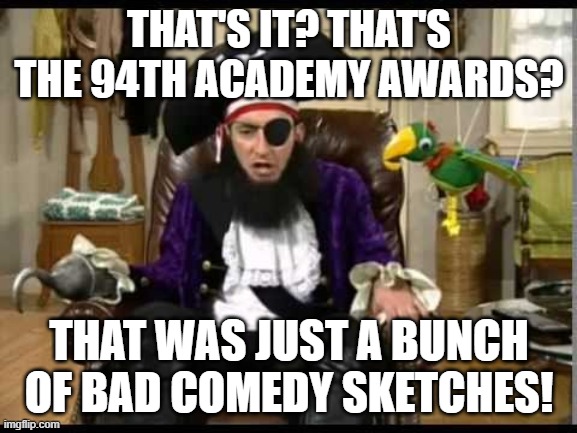
In Laman's Terms: Why was the 94th Academy Awards such a calamity?


We're not talking about "that slap" here.

Yes, it's all anyone's talking about, but that's why I'm not bringing it up yet again here. What would be the point? Plus, as a white person, I have no business dropping a "hot take" on a public altercation between two Black people.

As for the rest of the ceremony, though? Oh boy.

The 94th Academy Awards seem to have been cursed from the get-go. The decision to shuffle off eight categories to before the proper live ceremony already put a bad taste in people's mouths. But oh, if only we knew what the actual ceremony would deliver. For starters, lots of bad jokes mocking movies. If there's ever a place for that, it's the Academy Awards, a ceremony, in an ideal world, dedicated to loving this artform. Nobody's saying some good ribbing should be off-limits, but Amy Schumer making an unoriginal gag about how "The Power of the Dog is so loooong" (ironically, that Jane Campion meditation on how cycles of toxic masculinity are perpetuated has the exact same runtime as Schumer's Trainwreck) or nobody seeing The Last Duel just rang hollow and mean-spirited.

Why can't the Oscars show affection for movies? Why are they so self-conscious? Justin Chang just wrote a great Los Angeles Times piece about how baffling it is to see Academy Award voters recognizing an eclectic group of motion pictures that include Drive My Car yet producers of the same show keep doing everything to undercut recognizing those same films. That sentiment ran through my head all throughout the night. Ryusuke Hamaguchi got rudely hurried off-stage during his acceptance speech for Best International Film, but don't worry, there was still time for BTS to show up and shill for Disney movies.

But the inexplicable parts of the night were what really proved to be the unforgettably miscalculated aspects of the whole ceremony. Pushing all those technical awards to before the show, much to the derision of everyone in Hollywood, was supposed to guarantee this event wouldn't run long. However, the 94th Academy Awards still ran well over 30 minutes over its three-hour runtime. Meanwhile, the video montages to both James Bond and The Godfather may have had their hearts in the right places, but they ended up coming up short, especially the latter presentation. The Godfather was a subversion of consequence-free fantasies of gangster life, not an indulgence of it like this montage suggested! 

Then there was the fact that only half the Encanto cast could come out to perform "We Don't Talk About Bruno"? Much love to Megan Thee Stallion, but I was excited to see what the performers of the shape-shifting and super-hearing Madrigal family members looked like! Worst of all, though, was an initially promising decision to have a big choir come out and performer a tune for the In Memoriam segment. What started as a welcome departure from the norm because a baffling exercise once the tunes got upbeat and jovial. Plus, singling out a handful of deceased celebrities to get special tributes sounded nice on paper, but just seemed to elevate individuals like Betty White and Sidney Poiter as "important" against everyone else. 

Are the Academy producers so desperate to cram entertainment into every second of this show that even the In Memoriam segment isn't off-limits? Miscalculation seemed to be the name of the game here for the 94th Academy Awards as one comedic segment after another kept misfiring. It all seems to stem from one issue: the Academy Awards want to be loved. Really really loved. In the process, they're just alienating everyone. Bilge Ebiri wrote a great Vulture piece last month talking about how "self-loathing will kill the Oscars" and he's right, including on how the supposed "ratings woes" of the ceremony are not that bad. 

All live TV shows are down in ratings, this is just the name of the game in 2022. We're never going back to 2008 and that's OK. Stop sabotaging the show to make it 2008 again. It's not working for anyone. Viewers who previously never had an interest in the Oscars aren't tuning in by the droves to check out this clustercuss and movie lovers (who were supposed to be united by this event) are rightfully treating this ceremony as the mess it was. When we can't even count on competent camerawork for an Academy Awards ceremony, what're we even doing here?

There's value in the Academy Awards. They can help shed a light on little-seen movies, such as Drive My Car, which more than doubled its domestic box office haul once it scored a quartet of Oscar nods. A montage from the 90th Academy Awards ceremony is something I return to every month or so to feel good and cry over the magic of this medium. Plus, having spent the last two Oscars watching them with a bunch of other people, it's wonderful to watch the spectacle with a bunch of other passionate people. The Oscars, like movies themselves, have the ability to bond people. If only they were confident in that gift instead of constantly scrambling to be "entertaining" or "appealing" or promoting Disney properties. 

This years Academy Awards was a calamity. The producers of this show have been open for some time about the need to tweak this ceremony, and that's true, just not in the way they think. Rather than kick categories to the curb or eat up time with pointless comic sketches, it's time for the Oscars to look inward and start prioritizing movies and the artists that make them. 

And also maybe don't let Kevin Costner drone on for three hours.

Saturday, March 26, 2022

Douglas Laman's 94th Academy Awards Predictions

Here we are again, another Academy Awards ceremony. And even with everything being super busy in my life, I couldn't resist the chance to ramble about my predictions for who will win in each of the 23 categories tomorrow night. Below, I've listed out each category and predicted who will win among the nominees, a runner-up, as well as who, among the five nominated films I wish would win. For a full list of the nominees, please click here.

On with the show!

Monday, March 21, 2022

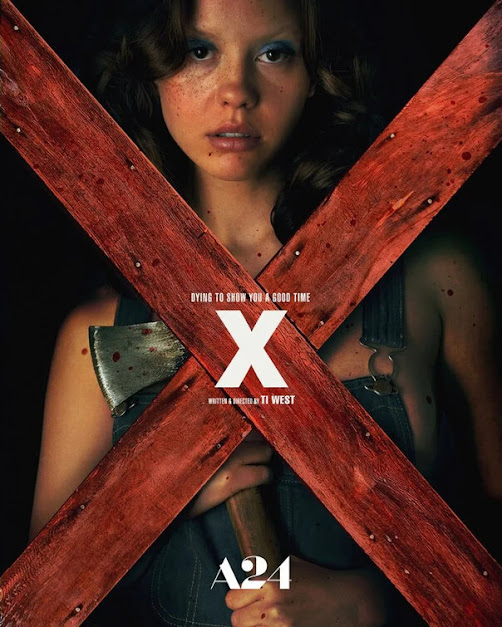
X is hot for empathetic slasher movie storytelling

Thanks to the sleeper hit The VVitch, A24 has turned to horror movies as a go-to vehicle for commercial cinema that can crossover into mainstream success. Many of these films have not only been good, but they've also been slow-burn titles with minimal dialogue and storylines that run on ambiguity. Ti West's new horror film X also hails from this studio and it's certainly got bold filmmaking and heftier ideas running through its veins. However, by its very nature of adhering to the mold of a 1970s/1980s slasher movie, it's also a more in tune with crowdpleaser elements. There's plenty of nudity, comical lines, and near-death experiences to keep people satisfied until the blood starts flowing. If your main complain with prior A24 horror movies was that they didn't have enough going on, well, X should keep you satisfied. 

Maxine Minx (Mia Goth) is traveling through Houston, Texas with boyfriend Wayne Gilroy (Martin Henderson) and four other people, including other actors and a pair of technicians, to shoot a porno that they're all convinced will send them to the stars. Minx is especially enamored with the idea of achieving stardom, a status she feels she's destined for. To shoot this lewd picture, Gilroy has secured the a farmhouse belonging to an elderly couple, Pearl (Mia Goth in a second role) and Howard (Stephen Ure), who're initially unaware of the naughty action taking place just behind their back. As shooting commences, peculiar happenings begin to stack up around Minx and company. Their elderly hosts may be dealing with something extra that could have gruesome consequences for this film crew.

The most welcome surprise of X is that it likes its characters. I've never disliked slasher films per se, but they've always felt like a strange genre to me, one where humans can often end up being just bowling pins that a masked killer knocks down like a bowling ball. It can be fun, but since the characters aren't treat as much beyond walking corpses, they can be hard to engage with. X, meanwhile, gives you some enjoyable and larger-than-life personalities to chew on. We're all aware most, if not all, of these people will end up dead long before the credits roll, but West isn't treating that as an excuse to churn out run-of-the-mill fictional people. Varying perspectives, demeanors, and even approaches to cinema manifest across the primary cast, making them much more than just the bowling pins that populate other slasher fare.

Even the antagonistic elderly couple that are initially mocked by the younger characters for looking exceedingly ugly are presented with more than a touch of empathy. Pearl, in particular, gets a lot of screentime to have her perspective fleshed out, with a yearning for intimacy and affection becoming key in her sequences. Even once people start getting knives jabbed into throats and shotguns are blasting all over the place, West makes time for quiet moments of interaction between the older duo that've helped set the plot into motion. Having the screenplay be as fascinated with quiet conversations as it is with bloody carnage is a great move all around.

If there's a chief complaint to be had with X, it's also something that proves charming about the feature: this is very much a classic slasher movie. Ti West has not set out to make something that deviates from the norms of this genre, he's just made a more polished and thoughtful version of what you'd expect. That has its own pleasures, but the gestures at weightier themes did make me wish that some parts of the film strayed a bit farther from slasher movie norms. It also has to be said that this adherence to the familiar does make X less scary than it could be. We're not here for terrifying uncertainty, but rather here for West to deliver a tasty version of a dish we've gobbled up before.

That quibble isn't fatal, though, and X proves a fun watch more often than not. A gaggle of committed performances from the assembled actors help quite a bit with that, especially Martin Henderson's swaggering Southern producers. This dude's just diving in headfirst into being just Matthew McConaughey if he became a porn producer and I'm here for it. The use of unorthodox editing to cut between disparate locations, serving as an extension of one character referencing the editing techniques of the French New Wave, also proves a both an enjoyable visual motif and a creative way to differentiate X from other slasher films. 

X may not be a game-changer for slasher fare, but when an entry in this genre is told with this much flair and is this fun, it's hard to complain. Plus, great use of the "Don't Fear the Reaper" song, that counts for a lot in my book.

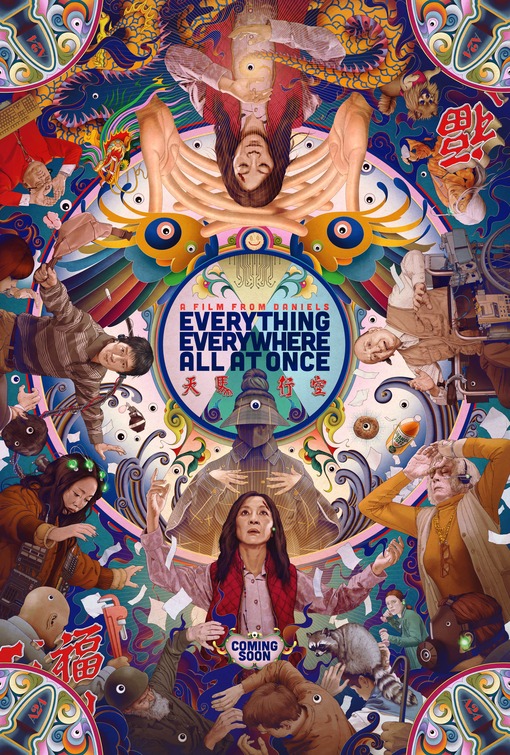
Everything Everywhere All at Once is a great balance of the sprawling, the intimate, and the bizarre

If you saw Swiss Army Man, the last movie from the directorial duo Daniels (comprised of Dan Kwan and Daniel Scheinert), then you know what to expect from their work. They do things weird. Not just weird as defined by mainstream corporations, oh no. They're the kind of weird that gazes upon Daniel Radcliffe and see's a farting corpse whose erections can function as a compass. Their weirdness is also laced with sincere melancholy, they're anarchic pranksters who also want to touch your heart. Their strangeness and unexpected sweetness are more apparent than ever in Everything Everywhere All at Once, which is guaranteed to either confuse or, if you're like me, dazzle. 

Evelyn Wang (Michelle Yeoh) is a busy person. She's got to run her laundromat perfectly while dealing with demands from the IRS that could endanger her livelihood. All the while, her husband, Waymond (Ke Huy Quan) is grappling with falling out of love with his partner, to the point he's preparing to serve Evelyn divorce papers. Evelyn's relationship with her daughter, Joy (Stephanie Hsu), is even more strained than that. This is already a lot to juggle for one person, but a trip inside an elevator leads Evelyn to discover the existence of a multiverse. There are countless alternate dimensions out there and a seemingly ordinary woman is being called upon to stop an evil force that could destroy everything in existence.

What follows is something that has the subversive streak of The Matrix Resurrections, the high-concept melancholy of Eternal Sunshine of the Spotless Mind, and the unpredictability of Xavier: Renegade Angel. The result is a strange brew that proves shockingly effective at managing to have heart and chaotic energy. Sometimes, such a potent mixture can be chalked up to something deep and academic. There’s real detail to how Daniels is executing this madness, but the reason Everything Everywhere All at Once can swerve from buttplug gags to poignancy without coming as disjointed simply comes from the character of Evelyn. Her plight and mindset are always front and center in the madness. She’s like the lighthouse, providing a constant sense of light that the viewer can turn to in the middle of an onslaught of strange imagery. 

Even more critical to making the absurd concoction work so well is how Daniels embrace every possible visual opportunity that the multiverse provides. Evelyn and the viewer travel everywhere from classic kung fu movies to a prison movie to a hand-drawn realm that looks like it was scribbled by a kindergartener. Who needs airtight logic or constant coherency when there are many nifty interpretations of reality to explore? The creativity on display is incredible, especially the little details (like the lenses used and the aspect ratios) to differentiate the various universes. Rather than just tinting the frame a slightly skewed shade of blue and calling that a unique dimension, a vast array of costumes and color schemes are employed to suggest the infinite possibilities out there for multiverse mayhem.

 It’s doubly impressive that Everything Everywhere keeps this rambunctious ambiance up for its entire routine without either running on fumes or wearing out the viewer. Just when I thought I had this movie figured out, a new ace up its sleeve would get revealed. Especially fun is how seemingly throwaway gags tend to keep coming back for not only humorous extensions but also reinterpretations that make the ludicrous emotionally potent. In what turns out to be an apt parallel to the characters themselves, the silliest parts of this motion picture have a lot more depth to them than you’d ever expect. 

All those layers upon layers of details are handled with mastery by the principal actors. Each of these performers seems to be relishing the chance to play not just one character but a whole slew of people wrapped up into fleshy humans. Michelle Yeoh, for instance, is already a hoot as an everyday human being who quickly finds herself out of her depth. However, once the multiverse absurdity begins to get unleashed, she reaffirms both her long apparent gift for hand-to-hand skirmishes and moments of intimate poignancy. Ke Huy Quan especially excels at lending authenticity to each side of his character, playing personalities that echo John Wick and Jimmy Stewart with consistent believability. Stephanie Hsu gets both the most tender moments and greatest costumes in her performance, while the always delightful James Hong adds another unforgettable acting credit to his endless resume.

Watching something as bursting with imagination as Everything Everywhere All at Once for the first is an incredible experience, especially when viewed on a gigantic screen that consumes your entire gaze and with an appreciative crowd. Even with an avalanche of modern pop culture items about the movies out there, Everything Everywhere All at Once stands out from the crowd. Impressively, it accomplishes this by delivering gags and action beats that couldn't exist outside of the multiverse concept...and also by using this multiverse notion as merely a springboard for larger ideas and emotions. Prepare for something special when you sit down to watch Everything Everywhere All at Once and also to never be able to look at either paper clips or raccoons the same way ever again.

Everything Everywhere All At Once plays in limited release on March 25 and expands into theaters everywhere on April 8.

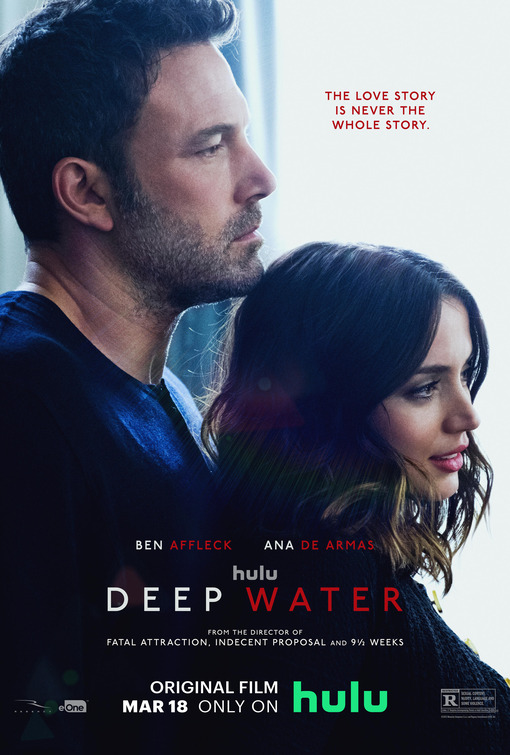
Deep Water is too shallow for its own good


Cue up the Staind music, cause "it's been a while" since we had a major erotic thriller in American cinema. A staple of 1980s and 1990s mainstream moviegoing, the erotic thriller fizzled out thanks to box office and critical duds like Striptease. Since then, the death of the mid-budget American movie and a lack of emphasis in this country's cinema on sex has led to the further erasure of the erotic thriller. Director Adrian Lyne, director formidable entries in the genre like Fatal Attraction, returns for his first directorial effort in two decades to helm Deep Water, an attempt at reviving the erotic thriller  for the modern era. The resulting film has some admirable qualities, but can't quite stick the landing.

Vic (Ben Affleck) and Melinda Van Allen (Ana de Armas) are a married couple with a far from perfect marriage. Even the smallest of discussions between the two are riddled with animosity and Melinda has a passion for engaging in physical intimacy with other younger men. Initially, it seems like the conflict here will be restricted to just barbs between spouses, but it turns out, Melinda's flings keep winding up dead. Neighbors and other residents around town begin to whisper about Vic maybe being responsible for these slayings. With tension only growing between the Van Allen's and the body count rising, secrets are about to come bubbling to the surface.

The most fatal flaw with the screenplay for Deep Water by Zach Helm and Sam Levinson is how it tries to be both a steamy thriller and a contemplative domestic drama about a marriage slowly falling apart. It's perfectly reasonable to imagine a movie that combines the aura of Basic Instinct with a married couple straight out of Who's Afraid of Virginia Woolf? Unfortunately, this is not that movie. The two disparate pieces don't quite work right together, mainly because Helm and Levinson make the critical error of believing that downplaying everything will automatically give it depth. Gloomy faces do not equal substance, though, and that lack of depth renders Deep Water scenes relying on the tense dynamic between Vic and Melinda inert.

Too much of the runtime in Deep Water is just spent spinning its wheels rather than finding its way to channeling its intended vibes of Paul Verhoeven and Douglas Sirk. However, there are still worthy elements here. Ana de Armas, for one, is having a ball in her lead performance, especially in the first act of Deep Water where her character's at her most chaotic. She purrs, she screams, she drunkenly sings, she slinks around on a staircase, I half-expected her to also reveal that she can fly in a twist ending. She's got the sort of gung-ho vibes and over-the-top sensibilities that more of Deep Water could've taken a cue from.

Lyne, cinematographer Eigil Bryld, and editors Tim Squyres & Andrew Mondshein also incorporate a handful of fun visual details into Deep Water that deserve praise, even if their choice to coat most of the movie in a hideous light blue tinge is abhorrent enough to make me want to give the whole movies imagery an F. Immersive camerawork used to realize a car bouncing along a woodland path is quite an exciting touch, as are the cuts used to Melinda's extramarital affairs whenever Vic is out biking. Props also to Tracy Letts, for absolutely crushing his line deliveries in the last thirty minutes of Deep Water, his way of declaring one character is going to jail is especially outstanding.

Deep Water has its share of standout elements, but unfortunately, they're not enough the norm within the film's two-hour runtime. Deep Water is rarely terrible, but it's also so trapped between weighty and steamy aspirations that it's doubtful it'll satisfy most who tune in. The erotic thriller's absence from mainstream American cinema has been a significant detriment to the world of film, we desperately need to see more motion pictures with the scope and ambitions of Deep Water. However, future attempts to revive this genre would be well-advised to opt for more cohesion or even just fun than this particular Adrian Lyne movie.

Sunday, March 20, 2022

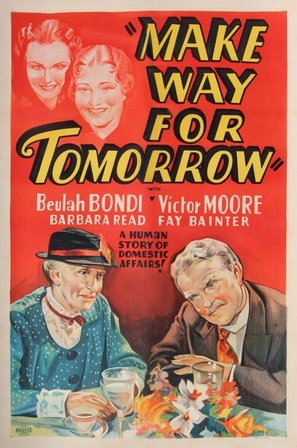
Make way for masterfully melancholy filmmaking with Make Way for Tomorrow

Movies fall through the cracks of history for different reasons. Some wind up obscure because of mixed reception from audiences and critics. Other falls by the wayside due to bad marketing. In the case of 1937 feature Make Way for Tomorrow, I'd propose it's because director Leo McCarey was too good of a filmmaker that yea. That's no hollow praise masquerading as analysis. McCarey won the Best Director Oscar for The Awful Truth that same year, with that same film becoming a box office hit and helping to launch Cary Grant to stardom. There were a lot of positive ripple effects from The Awful Truth, but it did overshadow Make Way for Tomorrow, which carried a tone so grim that it was going to need all the help it could get to not be dismissed by the public at large.

Such a somber aesthetic is used for the story of Barkley "Bark" (Victor Moore) and Lucy Cooper (Beulah Bondi), who have just lost their home. The duo are now in need of somewhere to rest their bodies and their adult children offer to take them in. However, none of them have enough room for two extra people, so Lucy goes to live with George (Thomas Mitchell) and his family while Bark hunkers down with Cora (Elisabeth Risdon). The living situations at both establishments becomes hostile quite quickly, with Lucy often being perceived as "intrusive" on the household while Bark catches a cold that requires a lot of attention.

From there, things only go from bad to worse. Viña Delmar's screenplay, adapted from a Josephine Lawrence novel as well as a play, holds back no punches in examining the domestic strife that occurs once these elderly parents are forced to become a part of their kids lives again. While we always have sympathy for protagonists Bark and Lucy, it is easy to see the points-of-view of the frustrated folks thanks to the nuanced screenwriting of Delmar. Anita (Fay Bainter), George's wife, for instance, doesn't get fed up with Lucy because she's innately wicked. Instead, her grievances come about when Lucy begins to interfere with the work she does from home as well as when she perceives her teenage daughters to be in danger.

Even with this level of intricacy woven into most of the characters, the focus here remains on the elderly Cooper couple, with tragedy seeping into every frame chronicling their current condition. Society often views the elderly as something to be dismissed, shoved under the rug, a norm reflected throughout Make Way for Tomorrow right down to its title. That makes the various scenes just showing Bark and Lucy as everyday human beings, such as quiet interactions between the former character and local shop owner Max Rubens (Maurice Moscovitch), all the more emotionally potent. This is a feature-length exercise in reaffirming the humanity of people often seen as no longer having any.

This becomes especially noticeable in the final half-hour of the film, which oscillates beautifully between wistful melancholy and then quiet despair. The former tone gets reflected in Bark and Lucy popping into a hotel they stayed at on their honeymoon decades earlier. It's a rare moment of unbridled joy for these two in Make Way for Tomorrow as they stroll down memory lane, sip fancy drinks, and process how the decades have slipped through their fingers. After all this time, there's still such endearing affection between these two that's lovingly represented by Moore and Bondi's great performances. Just look at the authentic depiction of Bark giggling over Lucy getting tipsy. The acting between these two aches with years of experience right down to the tiniest details.

Once we're away from the hotel, it's time for Bark to board a train to California while Lucy stays behind. The distance between these two will now be greater than ever before and the financial uncertainty lingering over this whole story (which was told during the Great Depression) makes it impossible to ignore the notion that they may never see each other again. All the quiet characters moment and realistic behavior in Make Way for Tomorrow has built up to this moment beautifully. The bittersweet good-bye here is a massive departure in tone from typical American movies of this era, there's nary a happy ending in sight. But that's just the perfect way to cap off this story, with this masterful conclusion along making the perfect case that Make Way for Tomorrow should be much more widely talked about.

Friday, March 18, 2022

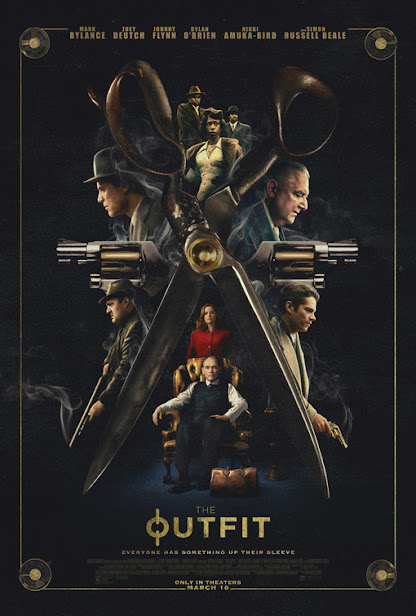
The Outfit is perfectly acceptable crime fare

In a recent episode of the This Had Oscar Buzz podcast, there was a comment about Springtime indie movies. The hosts of this podcast reflected that such movies aren’t massive in scale, they don’t dominate the zeitgeist. Think of such titles like Eye in the Sky, Gloria Bell, or Gifted, to name a few from the last decade. They lack in innovation, but they’re often pleasant and deliver just what you want out of a movie for that time of the year. That’s where The Outfit comes into play. It too follows in the footsteps of your average Bleecker Street or Focus Features release from this time of the year by being not a masterpiece, not quite a hidden gem, but a solid piece of moviegoing that’ll deliver on what its target demo wants.

Leonard (Mark Rylance) works as a cutter (not a tailor!) designing suits in a shop in Chicago. Here, his regular customers include local mobsters, most notably Richie (Dylan O'Brien), who use a mailbox in the back to drop correspondence to an organization known as The Outfit. Typically, Leonard keeps his distance from these boys. They don't bother him, he doesn't bother them. One night, though, things change drastically when Richie shows up at Leonard's shop bleeding profusely. Whether he likes it or not, Leonard is now stuck with these mobsters, who are all extra paranoid over there being a rat in their crew. It's gonna be a long night.  

Opting to confine The Outfit to one location could’ve been a kiss of death for the entire feature, especially since it’s being guided by first time director Graham Moore. But The Outfit has a not so secret ace up its sleeve: Mark Rylance. Confining viewers with Carrot Top or Adam DeVine in one place for two hours would be torture. Rylance, though? That’s a much different story. Not only is this Oscar-winning performer an enormously gifted talent (save for his miscalculated Don’t Look Up performance), but his extensive experience in stage productions means that he knows how to get a lot out of little resources. Rylance doesn’t need expansive landscapes or an endless series of props to keep your attention. He can capture your attention with subtlest details, especially in his facial expressions. Rylance has such an expressive face, especially in a grin that lights up your soul. 


The Outfit turning into the Mark Rylance show is an A-OK development by my book, especially since the playful script by Jonathan McClaine and Graham Moore (the latter of whom also directs) has lots of fun with Rylance being more scheming than he appears. There’s a surprising amount of mileage to be had with the sight of Rylance talking like a kindly fragile old man while delivering dialogue clearly meant to make these paranoid gangsters get suspicious of one another. If your movies going to be this restrained, it’s best when it had these kinds of entertaining ingredients at its beck and call.


On the other hand, the straightforward presentation of this material does lend a lack of unpredictability in some of the big plot turns, which undermines some of the entertainment. Meanwhile, some of the supporting actors inhabit classical outsized gangster archetypes better than others. Visually, Graham Moore doesn’t lend as much visual panache in his filmmaking as a more experienced director might’ve. There's also a final extension to the third act feels like an unnecessary detour. There’s a one really fun action beat in this section of The Outfit, but it’s not enough to erase the feeling that the movie should’ve wrapped up five minutes ago. 


These are the most critical shortcomings that keep The Outfit from going above and beyond being perfunctory. Still, it delivers decently on what it should, especially with some lovely looking costumes sprinkled throughout the cast. This is a throwback feature, one whose primary objective is to harken back to simple mid-20th century crime capers. Such creative influences result in a movie that doesn't exceed expectations, but it'll probably meet them if you like either Rylance or gangster movies. but its commitment to simplicity and its best elements make it a fine watch. In other words, The Outfit is a quintessential example of the Springtime indie movie. 

Sunday, March 13, 2022

The Adam Project is insulting in its lack of creativity


Adam Reed (Walker Scobell) is having a tough time. He's a 12-year-old grappling with the death of his father, Louis (Mark Ruffalo), from a year earlier, not to mention that he's developed a strained relationship with his mom, Ellie (Jennifer Garner). But this humdrum everyday existence gets thrown for a loop when a mysterious adult man crash lands in Reed's backyard. Turns out, this guy (played by Ryan Reynolds) is a version of Adam from the year 2050. Older Adam has a renegade but important mission rooted in the past that has made him the number one target of ruthless businesswoman Maya Sorian (Catherine Keener) and her goons.

It's already a tough job trying to jump across time while evading Discount Stormtroopers, but now Adam has to come face-to-face with the adolescent version of himself that he's tried to forget about for so long. Ask Joseph Gordon Levitt and Bruce Willis, it's no picnic when older and younger versions of one person collide. But maybe this mismatched duo can save the world and confront the past that haunts them both.

The Adam Project's greatest fault is how relentlessly lazy it is. Despite having an interesting starting point for its premise, director Shawn Levy and a quartet of screenwriters proceed to take this story in creatively stagnant directions. This includes the personality of 12-year-old Adam. One would think the point of a time travel movie involving older and younger versions of one person would be to emphasize how different one is at various points in their life. Think of the moment in Back to the Future where Marty McFly encounters a drastically unexpected teenage version of his father, George. That wouldn't be nearly as funny if George was just a teenage replica of his middle-aged self.

Unfortunately, 12-year-old Adam is just a miniature Ryan Reynolds, complete with Walker Scobell doing an impression of the actor's non-stop sarcastic quips. This schtick can get old when Reynolds is doing it, so you can imagine how tiresome this routine gets in the hands of a youngster. It's a lazy choice that's also stunningly miscalculated, the rapport between the two Adam's immediately came across like a single person just talking to themselves. Meanwhile, this also eschews the chance to have some variety between the two lead characters of the story. All it does is remind people of movies they've already seen before, a problem that gets exacerbated to groan-worthy degrees when young Adam recreates a joke from Deadpool, complete with a reaction shot from his older self. Rather than use the time travel gimmick to create fun new scenarios, The Adam Project is content to just rehash the past.

Meanwhile, the script's generally gloomy disposition is an incredible drag. The Adam Project desperately wants to tug on your heartstrings, to the point that every other scene turns into characters channeling their inner Vin Diesel by going into extended monologues on the value of family. This falls apart for a multitude of reasons. For starters, when everything is trying to be poignant, nothing ends up poignant. Put it this way: Toy Story 3's ending wouldn't be nearly as effective if every preceding scene had involved Andy giving his toys away. Even worse, so much of it is built on stuff we're told but not shown. This is especially true of older Adam's resentment towards his absent father. Since Louis is dead once the story starts, we don't get to see the childhood events that would've molded all this bottled-up angst. 

It's no surprise that the most successful instance of poignancy in The Adam Project comes in a tavern chat between Ellie and adult Adam since at least that's built on the strained mother/son dynamic that the audience has been privy to. Otherwise, The Adam Project's attempts to tug on the heartstrings mostly just result in didactic dialogue. The constant emphasis on schmaltz lends a weirdly downbeat vibe to the whole affair and makes it hard to get invested in characters that this production wants you to cry over. Other features, like The Muppet Movie, deliver a steady stream of gags and entertainment and then sneak up on you with the reveal that you've become emotionally invested in the on-screen characters. The Adam Project, by contrast, is all sentimentality, but no fun. Who wants that in a time travel movie starring Deadpool?

The attempts at faux-PIXAR pathos are complimented by a swarm of generic sci-fi action sequences, complete with futuristic soldiers and vehicles that eschew bright primary colors in favor of subdued steel and grey hues. Even the sound effects for the weapons and ships from the year 2050 end up evoking other movies by sounding alternately like the live-action robots from Transformers transforming or modes of transportation from Star Wars. The obligatory fight scenes are often set to 1970s and 1980s tune with the word time in the title, like Led Zeppelin's "Good Time/Bad Time." I know Guardians of the Galaxy popularized these kinds of needle drops in blockbusters, but they don't make much sense here. Neither version of Adam has a connection to 1970s and 1980s pop culture or even existed in that era, nor is this music a key part of Louis's background. Meanwhile, none of the tracks are incorporated into their respective sequences interestingly enough to justify their presence. You can blame the latter problem partially on Levy's sloppy and unimaginative framing of the various skirmishes. 

Tragically, good songs from bands like Boston are here used simply because The Adam Project isn't capable of coming up with its own cool ideas. Levy and company are content to just remind people of other superior motion pictures and hope that's enough to carry the day. This is even felt in Rob Simonsen's score, which strains so hard to evoke the sound of compositions by John Williams that it's embarrassing. Among the scarce distinctive elements here is Catherine Keener getting saddled with both a terrible wig and equally atrocious CG de-aging. Please, someone in Washington D.C. outlaw digitally de-aging actors outside of The Irishman. On a happier note, a rare piece of original entertainment here can be found in Alex Mallari Jr.'s performance as evil henchman Christos. He's got an unabashedly silly and over-the-top demeanor that the rest of The Adam Project sorely lacks. Everyone else is so dour and yet here comes Mallari Jr. yelling to a supporting character to get their "bitch-ass husband outside now!" 

It's fun to watch the works of Rian Johnson and see how he conveys such passion for certain genres (murder mysteries, noirs, time-travel tales, etc.) while taking them in unexpected but fun directions. The Adam Project is the inverse of that. While trying to evoke so many beloved blockbusters of the past (and also the climactic location of the dismal Terminator: Genisys, for some reason), The Adam Project ends up most resembling the Pokemon Ditto in how it's only capable of surface-level mimicry. Rather than being a fan of older pop culture, The Adam Project is more conscious of how popular Amblin features, Guardians of the Galaxy, and poignant family movies are and wants some of that action. Not once does it consider why those films were so good to begin with. I guess nobody involved in this woe begotten blockbuster had any time to think of that.

Tuesday, March 1, 2022

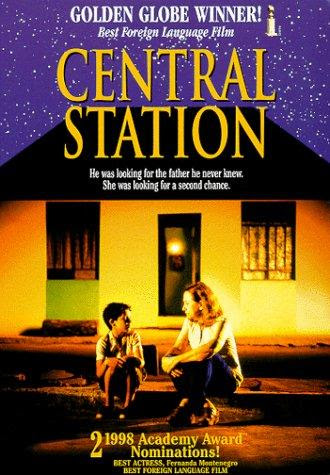
You need to catch a ride at Central Station


It's so much fun to finish a movie and then immediately know "Oh, that's gonna become one of my favorites."

That doesn't happen very often, but it's just what I experienced with Central Station just last week.

Central Station begins with Dora (Fernanda Montenegro) making her living writing down letters that people dictate to her at a local train station. She's instantly hostile for the people she writes for and even refuses to mail some of the letters she pens. Her life gets upended when Josué (Vinícius de Oliveira) enters the picture. After his mom is abruptly killed by a speeding bus, this youngster has nowhere to go. After initially ditching him with strangers for cash, Dora proceeds to take the kid on a road trip to reunite him with his father. With minimal cash to their name and no consistent ride by their side, it's going to be a miracle if they ever get to their destination.

We've all seen movies with crotchety adults getting mixed up with precocious youngsters and, wouldn't you know it, both parties learning some valuable lessons through their interactions. Central Station is technically part of this subgenre, but it's up there with Paper Moon as an example of this strain of cinema at its apex. Rather than constantly remind you of other movies, Central Station makes warm and fuzzy cinema feel fresh out of the box again. It's clear now that the likes of St. Vincent were chasing this movies coattails, hoping to capture a fraction of Central Station's intellect or filmmaking ingenuity. 

Part of what makes the screenplay by João Emanuel Carneiro and Marcos Bernstein work so well is its commitment to rendering its two leads as real people. For Dora, this means allowing her to be an especially messy person, with no concern over whether she's "likeable" or not. She's supposed to capture relatable angst over everyday existence, not be a model citizen. She also doesn't have a ham-fisted origin story always dictating her actions, we only get brief glimpses (like her recalling a story of when she ran into her absent father as a teen) into the events of yesteryear that molded her into who she is. For his part, Josué also behaves in a manner that's rooted in reality, with all the imperfections of an actual child rather than the tidy precociousness of a 1990s sitcom kid.

Plus, it's all captured with such impeccable visuals courtesy of director Walter Salles and cinematographer Walter Carvalho. An early piece of camerawork where Dora's conversation with another adult man at her work station, captured through a low-angle shot in a peephole to simulate Josué's point-of-view, sets the standard for the kind of thoughtful camerawork that works its way into the entire feature. I especially love the way Salles and Carvalho use empty space once the main duo of Central Station gets into more rural territory. A shot of the two characters sitting in front of this mountain-like object while a sprawling sky hovers above them is such a striking image that immediately communicates how outmatched Dora and Josué are in their quest to find the latter character's dad.

Combining such tenderly thoughtful visuals with a whip-smart script makes Central Station one of the very best road trip movies as well as something that accomplishes one of my favorite things in any piece of art. Specifically, Central Station is able to sneak up on you with how much you've got invested in these characters. The seemingly throwaway interactions Dora and Josué have shared throughout the film gradually add up to Dora coming out of her shell, a development that hit way harder than I expected when I started watching this movie. By the time she's writing letters again, but this time being more conscious of the humanity of the people she's putting pencil to paper for, I was astonished with how well Central Station had set up and pulled off Dora's totally organic character arc!

It's only fitting that a movie like Central Station that can pull off character beats like those would wrap up its runtime on a note that opts for realistic imperfections rather than a tidy resolution promising happy endings for all. In the end, Dora and Josué go their separate ways. The latter character will wait with his older siblings for their dad to maybe return, and Dora will go back to her old life. Uncertainty hangs over both of these characters, but thanks to the time they spent with one another, they're a little more capable of tackling whatever comes next. Neither they nor the audience needs to know what happens next. They just need to hold on to memories of everything that just happened.

This bittersweet but utterly perfect conclusion reminded me of the works of Mike Mills, specifically C'mon C'mon and 20th Century Women in terms of its complicated depiction of who helps shape our adolescent selves. The fact that a random lady like Dora could have such a profound impact on Josué even reminded me of this quote from 20th Century Women:

"I don't know if we ever figure our lives out. And the people who help you, they might not be who you thought or wanted. They might just be the people who show up."

Thank God for the people who show up and thank God for movies like Central Station.


Monday, February 28, 2022

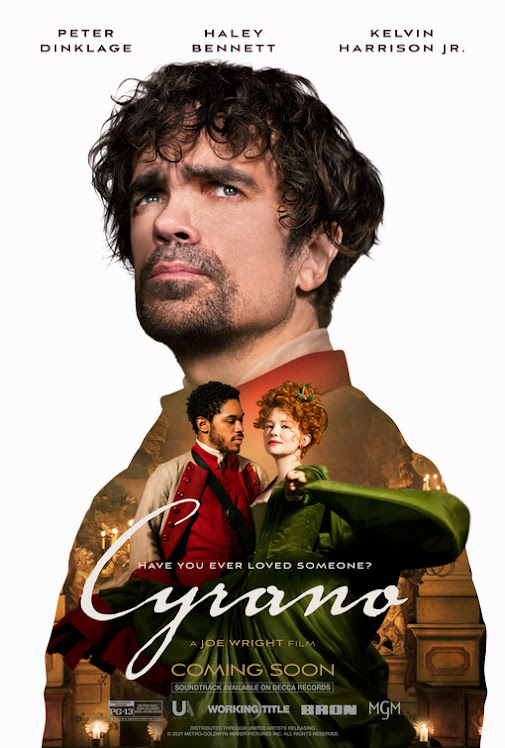
Cyrano is an endearingly unabashedly romantic, if still flawed, musical


Cyrano makes it apparent early on whether or not this romantic musical will be for you. As Roxanne (Hayley Bennett) is riding in a carriage on her way to an unexciting date, she locks eyes with Christian de Neuvillette (Kelvin Harrison Jr.). In that moment, the two of them fall in love immediately even without knowing each other's names. If that sounds ridiculous or like too much of a leap, that's understandable and Cyrano is simply not going to be your cup of tea. If that sounds like just your kind of sweeping romantic storytelling, though, then the ensuing film director Joe Wright is going to strike your fancy and then some.

Based on the stage musical of the same name by Erica Schmidt (who also writes this film's screenplay), as well as the 1897 play Cyrano de Bergerac by Edmond Rostand, the titular character of Cyrano (played by Peter Dinklage) is a man of considerable courage in battle or on a stage who has difficulty confessing his longstanding feelings of romantic affection for Roxanne. He's convinced that his physical attributes, here represented by his height rather than the size of his nose as in the original 1897 play, will always keep him at arm's length from Roxanne.

His struggles to convey his heart are only exacerbated when he learns that she's fallen in love with Neuvillette, whose just been recruited as a soldier in Bergerac's regiment. As the two interact, they come up with a plan where by Bergerac will write love letters that the tongue-tied Neuvillette will claim as his own. An act of duplicity in the name of love, the whole charade becomes increasingly difficult for the two men to keep up even before the prospect of a war rears its ugly head.

The last few Joe Wright films have struggled to establish their own identity apart from the films they were emulating. Pan was just a woefully misguided attempt to make a live-action Disney cartoon remake without any Disney cartoon to use as creative inspiration. Darkest Hour was a paint-by-numbers biopic. The Woman in the Window was a Hitchcock pastiche lacking in thrills. Part of the entertainment in Cyrano, though, comes from seeing Wright do something that doesn't feel like it's riding the coattails of past movies. Even considering how The Greatest Showman and La La Land ushered in a new age of big-screen musicals, nobody out there was demanding a new musical take on Cyrano de Bergerac or even a straightforward adaptation of this material.

That's not meant to be a complaint, though. On the contrary, emerging as something chasing its own creative beats rather than adhering to what it believes audiences want is what makes Cyrano an unexpectedly charming endeavor. Part of that charm also comes from Schmidt's willingness to embrace entertainment rather than chasing a conventionally cohesive tone. Early on, the story alternates between rap battles in a 19th-century playhouse to Cyrano setting enemy assassins on fire and then back to poignant romance all in the span of just a handful of scenes. Disjointed? Maybe. But I love when movies are free-wheeling and going wherever they please, especially when it's clear there's palpable interest in the various places it takes the audience.

Best of all, this is a movie that wears its heart on its sleeve. The old-school romantic inclinations of our lead characters, who burst into pronounced expressions of love-soaked affection at the drop of a hat, are delivered with nary a snarky quip or a self-referential line in sight. This is a movie confident in its dedication to melodramatic love, rather than something dripping with self-consciousness. It's also a hoot how Cyrano keeps finding new ways to visually represent sensuality. The omnipresence of romance in these people' lives is reflected in how everything from baking bread to even Roxanne reading a letter on her bed can be an opportunity for sexual imagery to dominate the frame. Sometimes a cigar is just a cigar, but in the case of Cyrano, so much of what's on-screen is creatively rendered as a sexual metaphor. 

Unfortunately, the visuals of Cyrano do connect to the biggest shortcoming of the movie: its camerawork. If there was ever a 2022 feature crying out to be filmed on 35mm film, it's this one. Something so rooted in classical musical cinema is primed and ready to be captured on the same kind of cameras used by MGM musicals in the 1950s. By contrast, the digital cameras used here end up making certain scenes look murkier than they should and exacerbate flaws in pieces of green-screen work. Meanwhile, Joe Wright's work behind the camera in executing the musical numbers can't help but feel like it needed a little more imagination and energy, especially when compared to the camerawork in recent live-action musicals like West Side Story and Tick...Tick...Boom! Even without the high bar set by those two films, some of Cyrano's grander tunes needed framing as passionate and unique as the romantic feelings of its in-movie characters.

Wright and cinematographer Seam McGarvey fare significantly better in their camerawork whenever it comes to more intimate musical numbers, such as the highlight of all of Cyrano, "Wherever I Fall." The restrained and intimate nature of the camera here allows the complex thoughts of the frightened and tormented soldier singers to be properly felt. You feel like you're in the foxhole with them, grappling with mortality but also the emotions and human connections that made this life worth living. It's a song that evokes the same thematically rich material as the Kingston Trio ditty "Long Black Rifle", but the camerawork here makes those words land with a unique impact.

Capturing those sorts of emotions with vigor is what makes Cyrano work even with its flaws, like the underwhelming digital camerawork  or certain repetitive song lyrics. It's a gusto production where songs can break out at anytime, where performers like Peter Dinklage and Kelvin Harrison Jr. are knocking you on your feet (who knew Harrison Jr. could sing this well in addition to his other talents?), and where Joe Wright has come alive as a filmmaker once again. It'll understandably be too much disjointed musical madness for some, but Cyrano hit my sweet spot in terms of its conviction to romance and being its own poignant creation.

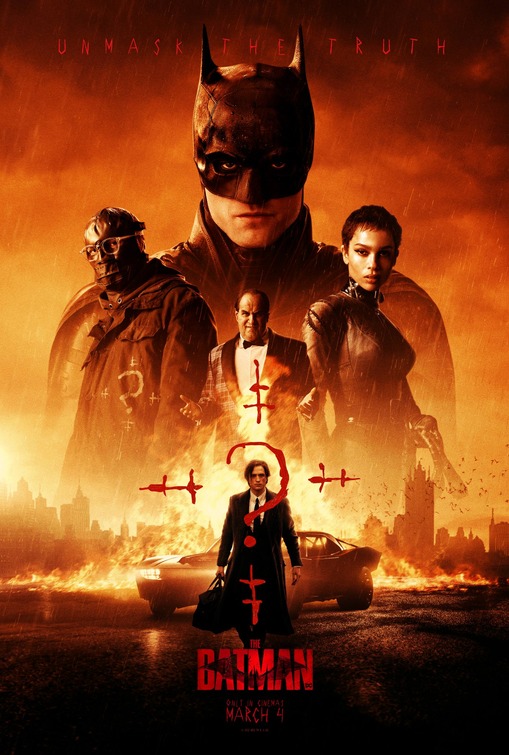
"Darkness!" and "No Parents" actually serve The Batman well


With eight different live-action movies starring Batman (and that's not even counting the two projects headlined by Ben Affleck's version of the character) already in existence, it's understandable to wonder what exactly The Batman is bringing to the equation. What is it doing to justify its existence beyond giving Warner Bros. a new opportunity to sell more Batman action figures and lunchboxes? Director Matt Reeves, who also penned the screenplay alongside Peter Craig, has opted to go in interesting directions with this project, and not just by making it the second time in pop culture history that Batman and the hymn "Ava Maria" have been put together.

No, the biggest point of distinction here is by making The Batman a mystery thriller first and foremost. The World's Greatest Detective finally gets a movie based largely on those skills, to the point that big-scale action sequences are limited to just two large set pieces. The result isn't something that can entirely shake off the past or live up to all of its ambitions but is more entertaining than expected given how familiar the Batman series has become.

The Batman begins with Bruce Wayne/Batman (Robert Pattinson) being two years into his tenure as Gotham City's vigilante. He doesn't just strike terror into the hearts of thieves, even everyday Gotham citizens are as terrified of Batman as they are of potential muggers. As Wayne pours everything into his Batman exploits, a killing spree of high-level Gotham City personnel begins. The culprit behind these slayings? A mysterious masked figure known only as The Riddler (Paul Dano), a Zodiac Killer pastiche who coughs more than a chain-smoking version of General Grievous. Wayne will need to be at his sharpest to dig up the clues and find out what's fueling The Riddler's rampage. Intersecting in this mystery is Selina Kyle/Catwoman (Zoe Kravitz), who has her own agenda in tackling the criminal underbelly of Gotham City. 

Each Batman movie approaches the dichotomy between the Bruce Wayne and Batman personas in different ways. For The Batman, the latter identity is the one we're introduced to first, with Wayne eventually revealed not as a guy putting on the act of a billionaire playboy, but as a ghost. This guy saunters around his domicile in oversized hoodies, pain in his eyes, remorse fueling his behavior. A figure who strikes terror at night is just a broken shell of a person in the daytime. The heavy contrasts between the two sides of The Batman's protagonist are immediately interesting, especially since Pattinson does great work differentiating the two in terms of physicality. 

Taking a cue from Rick Altman’s essay "The American Film Musical as Dual-Focus Narrative," which suggests that musicals are defined by parallels between musical numbers, The Batman creates intriguing visual parallels between Batman and Bruce Wayne. They'll inhabit the same environments, but with starkly different body language or lighting to suggest their differing outlooks.  An especially fascinating example of this dichotomy comes during a sequence where Wayne runs into people like Commissioner Gordon who’re strangers to this billionaire playboy, but familiar allies to Batman. The haunting loneliness of his life comes to the surface here, as he and the audience realize how even his "friends" don't really know him. Emphasizing the disparity between the two halves of this superhero lends The Batman some of its most quietly thoughtful moments.  

Duality manifests in interesting fashions throughout the piece, including pieces of camerawork meant to intentionally confuse the audience on whether we're seeing things through the eyes of Batman or The Riddler. These shots, as well as how certain moments are framed through windows or from far-away positions, convey a sense of voyeurism, as if The Batman is transporting the viewer into the observational gaze of its hero and villain. This and other similar visual touches being well-realized through the direction of Matt Reeves and cinematographer Greg Fraser. Even when duality is put on the backburner, both of these men do commendable work throughout The Batman in making this look like a handsome production. Particular kudos the team behind this film for realizing the handful of fight scenes in a visually cohesive way. These skirmishes all take place at night, but Reeves and Fraser make sure you always understand what's going on on-screen and why.

Amusingly, most of the cast feels like they’re each inhabiting different movies, which weirdly fits for how Gotham is supposed to be a jagged disjointed community where nobody trusts each other. Jeffrey Wright’s take on James Gordon feels like he got lifted from a 1990s crime thriller, Zoe Kravitz is doing a femme fatale straight out of Laura, while, most amusingly, Collin Farrell plays Oswald Cobblepot like a 1950s gangster. This comes complete with the character saying “hoid” instead of heard. Alas, Farrell's Penguin does not ever say "five chubby digits," so The Batman automatically gets demoted a star. Thankfully, The Batman offers up plenty of opportunities for Robert Pattinson to utilize his enormous talents as an actor. He's great as the titular superhero and he does fine subtle work in making sure that he's not retreading ground from prior incarnations of the character.

Pattinson and the other cast members are inhabiting an aesthetic that's grim, but not necessarily realistic, which is a compliment. The aim here seems to have been mimicking the tactility of Christopher Nolan’s Batman films, but combining it with the expressionistic visual touches of Tim Burton’s tenure in the franchise. For instance, Bruce Wayne doesn’t just live in a mansion anymore, the interior of his home is like a gothic castle straight out of Crimson Peak. Fraser's cinematography frames these and other environments with bold camerawork emphasizing wide shots, rather than more intimate framing evocative of cinema verite. Not all of its visual touches are 100% original, but as executed here, they lend a nice stylized air that ensures the production doesn’t get weighed down with anchoring everything in realism. Happily, the lavish visual touches are complemented by a great lively score by Michael Giacchino. 

Despite being a well-crafted endeavor that offers lots to chew on, The Batman does have its share of frustrating shortcomings. It's hard to dive into them getting into spoiler territory, but for one thing, it's disappointing that this is yet another major Hollywood blockbuster that tiptoes around relevant sociopolitical issues but refuses to get into more uncomfortable topics like systemic racism (save for one line form Kyle gesturing at white privilege). Similarly discouraging is that The Batman's homages to film noirs mean maintaining the limited roles for women from classic entries in this genre since there are only two prominent ladies in the whole script. Heck, some noirs, like Pickup on South Street, even had better and more varied roles for women 70+ years ago! The works of Matt Reeves have often struggled to deliver weighty parts for ladies, but it's a shame that didn't get improved on here.

There are also some smaller, but no less important, gripes to be had with details like Batman's opening narration sounds too much like Rorschach's inner monologue or a section of the second act involving Wayne interacting with Carmine Falcone (John Turturro) that feels too much like an unnecessary digression. For the most part, though, The Batman delivers nicely as an enjoyably atmospheric grim crime thriller that keeps you guessing and engaged (yay for earning that prolonged runtime!) Even better, it also isn't afraid to embrace fun comic book-y details of Batman's lore like Catwoman throwing a whip around or all the excitement that can be had with the Batmobile. 

The Batman aims high to deliver both a grounded mystery thriller and something that fits snugly into the Batman mythos. Impressively, Reeves manages to pull that combo off with finesse. It's not a game-changing entry in the franchise and it's easy its pervasively dour tone being something some people won't want to sit through three hours for. But if you've liked Batman movies before this, The Batman will be up your alley while even those left cold by past installments will be won over by the unique touches and commitment to thoughtful storytelling. 

Still not as good as The LEGO Batman Movie, though.

Friday, February 25, 2022

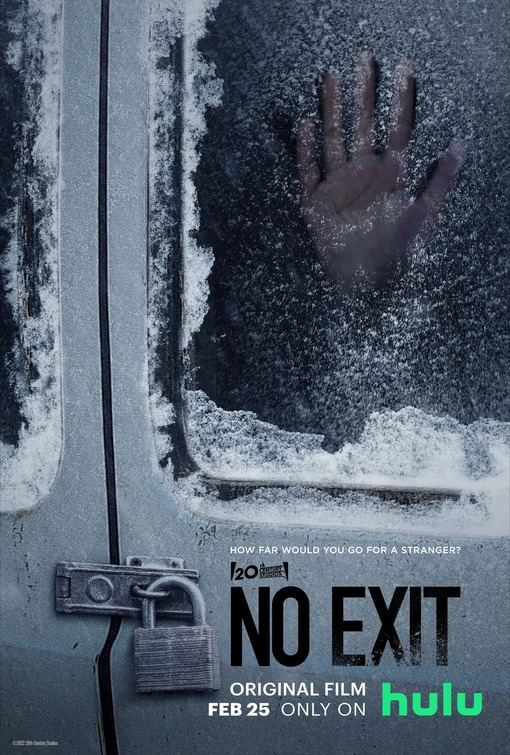
It's best to promptly leave No Exit


The modern age of streaming movies dictates that such titles emulate the kind of fare you could see on the big screen. Of course, this varies in execution. There's been plenty of discussion over Netflix movies looking cheap or why Netflix's mandate for all films to be shot with Ultra High-Definition cameras ends up making its original features look off-putting. However, conceptually, projects from Netflix and other streamers typically want to evoke the kind of projects you'd normally have to drive to a Cinemark to see. The new Hulu title No Exit, then, is a departure from these norms as its scale and storytelling would've been right at home as a CBS original TV movie in years past. 

No matter whether it aired on the big or small screen, though, nothing can disguise the fact that No Exit doesn't work as a thriller. 

Adapted from a short story of the same name by Taylor Adams, No Exit begins with Darby Thorne (Havana Rose Liu) receiving the news that her mother has been taken to the hospital in critical condition. The problem, however, is that Thorne is in court-mandated rehab, she can't leave to visit her mom. It isn't long before Thorne makes a quick escape and steals a car in order to get to her mom. However, a blizzard derails her plan and she's soon forced to wait out the storm in a nearby rec center with four other people. While wandering around outside in the parking lot, Thorne discovers a girl tied up in somebody's truck. One of the four people inside is not who they seem and the revelations are only getting started.

Limiting your movie to one location and a small cast has inspired gripping filmmaker from other directors. In the case of director Damien Power and screenwriters Andrew Barrer and Gabriel Ferrari, the stripped-down setup of No Exit has only inspired monotony. Part of the problem is that the plot loses track of Thorne's central struggle of dealing with addiction. Once she gets to the rec center, her sickness as well as her quest to get to her mom become secondary to the little girl she's stumbled on. Barrer and Ferrari fail to capsize on several intriguing opportunities to intertwine this predicament with Thorne's interior life. As a result, there's no central character to get invested, no personalities that can distinguish this from other similar thrillers.

It's also puzzling how quickly the central mystery of whose kidnapped the girl taken care of. What should be a driving engine of suspense instead sputters out without much fun or excitement. This issue goes hand-in-hand with the similarly fatal flaw that you can guess who can be trusted and who can't from the get-go. No Exit doesn't even have the good sense to get weird and gonzo with its twists and turns. This is a movie too deeply on autopilot to liven up enough to deliver trashy fun or enjoyably over-the-top performances. A movie this self-conscious about being seen as ridiculous gets old awful quickly. 

The closest thing to an inspired narrative detail in the whole thing is the genuine affection one of our villains has for another one of the adversaries. There's no financial reward or duplicity here, this evil guy actually cares about another human soul. Evoking the George/Lenny dynamic from Of Mice and Me or even the Robert Pattinson's character in Good Time, this rapport is the one part of No Exit that surprises, along with the hysterically miscalculated way Thorne's addiction returns to the movie. Otherwise, there's little in the way that's noteworthy. No Exit is so disposable that even its shortcomings are instantly forgettable.

The same sentiments can be expressed for the lackluster visuals of No Exit. Power's filmmaking is subpar all around, but it's especially disappointing how he fails to convey any sense of claustrophobia in Thorne's scenes where she navigates being trapped in a small scape with a potential kidnapper. Cinematographer Simon Raby lathers on the darkness in his camerawork, an attempt to convey moodiness that ends up just making it hard to parse what's going on-screen. Worst of all, talented character actors Dale Dickey and Dennis Haysbert are stuck with nothing roles, with the latter performer getting some of the absolute worst dialogue of the whole feature. They deserved more and so do viewers interested in entertaining thrillers. No matter whether it debuted at Cannes or on Hulu, No Exit would've always registered as an especially drab and unengaging movie.

Wednesday, February 23, 2022

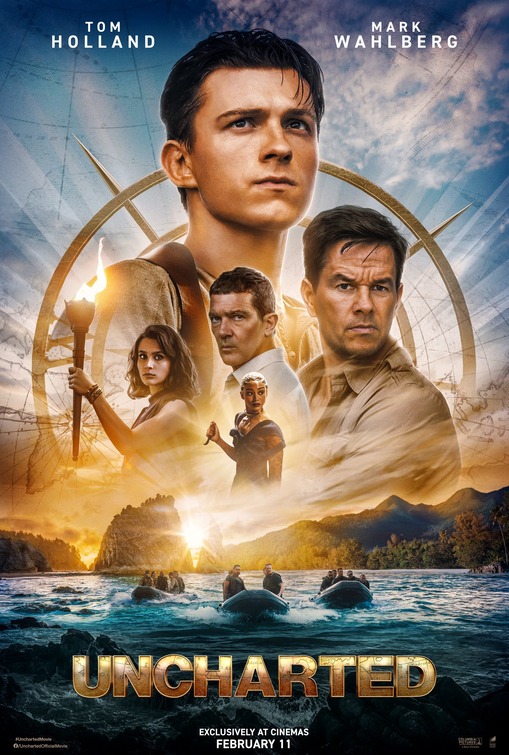
Uncharted goes to familiar territory for treasure hunting movies


As my screening for Uncharted began, I half-expected the Gremlins to break into the projection booth and sabotage the whole thing. This video game adaptation has seen so many delays and existed as a nebulous project for so long, it feels like it was destined to just be a what-if scenario rather than a finished film you could watch. But here it is and now all those postponements are immaterial. What's left is the movie itself. Unfortunately, Uncharted doesn't offer much as a movie, for either good or for ill. Having not played the video games it's based on, I can't tell you if this stacks up as an adaptation, but as a treasure hunting movie, it's only so-so.

Nathan Drake (Tom Holland) is a bartender in Boston, Massachusetts who has a lot of knowledge about ancient history and quick hands that allow him to be a gifted thief. He also harbors a lot of grief over his missing older brother, Sam, whom he hasn't seen in over a decade. A former colleague of Sam's, Sully (Mark Wahlberg), appears out of the blue to ask Drake to help him steal a cross that could lead to a massive undiscovered treasure. Drake agrees to come along for the ride, putting him right in the crosshairs of fellow treasure hunters Santiago Moncada (Antonio Banderas) and Jo Braddock (Tati Gabrielle).

The best word to describe Uncharted is perfunctory. It delivers what you want out of a basic treasure hunting movie, including people walking around catacombs with torches, exotic foreign locales, and clues hiding in plain sight. Director Ruben Fleischer seems much more comfortable executing a straightforward entry in this genre than he did in overseeing either a gangster movie or whatever Venom was trying to be. Cinematographer Chung-hoon Chung makes things look perfectly fine visually, with a big skydiving action sequence especially doing good work blending live-action humans with digital backdrops.

Unfortunately, competency will only get you so far. What Uncharted really lacks is a personality or wit. Some of this comes from the fact that the film tries to be primarily a two-hander buddy picture between a pair of mismatched performers. On the one hand, Tom Holland reaffirms why he's a good blockbuster leading man with his turn as Nathan Drake. He's engaging, he delivers the characters vulnerable moments with empathy, and I like how agile he is in the scuffles. Dude's jumping all around, swooping under tables, he has a spry physicality that's nifty to watch. Mark Wahlberg, meanwhile, is miscast as Sully, a character the film wants to be Jack Sparrow meets Long John Silver from Treasure Island. Wahlberg doesn't create much difference between Sully being shifty and Sully being playfully fun, which makes the character's moral ambiguity muddled.

Wahlberg being a poor fit for one of the two lead roles isn't the only problem here. It's also strange that Uncharted eventually breaks away from specific real locations to a generic locale somewhere in the Philippines. There's a lack of specific identity to the third-act backdrops of Uncharted while the nebulous setting and mythology informing this section of the treasure hunt doesn't make any use of Drake's gift for knowing so much about the past. It's hard to bring up historical trivia when your movie is just making up history as it goes along. Without any big character beats to lean on (even a potential romance for Drake gets jettisoned), this critical part of Uncharted becomes hard to get invested in. Plus, the movies heavy homages to Indiana Jones and National Treasure only remind you all the more how fun it was to see familiar landmarks and mythological elements repurposed for treasure hunt antics in those earlier movies.

At least this finale has the good sense to feature a battle between pirate ships in the air, even if I did have to emit a chuckle over imagining Paul W.S. Anderson watching this set piece and thinking "They stole my finale from The Three Musketeers!" As for the rest of the film, it has the good sense not to stretch out its runtime for long (it runs under two hours with credits) and both Banderas and Gabrielle make for entertaining baddie. Unfortunately, they, like the other positive parts of Uncharted, end up reinforcing how uninspired key aspect of the rest of the production are. Ramin Djawadi's forgettable score, for example, or the strained attempts at witty banter between Drake and Sully, they're all evoking other superior movies you could just stay at home and watch instead. 

It's doubtful anyone will be walking out of Uncharted shaking their fists and demanding a refund. However, if you're like me, you won't be able to shake the feeling that this should've been much more fun and imaginative. 

Sunday, February 20, 2022

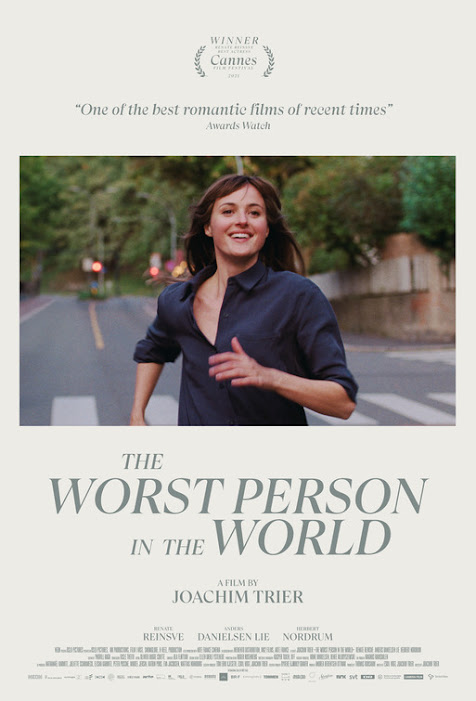
The Worst Person in the World is absolutely the best


One of the most affecting moments of BoJack Horseman comes when the titular character is talking to his prospective daughter, Hollyhock. They're sitting next to his pool and after a moment she asks him if "that voice...that tells you you're worthless and stupid and ugly...it goes away, right?" BoJack proceeds to tell her yeah, which inspires a slight smile on her face while BoJack just looks away with pain consuming his expression. He knows the truth. That voice isn't limited to your teenage years. Adulthood is full of insecurities. Whether you're measuring yourself up to society's expectations, the accomplishments of others, or even just what you wish you could see in yourself, you'll often feel like you're never enough. It's all enough to make you feel like...The Worst Person in the World

Taking place in Oslo, Norway, The Worst Person in the World follows Julie (Renate Reinsve). As the story starts, she's decided to pursue a career in psychology. After going to college and then scoring a relationship with one of her professors, she adjusts career paths to photography. This takes her through a handful of lovers until she gets into a committed relationship with comics writer Aksel (Anders Danielsen Lie). From here, Julie navigates what she wants out of life now that she's turned 30 years old. Who does she love? What passions does she have for her career? Does she even want kids? Life is messy and so is Julie as she tries to figure out what she even wants her life to look like.

The simplest charms draw you into the world of The Worst Person in the World while the deeper contemplations of the screenplay by Eskil Vogt and Joachim Trier (the latter of whom also directs) keep you glued to the screen. The former elements come about as a byproduct of Julie steering herself through the quagmire that is adult social situations. Reinsve's performance is remarkable in conveying subtle comedy just through facial expressions or the way she delivers dialogue. These gifts become apparent as her character experiences situations like loud children at a big gathering or when she pretends to be a hotshot doctor to guests at a wedding she crashes. No matter what Julie gets into, Reinsve is there to lend a sense of skillful comic timing and especially authenticity.

Her initial scenes with Herbert Nordrum as Elvind, a man in a committed relationship she runs into at a party, are especially delightful from both a performance and writing standpoint. Vogt and Trier's writing finds such amusing and creative ways to depict these two flirting with one another while trying to exhibit a determination to not cheat on their respective partners. Their writing works so well that they're able to make a fart work simultaneously as a humorous gag and an instance of emotional bonding! Reinsve and Nordrum have such good chemistry here, all of it built on unspoken feelings and sexual attraction, that just the sight of them chilling on a bed together fully clothed grabs your eyeballs. This section of The Worst Person in the World is emblematic of the kind of performances and attention to detail the whole movie provides. 

From here, Trier's directing keeps coming up with unforgettable ways to visually realize the indecisiveness that grips Julie's mind. A sequence depicting the character running around a version of Oslo where everyone else is frozen in place is full of terrific moments while deftly combining the atmospheres of melancholy and romantic yearning. A later drug trip scene blends hand-drawn animation with live-action players against an unsettling primarily darkened backdrop. Combining such distinctive details creates an eerie and evocative largely exploration of Julie's psychological vulnerabilities, one rendered largely without dialogue. Who needs words when the imaginative imagery on-screen can say so much?

This particular set-piece is a great example of how well the unflinchingly messy nature of Julie is realized on both a screenwriting and performance level. Sometimes, it can feel like movies (especially ones written and directed by men) believe the very act of a woman having messy hair or being uncouth is enough. This can reduce the depiction of flawed women as a novelty, something that exists only to "disturb" rather than as a way to examine women as multi-faceted people. That's not the case here, though, with Vogt and Trier using Julie's flaws as a way to explore this woman on a deeper level rather than just leaning on the "shock value" of a woman eagerly gulping down magic mushrooms. 

The deeper nature of The Worst Person in the World isn't just reflected here, but also in later sections of the story (the movie is split into 12 segments, plus a prologue and an epilogue). This is where a greater level of tragedy seeps into the story, with a key supporting character taking on whole new dimensions a a result. It's a story turn that, in the wrong hands, could've felt like a contrived melodramatic detour, an undermining of the hangout vibes that had defined so many of the best preceding sequences. But by keeping everybody's reactions to the devastating events subdued, this narrative development feels so natural, especially in its contemplations on mortality. 

This is where the movie's ruminations on what defines a fulfilling life come to a head and it's no spoiler to say that The Worst Person in the World does not offer a solid answer to that question. Much like "that voice...that tells you you're worthless and stupid and ugly", insecurities over whether or not we're doing enough with our lives never fully vanish, no matter what age we reach. Instead of attempting to provide a treacly solution to these woes, The Worst Person in the World wraps viewers up in a soft hug and tenderly whispers that they're not alone. Maybe that's enough to make life seem a bit more manageable, at least for now. It's certainly more than enough to make for a great movie.

Monday, February 14, 2022

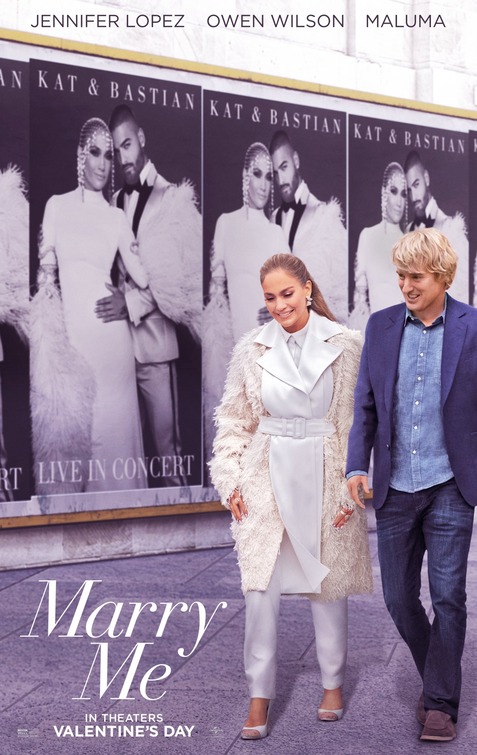
Marry Me is just what you'd want from an old-school romantic-comedy


Shortly after his directorial debut, The Rental, came out, Dave Franco revealed that his next project as a filmmaker would be a romantic-comedy. But not just any entry in the genre, oh no, this would be an "elevated romantic-comedy". Using the same "elevated" term used to describe many modern horror movies, this comment bugged me. The romantic-comedy doesn't need to be "elevated", just make an entry in this genre! Don't be ashamed of it! There's such a self-conciousness in approaching romantic-comedies in this manner, though that quality is totally absent from the new motion picture Marry Me, which is about as traditional of an entry as you can get. That's no complaint, though, and the best moments of this movie suggest why it'd be best for the romantic-comedy to be unapologetically old-school.

Kat Valdez (Jennifer Lopez) is a massively successful singer preparing to get married during a concert to her boyfriend Bastian (Maluma). Charlie Gilbert (Owen Wilson), meanwhile, is a cynical math teacher reeling from divorce whose just concerned with helping his students and daughter. The duo would've likely never crossed pathes, let alone gotten involved in a whirlwind romance, if not for the fateful night Gilbert accompanied a friend to Valdez's big marriage concert. There, Valdez discovered Bastian was cheating on her and then made the impulsive decision to marry a random stranger from the audience. That stranger turned out to be Gilbert, whose now stuck navigating stardom and a possibly blossoming marriage he never could have imagined.

The predictable nature of Marry Me is interwoven into the fabric of the story. You come to a musical for singing and dancing, you come to a superhero movie for the spectacle, and you come to a romantic-comedy for certain story beats. Marry Me is all too happy to provide on that front and that's just fine. A bit more of a problem is an exposition-heavy first act that works a bit too hard to try to justify the outlandish premise. Some of the gags here also fall flat, namelt broad attempts at mimicking jokes from older movies, like yet another instance of someone in a film forgetting to put the cap on a blender. It's an odd problem for a film belonging to a genre that's often as much about the jokes as it is the passionate love affairs.  

Marry Me isn't so much a laugh riot as it is deeply pleasant to watch, which is it's secret weapon. Director Kat Cairo's traditional approach to this movie goes hand-in-hand with a decision to eschew snark or random outbursts of cruelty to see seem savvy to modern-day cynicism. Does it result in hokey moments? Of course, ditto for the inevitable side-effect of too many characters talking in profound kernels of wisdom destined to be shared as generic inspirational quotes on Facebook.  But making Marry Me unabashedly content to just be upbeat escapism proves endearing enough to carry the movie. 

It helps that the feature is capable of delivering entertaining sequences that justify the chipper tone, including a grin-inducing rendenvous in a classroom where dance moves help Mathalon students recite their numbers. The constantly kindhearted energy of the movie also makes the lowkey bonding scenes between Lopez and Wilson's protaganists nice. Their dialogue is about getting to know one another rather than dropping snarky remarks or gratingly coy meta-jokes about romantic-comedy tropes. Even the inevitable second-act downturn in the duo's relationship is smartly built more on quiet detoriation rather than a big explosive argument. 

It's hard to dispute such an agreeable atmosphere that allows actors like Lopez and Wilson plenty of opportunities to shine. Plus, you get a bunch of original tunes from the former performer that aren't all-time great songs, but do work just right as enjoyable pop ditties. I always appreciate when fictional pop stars in movies produce music that's actually solid, makes it easier to buy their in-universe success. Even if it runs too long and the gags can feel more obligatory than hysterical, Marry Me proves a charming and enjoyable watch. Committing to the feel-good version of a familiar genre is so much more fun than being so self-concious about whether you've "elevated" the romantic-comedy enough.

Sunday, February 13, 2022

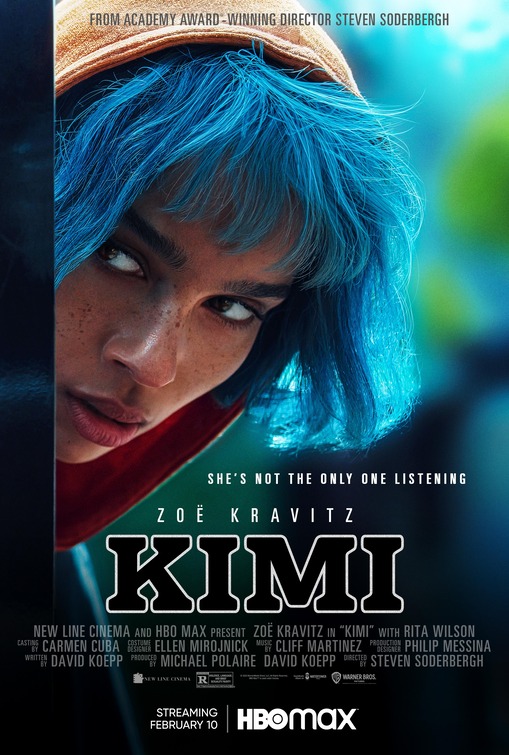
Kimi is a superb technological thriller

It'd be great under any circumstances that Steven Soderbergh, the man behind so many exceptional films, came back from retirement. But it's especially great given how his post-retirment output has been uniformly strong, save for The Laundromat, a weird attempt on Soderbergh's attempt to mimic Adam McKay. This hot streak continues on with aplomb with Kimi, a low-key thriller that shifts between intimate and gleefully fun modes with remarkable skill. The biggest complaint I have with the whole production is that this should've gone to theaters! How come The King's Man got the big screen treatment but not this treat?

Like so many of us in the last two years, Kimi protagonist Angela Childs (Zoe Kravits) works from home. Her job concerns an Alexa-like device called Kimi, with Childs working manually to help fix any miscommunication between this piece of technology and consumers. Listening to so many people's Kimi request is usually a snooze...but then Childs hears something disturbing. A woman getting murdered. But by who? And where? She begins to dig deeper, but finds herself in trouble. Not only is her company uninterested in Childs pursuing this any further, but somebody is hot on her trail and looking to silence her before she can find the answers.

David Koepp doesn't have a spotless track record with thrillers, but when he delivers the goods, he can make something that keeps you glued to the screen and satisfied. Kimi is like a polished version of his 2012 feature Premium Rush, a restrained entry in the thriller genre following a singular protagonist being pursued by relentless embodiments of the privileged class. That film could get a little sidetracked in its non-lienar plot structure, whereas Koepp keeps things cleaner and simpler for Kimi. This allows the focus of the story to remain firmly focused on Angela Childs and her plight. Koepp's streamlined approach really allows the tension of the story to crackle, there's a lack of pointless digressions, not to mention a short and sweet 89 minute runtime, that keeps things consistently intense.

Steven Soderbergh's direction and Peter Andrews' cinematography share the focused nature of Koepp's screenplay. These two are in especially rare form, as they constantly find great ways of visually reinforcing the anxiety that grips Childs when she goes outside. Disorienting lenses, tilted camera angles, and appropriately stomach-churning shades of yellow dominate the frame once Childs ventures beyond her apartment. Their work here in realizing how Childs is always looking over her shoulder evokes 1970s political thrillers, but cinema of the past is merely used as a springboard for something new and exciting. Keeping this story so small-scale hasn't curbed the imagination of these artists, it's only exacerbated their most imaginative impulses.

Sequences of Childs on the run also make heavy use of an original score by Cliff Martinez, reuniting with Soderbergh for the first time since the 2011 film Contagion. It's a welcome reunion since Martinez does outstanding work here. In a wonderful twist, Martinez incorporates several techno-sounding flourishes into his pieces, but also heavily leans on flutes and wind instruments that often make Kimi sound like a movie straight out of the 1960s. It's a wonderfully unique harmonious mixture that conveys so much personality that it's no wonder the movie often forgoes dialogue. Martinez's score has no problem picking up the slack and capturing the interior worlds of these characters. 

All these great writing, filmmaking, and musical touches and Kimi still has the good sense to deliver both a standout Zoe Kravitz lead performance and a great scene where protestors intervene in a potential kidnapping scenario. Kimi's obviously not perfect or a life-changing movie, but boy is it ever a fun and thoughtful thriller. It's the kind of feature that can delicately balance thoughtful, not exploitative, depictions of coping with long-term psychological trauma while also delivering a rousing climactic showdown between good and evil involving a nailgun. Any movie that can deliver both of  those ingredients is A-OK in my book, especially when it's executed through the lens of Steven Soderbergh.

Thursday, February 10, 2022

In Laman's Terms: A eulogy for Entertainment Weekly

The 1000th issue of Entertainment Weekly and one of the first issues I ever devoured of the publication

In Laman's Terms is an editorial editorial column where Douglas Laman rambles on about certain topics or ideas. Sometimes, it's all about serious subjects, other times it's just some silly stuff to shoot the breeze about. Either way, you know Doug's gonna talk about something In Laman's Terms!

For a 12-year-old growing up in the suburban landscape of Allen, Texas, far from the glitzy lights of Hollywood or New York City, it was hard to feel connected to the world of pop culture. Movies provided me so much escape, but what about the world that produced or commented on those films? That all felt so far away. But then I’d go to my uncle’s house and see a stack of Entertainment Weekly magazines, usually featuring a recognizable movie star or TV show on the front cover. Flipping through the pages of these issues, suddenly, everything that once seemed out of my gasp was between my fingers.

My obsession with this publication grew so fervent that it wasn’t long before my uncle bestowed me with an annual subscription to Entertainment Weekly. So begin a love affair that stretched on for more than a decade. My love for pop culture an especially cinema was bolstered by this outlet, with so many fond memories getting attached to individual issues that I refused to throw them out! Clearly, Dotdash Meredith, the company that owns Entertainment Weekly doesn’t quite have the same connection to this publication. This past Wednesday, Dotdash Meredith announced that the magazine iteration of Entertainment Weekly would cease publication. The brand name will live on for the foreseeable future as a website.

While a magazine dedicated to pop culture news people can access on Twitter may seem anachronistic in the modern era, those of us with a fondness for Entertainment Weekly will know why it’s hard to say goodbye to this magazine.

For starters, Entertainment Weekly was shockingly eclectic in the topics they covered. Sure, they loved putting Twilight characters or superheroes on their covers. But look within the issues themselves and one will find a pleasantly surprising assortment of different types of pop culture. Everything from books to music to video games to even stage productions were covered by the dutiful writers of this outlet. Even within the individual media sections of a single issue, a wide variety of projects would get covered. The movie review section, for example, is where I first got exposed to the existence of movies like Synecdoche, New York or filmmakers like Guy Maddin.

This comprehensive approach to different mediums of artistic expression made for enjoyable reading and served as a weekly reminder of just how much art is out there to experience and appreciate. Sure, the internet allows you to access movie reviews at the click of a button, but it doesn’t feel the same. The modern age of Twitter can let you access more information than a single Entertainment Weekly, but algorithms for major social media sites box you in and only regurgitate what you already like or things similar to what you’ve previously enjoyed. By contrast, issues of Entertainment Weekly wasn’t cultivated on a user-by-user basis. They gave readers a comprehensive look at all forms of popular media, in the process exposing them to new things they may have never even known about otherwise.

Just as influential was how Entertainment Weekly made the behind-the-scenes process of Hollywood moviemaking digestible. The language used in pieces from this magazine was designed to appeal to a broad range of readers and not just people who were already knowledgeable about every part of the filmmaking experience. For teenage me, these magazines were a reliable way to understand how the films I liked or disliked came to be. It wasn’t even like I was the only person to be impacted by Entertainment Weekly in this manner. In an interview for the magazine for his 2008 movie Tropic Thunder, Ben Stiller commented that Entertainment Weekly made enough people conscious of the behind-the-scenes world of Hollywood that a movie like Tropic Thunder could resonate with mainstream audiences.

Something else Entertainment Weekly exposed me to? Writers. Lots of great writers. I’m not even just talking about the immensely talented collection of regular reviewers for the outlet, like Lisa Schwarzbaum. When I was growing up, Entertainment Weekly had an editorial in each issue penned by a famous face, with these writers ranging from Stephen King to Diablo Cody. This was my first exposure to King’s writing, not through a horror novel but his declaration that Junior Mints eaten with toothpicks were the quintessential movie theater snack. Getting to digest so many types of writing styles from such distinctive writers opened my eyes to a whole new style of writing.

The benefits of Entertainment Weekly magazines aren’t just limited to what was within the pages of individual issues. One of the greatest parts of this publication was the human being I associated with them. My Uncle Doug turned me onto Entertainment Weekly, a publication that ended up playing a pivotal part in me pursuing a career as a film critic. Even more importantly, receiving these magazines has been a great way to be reminded of his presence even after he passed away in July 2017. Hard to believe he’s been gone for almost five years. Even harder to believe that yet another way of me connecting with him is gone.

But the memories I have of bonding with him over articles, covers, reviews, and everything else in Entertainment Weekly, those aren’t going anywhere.

In talking about the demise of Entertainment Weekly, Mark Harris, a former writer for the publication, wisely said he’d learned long ago “not to be sentimental about businesses, brands, titles.” It’s a good lesson and one that’s guided me in processing my sadness over the Entertainment Weekly magazine being no more. What I’ll really miss here isn’t so much the brand name or even physical magazine of Entertainment Weekly, but the voices of talented writers, the artists these issues exposed me to, the career field this magazine pushed me towards pursuing, and especially the people this magazine brought me even closer to. Like the fond memories I have with my uncle, those positive aftereffects of the Entertainment Weekly magazine won't be vanishing anytime soon.