Sunday, August 28, 2022

It won't be for everyone, but Funny Pages is a solidly-crafted dark comedy


Funny Pages, the feature-length directorial debut of Owen Kline, lets you know right away if this movie is going to be up your alley. We're introduced to our protagonist, High Schooler senior Robert Bleichner (Daniel Zolghadri), talking with art teacher Mr. Katano (Stephen Adly Guirgis), to discuss some drawings Bleichner has sketched. Katano is highly encouraging of his pupil, but the encounter takes on a new disturbing level once this middle-aged man volunteers to be sketched by Bleichner. The ulterior motives behind his support of this teenager become clear as he disrobes entirely in front of Bleichner. This is quickly followed up by Bleichner making a mad dash out of the classroom, Katano trying to force his student to get in his car for a ride home, and then a sudden car crash, all before the title of Funny Pages comes on-screen. Strap in folks, we're in for an especially grim dark comedy.

From there, Funny Pages settles into a groove in exploring Bleichner suddenly deciding he wants to never return to school again. He's going to set out on his own, eschew the prospect of college, and pursue his dream of being a cartoonist. Abandoning his parents and clingy pal Miles (Miles Emanuel), Robert gets a job working for a pro bono attorney, which leads to him encountering former Image Comics employee Wallace (Matthew Maher). In Wallace, Robert sees a potential teacher, a gateway to an industry he desperately wants to be a part of. But, much like anything in Robert's life, nothing turns out to be that simple.

Something that's immediately admirable about Funny Pages is how much it commits to a grimy aesthetic. This is happily reinforced by how the movies been shot on 16mm film by cinematographers Sean Price Williams and Hunter Zimny. This lends an immediate tangibility to the textures in the frame, but there's also a welcome inherent imperfection to the images we're seeing. The cracks in the visuals make them feel like the perfect vessel to capture the tormented people and crumbling buildings on-screen. An imperfect world like this one would feel so inappropriate for the glossy sheen of digital cameras. Huzzah, then, that a more retro style of camerawork has been embraced for this story.

With a pervasive aura of scumminess coming from the 16mm cinematography, Funny Pages continues this aesthetic by featuring a screenplay (also penned by Kline) that never wavers from making the people we're seeing on-screen so thoroughly unlikeable. Too many movies of this ilk try so hard in the third act to offer a tidy "redemption" arc for our wayward hero, but the people who start out as unlikeable in Funny Pages tend to end that way. This leads to lots of quality cringe comedy, particularly a rendezvous between Bleichner and Wallace on Christmas involving the latter character getting unspeakably overwhelmed or Bleichner's misguided idea of how to provoke a pharmacist. There's also a shocking amount of resilience in the running gag of Miles being an encouraging light in Bleichner's life but always getting treated like garbage, probably because Bleichner's rejections of Miles are always nicely underplayed.

With wall-to-wall unpleasantness around, Funny Pages won't be to everyone's liking, but I found that, much like your average Far Side comic, it tickled my funny bone and kept my interest. Part of that was just the consistently interesting 16mm cinematography, but it was also Kline's commitment to always finding a new bottom for Bleichner to sink to. Like so many teenagers, Bleichner is a bit on the obnoxious side, particularly when he's talking about what comics you "should" like. Funny Pages makes this guy tolerable just by constantly throwing him through the wringer. This is not somebody that moviegoers should walk away admiring (though God knows some toxic dudebros online will probably think otherwise), but rather a much darker figure whose selfishness only gets him into even more turmoil. There's also a quiet sense of tragedy in how the only way he knows how to process the world (through rendering it through disturbingly-realized comics) is also a way that, thanks to the mocking caricatures he draws, constantly alienates people around him.

Kline's direction of all this disturbing mayhem is quite assured, particularly in guiding the performances of the actors. Under the direction of this filmmaker, for instance, Daniel Zolghadri lends distinctive layers to cinema's umpteenth portrayal of an angsty teenager. Meanwhile, Matthew Maher delivers a very compelling performance as Wallace that feels like a fascinating evolution of his usual persona in his character actor roles. Maher conveys a genuine sense of chilling unpredictability here, there's a volatile nature of his portrayal of Wallace that suggests he suffers from deep mental health issues he likely cannot afford to get treated properly. Maher can have you at once feeling sympathetic towards what's informing Wallace's actions while also fearing what he's capable of when agitated.

Funny Pages may not add be a groundbreaking slice of American indie cinema, but if it hits your wavelength, you'll almost certainly walk away satisfied. In his first feature-length directorial exercise Owen Kline shows a remarkable ability to not bristle away from either following dark and disturbed characters to their inevitable endpoints or bold visual choices. Combining these unique traits with some humorous burts of dry and dark humor (Michael Townsend Wright slayed me with each of his quiet line deliveries as oddball roommate Barry) and a short and sweet runtime of 86 minutes means that Funny Pages is worth checking out if it seems like it'd be up your alley. To judge whether or not Funny Pages would be your cup of tea, just gauge your excitement over the prospect of watching comedy reminiscent of a Nathan Fielder show told through the cinematography of a Josh and Benny Safdie movie.

Thursday, August 25, 2022

Three Thousand Years of Longing is a flawed, but grand exploration of storytelling


Three Thousand Years of Longing may hinge its plot on wishes, but this is primarily a cinematic ode to the power of stories. The way we tell them or the types of characters who inhabit them may change over the centuries, but human beings are always entranced by a good story. Like so much of life, stories offer up a paradox. They're a retreat from the world we inhabit, yet the best ones tend to remind us of our experiences in everyday reality. There's often a very thin line separating the fantastical and the mundane, no matter what era you live in. Those seemingly disparate forces are comfortable bedfellows in director George Miller's new movie Three Thousand Years of Longing, which features wraparound segments reminiscent of My Dinner with Andre along with expansive flashbacks evocative of Cloud Atlas.

In this adaptation of A.S. Byatt's The Djinn in the Nightingale's Eye (penned by Miller and Augusta Gore), Alithea Binnie (Tilda Swinton) is an expert in narratives and literature heading off to a conference in Istanbul. While there, she stumbles on a trinket that contains a Djinn (Idris Elba). This being is prepared to grant Binnie a trio of wishes, but she's read a story or two in her life about wishes and is convinced only trouble will follow any wishes she makes. Since Djinn needs to grant three wishes to a mortal person to finally end his existence on Earth, he proceeds to recount to Binnie the stories of his various existences. This is all done in the hopes of making her see the problems with wishes they can now avoid. "We can control this story," he tells her, though this Djinn, more than anyone, should know that stories, much like people, can never be fully controlled.

With so much uncertainty plaguing the world of big-screen feature-length filmmaking every day, there's an undeniable thrill in seeing George Miller toss out an oddball entity like Three Thousand Years of Longing into the world. The very existence of this film seems to be a refutation to the idea that only pre-established properties and all-ages fare can now play at your local Cinemark. Of course, Longing is far from a perfect movie, but even its rough edges speak highly to what a personal and unique creation this is. Like when he decided to make Mad Max: Fury Road or the quietly devastating kid's movie Babe: Pig in the City, Miller is swinging for the fences here rather than sticking with the tidy and the familiar. This filmmaker would rather make something that's occasionally messy but memorable rather than a feature that's thoroughly cohesive but generic.

If there is one pressing issue here, it's that Miller's dialogue-reliant storytelling sensibilities are not quite as strong as his narrative impulses leaning heavily on visuals (as seen in Fury Road). Narration from Idris Elba makes up a good chunk of the screentime in Three Thousand Years of Longing while our lead human character also has recurring bouts of narration. At their best, these voice-overs serve as a perfect complement to the on-screen imagery. These words can capture a reflective melancholy over past transgressions or romantic bonding that could never be properly understood as these events were happening. In other instances, though, all those words are in service of ideas that could've been even more potently expressed in exclusively visual terms. Some dialogue exchanges, like a conversation in an abruptly introduced adversarial relationship between Binnie and her neighbors, also suffer from some strange phrasing.

An overdose of narration and occasionally clumsy dialogue cannot come anywhere close to suffocating what does work in Three Thousand Years of Longing, though. Chiefly, this is a film packed to the gills with imagination on a visual level. Splendor is the name of the game here, with the various time periods allowing the set and costume designers free reign to indulge in eye candy adhering to a range of visual influences. Bright colors drape the screen while, best of all, Miller and Gore's screenplay freely indulges in inexplicable imagery and details that make you immediately want to rewatch the movie to make sure you saw everything properly. I could've sworn I saw a monkey with tentacles just chilling in a scene where King Solomon tries to woo the Queen of Sheba while another scene has a humanoid seahorse just poke its head out of the shadows and then retreat into the darkness. You never know what unusual elements will pop out around the corner in Longing, even when the camera is just focused on Swinton and Elba chatting in a hotel room.

The willingness of Three Thousand Years of Longing to engage in the inexplicable without cynicism or wry winks to the audience to dilute the strangeness speaks to how much Miller and company want this movie to fit into the grand tradition of myths and fables. Binnie even says in her opening narration that the only way she can make her story coherent to viewers is by telling it "like a fairy tale." This carries through the whole movie and its approach to not just the fantastical, but also its grand displays of emotion or equally sizable depictions of sorrow. There's no desire to ground everything in realism and that suits the confident filmmaking tendencies of Miller beautifully. The sweeping visual scope and unabashedly sentimental qualities of the romantic elements may not work for every viewer, but they sure won me over more often than not.

George Miller has dabbled in the world of mythology and fables for his entire career, particularly when it comes to his Mad Max movies (which do play like post-apocalyptic parables). Now he's gone to the very source of this style of storytelling with Three Thousand Years of Longing, which looks at the way human foibles, the power of narratives, and feelings of passionate connection are eternal. Realizing that scope does result in some noticeable shortcomings, but even those are at least indicative of Longing trying something new and grand. It's not a new classic or anything like that, but Three Thousand Years of Longing is still a remarkable exploration of the power of stories.

Saturday, August 20, 2022

The Territory pulsates with rebellious and subversive vigor


"It's important to record, because then you have a weapon," - Bitaté

Within the Amazon rainforest, the indigenous Uru-eu-wau-wau people have carved out a home for themselves. They want nothing more than to just be left alone, to not have to fight for the very act of existing. Unfortunately, "invaders" are constantly cutting into their rainforest to build new houses and cities. With government officials in Brazil, namely the President of the country, Jair Bolsonaro, refusing to help indigenous populations, deforestation and its effect on marginalized groups are only bound to increase. As captured on-camera in The Territory, activists like Neidinha Bandeira and members of the Uru-eu-wau-wau will do whatever it takes to protect these lives and this culture, even though the odds against them keep growing more and more momentous.

The Territory does not immediately conjure up memories of other documentaries dealing with deforestation or hardships facing the Amazon rainforest. Instead, what it most immediately echoes is Harlan County U.S.A., a deservedly iconic documentary that chronicled rebellion from everyday people in real-time. The determination of those striking coal miners crusading for their humanity seemed to emanate off the screen, as did the obvious dangers they faced in their battles. Director Alex Pritz evokes such captivating filmmaking by putting viewers right in the middle of the land the Uru-eu-wau-wau call home as well as the nuances of their everyday lives. What is now being dismissed by intruders as just a stumbling block to monetary gain is the focal point of the camera in The Territory and those stakes lend a sense of urgency to the proceeding.

This immersive quality to The Territory is only enhanced in its final half-hour, where the on-screen indigenous subjects get to really control what gets filmed. In the wake of the COVID-19 pandemic, Bitaté, a lifelong member of the Uru-eu-wau-wau, decides it's time that he and his people have more say over how their lives are framed in the media. Bitaté and his allies proceed to chronicle the everyday lives of the Uru-eu-wau-wau extensively, with this footage making it into the final feature. The very existence of such footage serves as a refutation of the concept of an Ethnographic film, or a documentary of non-Western people by Western filmmakers. The sense of othering that can come from this style of filmmaking is fascinatingly absent from the images captured by cameras operated by indigenous hands. It's a subversive approach to documentary cinema that also results in some of the most intimate and memorable images of The Territory.

Combining different types of camerawork captured from varied perspectives lends a subtle sense of scope to The Territory without making the film either too bloated in scale for its 86-minute runtime or feel like it would be better served in a longer-form narrative. Fritz even finds time to interview the workers who've taken it upon themselves to start chopping down the wood that belongs to the Uru-eu-wau-wau. In their words, there's a quiet tragedy to their motivations that these interview participants don't even realize. In feeling desperate enough financially to harm this sanctioned territory, they're demonstrating how capitalism (a political and economic system constantly championed by Bolsonaro) turns members of the working class against one another. Their problems with monetary issues lie with powerful government forces, not indigenous populations just trying to survive. This discrepancy doesn't make the "invaders" sympathetic. However, it does make them fascinatingly oblivious examples of how capitalism leads people to demonize marginalized groups rather than focusing on fixing larger systemic problems.

The fact that the interview segments with the Invaders in The Territory carry so much underlying power speaks to how quietly detailed this entire documentary is. Pritz has created a consistently layered film rich with details, including in its depiction of the varying perspectives and personalities lying within the Uru-eu-wau-wau community. This subtly thorough nature even extends to how this film is captured in a 2:39:1 aspect ratio. An unusual (though, as the likes of Boys State show, not unprecedented) framing choice for a documentary, going this route allows The Territory to occupy the same visual style as classic narrative films that have offered up harmful depictions of indigenous populations. Just as Bitaté is reclaiming the media image of his people by filming his friends and neighbors, so too is The Territory reclaiming visual facets of cinema by using them to tell a story that's about humanizing native lives.

Thankfully, The Territory maintains its thoughtful nature through its very last frame. Any concerns that the feature would resolve itself in a tidy fashion that makes it seem like the hardships of the Uru-eu-wau-wau are in the distant past are proven wrong by the feature's final melancholy scenes. This includes an unforgettable moment where activist Neidinha Bandeira sits in a pond as raindrops fall around her. It's an evocative image on its own, but it gets even more powerful through her short bursts of narration. Here, she comments, in voice-over, that "I don't have a lot of time left, but I will use what I can to bother those who hurt the Amazon." In her words, we hear a quietly poignant reflection on the finite nature of existence. These lines also convey a recognition that the crusade for this land and its people is bigger than one person, not to mention a fighting spirit that defines the very heart of the powerful documentary The Territory

Monday, August 8, 2022

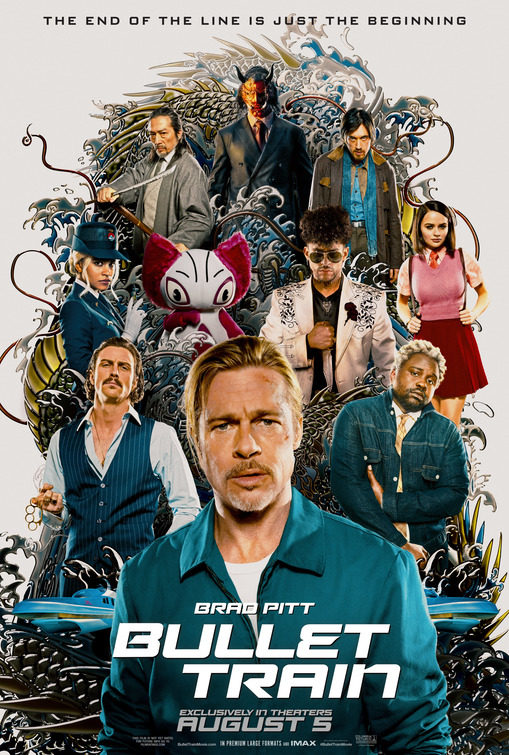
Bullet Train is a bumpy, albeit occasionally fun, ride

Imagine you're eating a meal that, while it's sliding down your throat, tastes really good. It doesn't reinvent the wheel, but it hits the right notes as your taste buds first get a hold of it. But in the back of your brain, something's off. There's a teeny tiny voice in your head saying "the flavor's off, the texture's weak." As the minutes pass, and the dish becomes more and more of a memory, those imperfections become increasingly sizeable in your mind. You don't hate what you just ate, but it's not quite as good as when you were chowing down on it. That's what Bullet Train is. There's enough razzle-dazzle and movement on-screen while it's playing to keep you reasonably satisfied. However, once I left the theater, I found myself fixating on how it could've been better rather than focusing on my favorite funny lines.

There are a lot of diverging plotlines in Bullet Train, but our lead character is Ladybug (Brad Pitt), an assassin that's been looking to put more peace out into the world. That's why he didn't bring a gun for his newest assignment, a snatch-and-grab mission revolving around a briefcase aboard a bullet train in Japan. The case belongs to a pair of British assassins, Tangerine (Aaron Taylor-Johnson) and Lemon (Brian Tyree Henry), who has a deal to finish up with the extremely dangerous gangster The White Death. Simultaneously, Yuichi Kimura (Andrew Koji) hops on to this train to take out The Prince (Joey King), who claims responsibility for pushing this man's adolescent son off a building. Turns out, though, that The Prince has her own scheme that she'll need Kimura for. 

All these storylines begin to gradually collide, sometimes amusingly, sometimes dangerously. As Ladybug deals with one new assassin after another, one thing becomes clear: this train is bad news. Oh, and that things are gonna only get worse as the train gets closer and closer to the end of the line.

In only his second screenplay credit, screenwriter Zak Olkewicz executes Bullet Train, an adaptation of a novel by Kōtarō Isaka, with an eye toward mimicking a lot of different styles. The gangsters with heavy British accents who can't stop chatting and engaging in non-linear digressions immediately evokes the works of Guy Ritchie. Meanwhile, lots of the wry dialogue evokes the style of comedy from Deadpool 2 (among other contemporary superhero movies), which shares director David Leitch with Bullet Train. Obviously, it's never inherently bad to make something that owes a debt to older pieces of cinema. Every movie is working in the shadow of older features, you can never divorce the medium's present from its past.

But Bullet Train would be better if its swirling storm of influences resulted in a mega-entertaining standalone film rather than something that constantly reminds you of other motion pictures. Part of the problem is that it's never quite as dangerous or innovative as it needs to be. Bullet Train thinks of itself as wildly unpredictable, yet the plot ends up resorting to dead wives to motivate characters so often that I half-expected this to culminate in a big final gag involving Christopher Nolan. The two big celebrity cameos have been done better with the same actors elsewhere, the barrage of needle drops (particularly a climactic use of "Holding Out for a Hero") aren't especially imaginative, while several gags (like a moment where Ladybug comments on how "weeeeeiiiirrrd" Japanese toilets are) feel about as stale as milk left out in the sun. The self-aware comedy and atmosphere of Bullet Train suggest something that's too hip to be predictable. Unfortunately, Olkewicz's script indulges in too many trite elements to be truly subversive.

The screenplay also runs way too long at 127 minutes, a tighter 80-minute edit would've made the familiarity of the proceedings significantly more forgivable. It also has to be said that, yes, Bullet Train does not do right by its Japanese characters, reducing three of its four most notable depictions of people from Japan to a mean conductor, a car attendant who has maybe two lines, and poor Andrew Koji being held for ransom. This is already a disappointing choice on its face, but it's especially weird since Kimura and his father, The Elder (Hiroyuki Sanada), feel like they should be the leads of the movie. They're the characters with the most emotional stakes in the plot, most rooted in the central backdrop, and both Koji and Sanada are enormously charismatic. Bullet Train isn't a mixed bag because it isn't that alternate movie, but it's rarely a good sign when a summer blockbuster has you thinking about alternate cuts that could've been superior.

Despite all these complaints, Bullet Train, believe it or not, still registered as a perfectly fine distraction for me, at least in the theater. The movie does what it says on the tin in terms of putting a lot of big-name actors playing people with violent tendencies into one cramped train and it often works decently in that regard. The film especially works well when it dials back the dialogue and relies on physicality and visual humor to carry the day. A skirmish between Ladybug and Lemon in a quiet car has some fun sight gags, for instance, while a character's comically accidental death by way of a briefcase is dark but highly amusing. The R-rating also allows for some enjoyably over-the-top demise, with our hero's lack of a gun meaning they have to come from much more creative places than just a bullet to the head. My personal favorite? One goon that just gets pulverized while trying to attack one of the heroes on the roof of the train.

The actors deserve much of the credit for making this material largely diverting, especially since director David Leitch doesn't bring his eye for incredible fight choreography like he did on John Wick and Atomic Blonde. Brad Pitt sometimes struck me as a bit miscast, but his extensive experience playing chilled dudes serves him well in someone trying to find inner peace among a steadily growing pile of corpses. Brian Tyree Henry stands out as the best of the ensemble cast, though, as Lemon, which shouldn't be a surprise given that Henry has managed to deliver the best performances in everything from If Beale Street Could Talk to Spider-Man: Into the Spider-Verse. He's a lot of fun on his own, but Henry also excels in his scenes with Aaron Taylor-Johnson (hey, he's a lot of fun here too, good for him). The duo has an entertaining rapport that manages to work even when the script's dialogue beats Lemon's initially humorous fixation on Thomas the Tank Engine to death. 

Bullet Train has its charms and serves as a good acting showcase for the likes of Brian Tyree Henry and Hiroyuki Sanada. As something to watch in August that'll get you out of the heat for two hours, you could do worse. Unfortunately, it's also a heavily derivative exercise, one whose gags and action beats feel too familiar to be as shocking as they should be. With so much talent assembled, you'd think there would be more creative sparks flying. I can't say I didn't have a decent time while I was in the theater with Bullet Train, but it's also not a ride I'll remember long into the future.

Bodies Bodies Bodies isn't a perfect horror/comedy, but it is a fun one


Some of my favorite Far Side comics involve drawings of two places or organizations that should never be next to each other (like individual gatherings of falcons and poodles) with the caption "trouble brewing". The horror comedy Bodies Bodies Bodies evokes these wonderful comics by immediately tossing viewers into a social situation that's clearly just a powder keg ready to go off. Sophie (Amandla Stenberg) has brought her girlfriend Bee (Maria Bakalova) to meet her longtime friends, including Jordan (Myha'la Herrold) and Alice (Rachel Sennott), at a massive house owned by the dad of the obnoxious David (Peter Davidson). Though everyone greets Sophie with open arms, there's hostility brewing under the surface. Lots and lots of hostility.

As everyone reunites, a hurricane hits the area that forces everyone to get inside. Once there, lines of cocaine get snorted, subtle microaggressions get thrown toward newcomer Bee, and everyone starts playing Bodies Bodies Bodies. This variation on a traditional party game where somebody's secretly a killer and everyone has to figure out who eventually culminates in somebody winding up murdered. There's a killer on the loose. All those hostilities won't stay capped for long under all this pressure. Like Gary Larson once said..."trouble brewing."

Whoever did the sound design of Bodies Bodies Bodies deserves some kind of medal. Once the power goes out in this house, there's no A/C or other electronics to make noises on the soundtrack. All we hear is the jangling of bracelets and beads on people's bodies or feet crunching against the mud. Sarah DeLappe's screenplay begins with a bunch of rich twenty-somethings partying up in a lavish environment seemingly detached from anything resembling reality. This grimy sound work emphasizing everyday noises effectively brings the Bodies Bodies Bodies characters back to reality. There's no escape from all this natural hubbub clanging against the deafening emptiness around him.

That's one of the more interesting ways elements related to class manifest in director Halina Reijn's filmmaking. It's a good way to remind viewers of this detail, especially since the sociopolitical commentary of Bodies Bodies Bodies sometimes gets lost in its script. If there's a primary complaint to be had with this movie, it's that its second and third acts lose track of seemingly important characters and thematic details. While an ensemble movie like this one will always be shifting around in the perspectives it chronicles, I did find myself yearning for more time exploring Sophie's point-of-view, for instance, smack dab in the middle of the story. Meanwhile, the commentary on class and exorbitant wealth has only a sporadic presence in the story, committing to these details more could've given the proceedings extra bite.

Still, overall, Bodies Bodies Bodies does entertain one for 90 minutes and that means a lot when it comes to this kind of movie. Part of the consistent entertainment comes from nearly everybody on-screen being just...so irredeemably bad. Almost no tragic backstories are here to justify why people act like as do, they're just messy and often cruel people. Turns out, there's a lot of fun dark comedy to be wrung about these kinds of individuals navigating an Agatha Christie mystery for the TikTok age. Plus, both DeLappe and Reijn do a good job of making these characters feel and sound like modern-day Generation Z kids without it coming off as grating or straining to be relevant. In other words, they never fall into the "How do you do, fellow kids?" trap.

It doesn't hurt that Bodies Bodies Bodies serves as a solid showcase for the acting talents of its various leads. The standout of the bunch is handily Rachel Sennott, whose the Roman Roy of the group in how she's a chatterbox that always just goes along with the group consensus rather than take the trouble of boldly establishing her ideas. It's an immensely amusing persona that Sennott delivers with comedic franticness that's worlds away from her lead role in Shiva Baby. What a transformative performer! Maria Bakalova also does strong work as something resembling an audience point-of-view character in all this neon-colored mayhem while Pete Davidson is getting better and better as an actor with each new film he appears in. 

Cinematographer Jasper Wolf's imagination got fired up in thinking up ways to frame all these assorted performers as they navigate a massive house for a killer once the lights go out. Flashlights from cell phones provide the majority of our lighting in Bodies Bodies Bodies, but, impressively, the frame is never incoherently darkened, we always see what we need to see. It's a fine line to walk, balancing rampant darkness with visual coherency, but Bodies Bodies Bodies manages to deliver. It's one of several aspects of the movie that's unique and fun enough to make Bodies Bodies Bodies worth a watch. The script is overstuffed and slasher movie devotees will be able to see some of the twists and turns coming, but there's enough entertaining chaotic mayhem here to deliver a good time. In other words, let the Bodies Bodies Bodies hit the floor.

Wednesday, August 3, 2022

Prey delivers the first true hit among the Predator sequel


Samuel Johnson once said that "when a man knows he is to be hanged in a fortnight, it concentrates his mind wonderfully." Similarly, when a movie franchise hits rock bottom in terms of quality, that tends to be when the creative juices get flowing. If you wanna save this series of films, you can't just produce another sequel. It's time to "contrate [your] mind wonderfully" on doing something different. Die Another Day gave way to a rebirth of James Bond with Casino Royale, while the tedious Fast & Furious was followed up by the exhilarating Fast Five

Following in this tradition is Prey, a new installment of the Predator series directed by Dan Trachtenberg. After 2018's dreadful The Predator, extreme measures would need to be taken if this saga was going to live on. Thankfully, Prey is just the shot in the arm this franchise needed. Some bold wings have been taken here and they've managed to pay off swimmingly. 

Set against the backdrop of 1719, Prey follows Naru (Amber Midthunder), who lives in a Comanche Nation and is desperate to prove herself a glorious hunter. Her brother, Taabe (Dakota Beavers), is her tribe's boldest warrior and casts a large shadow that Naru just can't escape from. She and her people are regularly fighting a bevy of dangerous critters, such as bobcats and bears. But Naru soon has to contend with a whole new kind of adversary in the form of the Predator. This alien has all kinds of unbelievable abilities and seems unstoppable. Naru is about to become this cosmic beast's newest trophy...or she might have a chance to prove her worthiness in combat once and for all.

Prey's screenplay by Patrick Aison is a clever creation that, whether intentionally or not, ends up taking some very broad but also smart cues from its directors last film, 10 Cloverfield Lane. Both of these projects are compact stories told with only a handful of cast members. They also share the willingness to eschew easy ham-fisted references to their respective predecessors in favor of making exciting standalone narratives. Prey doesn't waste time in trying to connect this story to the ones seen in Predator 2 or The Predator. It hits the ground running and proceeds to focus on delivering excitement, not fan service. Fans of earlier Predator movies need not fret, the titular alien still rips out spines and slices off heads, you'll get the carnage you want from one of these movies. It's just that Prey doesn't believe the only way to deliver that mayhem is through a rigid remake of what came before it.

The fun of Prey doesn't just come from its willingness to deliver new kinds of characters or themes for this franchise. It also comes from Trachtenberg and company embracing more practical means of realizing this story. CGI is used throughout this grisly tale, but it's not the only way heightened action is executed. The Predator alien is a guy in an elaborate suit rather than a CG being added in post-production, while the vast majority of environments appear to be natural locations. Going this route with the backdrops lends an immediate tactility to the world Naru inhabits while it's also neat how the Predator works as a constrast to these landscapes. This otherworldly creature sticks out like a sore thumb against roaring rivers and large fields of grain, which feels just right in reinforcing what an intimidating aberration this organism is.

Cinematographer Jeff Cutter thrives with such lovely outdoor exteriors to work with while he and editor Claudia Castello are critical to making the action sequences as fun as they are. Hand-to-hand skirmishes are, thankfully, as crisply-realized as the wide shots of expansive mountainsides. You can see and appreciate all the violence both the Predator and Naru are capable of inflicting, which is especially great since Aison has come up with some wonderfully gnarly deaths for these characters to dish out. Any R-rated action movie wins a lot of points from me if the demises are creative and Prey delivers some messy and fun ways for supporting characters to go.

Thankfully, in the middle of all the carnage, the character beats don't get lost in the shuffle. Possibly the highest compliment I can afford Prey is the dialogue-heavy scenes fleshing out Naru's personal conflicts don't feel like killing time until the next massacre from the Predator, Naru's an interesting character made all the more compelling by a fantastic lead performance from Amber Midthunder. Some of the dialogue and character dynamics at the forefront of the first act are some of the more predictable elements of Aison's script, to be sure. But by and large, Prey's attempts at making you care about the humans work just fine for this sort of genre exercise. We have enough characterization to ensure the fight scenes aren't hollow, while the movie also recognizes that too much chit-chat would disrupt the pace of the feature. Prey mostly gets that balance right.

Aside from a couple of quibbles (like some nighttime scenes being too dimly lit), the biggest complaint I have with Prey is that it's not going to movie theaters. How did The Predator get a substantial theatrical release but this vastly superior installment in the Predator saga has to settle for a Hulu bow? Who even goes to Hulu for movies anyway? Disney's botching of 20th Century Fox releases never ceases to be astonishingly misguided. But even if we all have to settle for exclusively watching it on our TVs, Prey is still a terrific action movie and much more engaging than it has any right to be. Following in the footsteps of other sequels that saved a franchise like Thor: Ragnarok and X-Men: First Class, Prey has come around to restore luster to the Predator saga just when this series needed it.

Friday, July 29, 2022

Thirteen Lives is tedious rather than inspirational


When making a movie based on a real-life event, it's important to ask what you hope to accomplish in this project. You don't have to change filmmaking forever with your efforts. However, it's important to ask what you'll accomplish that people couldn't get from a documentary or a book on your subject. This can even be something as simple as being an entertaining standalone watch, that's a perfectly reasonable reason to make a film. Many movies based on historical events, like Selma, Lincoln, or The Insider, manage to offer something unique in exploring the past. Thirteen Lives, a new Ron Howard directorial effort chronicling the 2018 Thai cave rescue mission, is, unfortunately, unable to do anything especially compelling with the harrowing material it's covering.

At the end of June 2018, 13 young boys and their football coach got trapped in the Tham Luang cave. With a monsoon arriving to flood the cave, any rescue mission to save the youngsters would be an incredibly dangerous exercise. Retrieving them will require the skills of some of the greatest deep sea cave divers in the world. This is where Richard Stanton (Viggo Mortensen) and John Volanthen (Colin Farrell) come into play. Hired by the governor to retrieve the adolescent captives, the impossible mission gets more and more preposterous every day. It's only in recruiting the aid of diver/anesthetist Richard Harris (Joel Edgerton) that a new, insane plan begins to emerge, one that may just have a shot at saving these kids.

When I say this plan is insane, that's no understatement. The eventual mission to get the kids out is to put them to sleep with anesthesia and then, to help keep them alive while underwater, jab them with tiny doses of ketamine on their journey to the entrance of the cave. On paper, it sounds ludicrous, the kind of plan that would never pass the second draft of a fictional film. Its preposterousness makes the constantly buttoned-up nature of Thirteen Lives infinitely more perplexing. Nobody is saying a narrative film recreation of the Thai cave rescue mission should have the maximalist wackiness of a Daniels movie. However, surely there was a way to juggle respect for the severity of the operation with some kind of pulse?

Whereas the vastly superior 2021 documentary The Rescue (which covered this same topic but with interviews with the actual participants of the rescue mission) eaned into the propulsive unpredictability of this entire scenario, Thirteen Lives is dead set on being as super serious as possible. This isn't so much channeling the vibes of Tony Scott or even the most intense scenes of Howard's Rush than it is a John Lee Hancock movie. William Nicholson's screenplay is here to just recite the basic facts of the rescue mission and offers little extra insight into the proceedings that could make familiar events feel fresh again. Even worse, his screenplay's penchant for ham-fisted dialogue undercuts the supposed serious tone of the movie. A somber atmosphere could've rendered this a potentially contemplative exercise, a muted examination of an event drenched in sensationalist news coverage 

Unfortunately, Nicholson leaves little to the imagination in the clumsy dialogue, especially when it comes to the character of Stanton. His unintentionally comical "I don't even like kids" line in his first few minutes of screentime sets the tone for the kind of words he delivers throughout the film. There are many ways you could make a compelling movie about the Thai cave rescue, but I'm not sure reimagining one of the divers as Dr. Alan Grant from the first Jurassic Park is one of them. Nicholson's writing also struggles at juggling a large cast, with so many people just fading into the background. Potentially interesting figures and plotlines, like the detail that some of the trapped people not native citizens of this region of Thailand, gather dust in the corner. In aquatic terms, the script for Thirteen Lives is vast in its size on the surface but is only a few inches deep.

Thirteen Lives also fails to make a case for its existence on a visual level too. Scenes of our divers making their way from one cave avoid some visual effects pitfalls (they don't immediately look like they're shot on a green screen, thank goodness), but unfortunately, the underwater segments just aren't visually striking. Once you've seen one murky underwater cavern, you've seen them all, but Thirteen Lives lingers on every step of the divers and their journey, making the repetitive nature of the imagery extra apparent. Here and throughout Thirteen Lives, director Ron Howard and cinematographer Sayombhu Mukdeeprom struggle to convey any sense of urgency or tangible humanity in the imagery flickering on-screen. I was especially struck by how any scenes that depicted profound emotions of the parents of the captive kids, whether it be crying or cheering, had a sense of detachment to them. The camera is awkwardly kept at a distance here as if there were concerns that getting too close to such pronounced emotions would rob the production of its pathos.

Recurring visual problems underscore the creative struggles of Thirteen Lives. The feature isn't devoid of merits, with Farrell and Edgerton doing especially well in their respective performances. But the word "tedious" should not be coming to my mind so often when I'm watching something that's supposed to be propulsive and ultimately cheer-worthy. Worse, by the end of the film, it becomes apparent that Thirteen Lives has nothing to say about this incredible rescue mission beyond acknowledging that it happened and the two people who perished because of it. Even if the superior documentary The Rescue didn't cover this subject already, Thirteen Lives would still be a humdrum example of how to turn a historical event into a narrative feature.

Wednesday, July 27, 2022

DC League of Super-Pets isn't super, but it is frequently amusing

The big screen adaptations of DC Comics properties have garnered a reputation for being too serious, sometimes for good reason. But in the last few years, the DC films have pushed back against that perception not only with lighter live-action fare (like Shazam! or The Suicide Squad) but also through animated kid's movies. These youth-skewing features, such as The LEGO Batman Movie or Teen Titans Go! To The Movies, haven't been afraid to be either silly or explore the most obscure corners of the DC mythology. DC League of Super-Pets is the latest reinterpretation of the world of Superman and Batman for the kids these days. The gimmick this time is that the story is told through the eyes of a bunch of super-powered pets, many of whom have been around in the comics for decades.

Everyone needs a cuddly pet, even Superman (John Krasinski), who has canine Krypto (Dwayne Johnson) as his loyal pal. In fact, he may be too loyal. Krypto can't imagine being anything but the only person that matters in Superman's life, even as this superhero prepares to pop the question to Lois Lane (Olivia Wilde). This dog's life is already ruff, er, rough, grappling with this change in his domestic life, not to mention his inability to socially interact with other pooches. 

Things get even more precarious once an evil plan by Lex Luthor (Marc Maron) ends up endowing superpowers on the vengeful guinea pig Lulu (Kate McKinnon). She proceeds to defeat and imprison the Justice League, leaving the fate of humanity in the hands of Krypto. To quote the poster for Justice League, though, "you can't save the world alone." Krypto will need to rely on the help of a gaggle of shelter pets who've just been given superpowers, including the Boxer Ace (Kevin Hart), pig PB (Vanessa Bayer), red squirrel Chip (Diego Luna), and elderly turtle Merton (Natasha Lyonne).

Though they couldn't be farther apart in terms of the audiences they're aiming at, DC League of Super-Pets happily reminded me of the excellent new Harley Quinn TV show in terms of its style of humor. Much like that (undeniably vastly superior) small-screen program, Super-Pets is here to deliver a comical vision of the DC universe, but also one infused with an apparent love for the material it's skewering. Just look at an exciting early set piece of the Justice League working together to foil Luthor, which radiates with infectious enthusiasm rather than contempt for the characters on-screen. One gets the sense that screenwriters Jared Stern and John Whittington (the former artist also directs) had been waiting years for somebody to deliver a movie where Green Lantern and Wonder Woman fought side-by-side and are now relishing the opportunity to deliver such imagery. 

Stern and Whittington's writing isn't just good for delivering the kind of Justice League action two separate live-action movies couldn't quite conjure up. Their sense of humor also proves entertaining more often than not since, thanks to them leaning into the inherent preposterousness of the DC universe, it tends to skew towards the ridiculous. Cats can hack up hairballs that are actually functioning grenades, while Krypto daydreams about tossing Lane into the farthest reaches of the ocean. The best of these gags is anything revolving around the elderly and absurd Merton. Lyonne opts to voice the critter like the turtle version of Abraham Simpson (all the character's missing is an onion on her belt). Her non-sequiturs and various asides are often hysterical, especially a running gag where Merton is flirting with a series of hard hats. 

Of course, just as Superman has Kryptonite and Green Lantern has the color yellow, the fatal weakness of DC League of Super-Pets is being derivative of other animated kid's movies. The worst offender of the film leaning onto other features come in the third act when a key character's backstory gets revolved in a flashback sequence that may as well have the words "WHEN SHE LOVED ME" flashing in bright red letters on-screen. Meanwhile, a key part of Krypto's character arc feels entirely lifted from The LEGO Batman Movie, the personal struggles of each of the shelter pets have been seen in countless other movies, pets while the presence of an army of superpowered destructive guinea pigs echoes this year's The Bad Guys. DC League of Super-Pets is an amusing diversion, but it could've been as hysterical and memorable as Teen Titans Go! To The Movies if it had been willing to be less familiar.

It also wouldn't have hurt if the feature's computer animation was better. DC League of Super-Pets was animated by Animal Logic, an animation house that Warner Bros. has regularly utilized for nearly two decades. Their past fully-animated projects have included Happy Feet, Legend of the Guardians: The Owls of Ga'Hoole, and the LEGO movies, all of which involve either realistic-looking characters or textures. They're way less experienced with stylized material, and it, unfortunately, shows in Super-Pets. Human characters like Batman and Superman, with their wonky designs, never look quite right, while textures like water and fire register as feeling off. Measures taken to cut costs on the animation, namely making the streets of Metropolis often downright deserted, also prove distracting. While many of the animal characters look fine, they deserved an animation style worthy of being dubbed "super". 

If the folks behind DC League of Super-Pets had shown a willingness to deliver bolder animation or be less derivative of other animated movies, it still wouldn't have been as good as The LEGO Batman Movie. Still, it could've lived up to more of its potential. The final product struggles to carve out its own identity in many respects, including with a lead vocal turn from Dwayne Johnson that just sounds like Dwayne Johnson speaking into a microphone. 

Luckily, there are enough humorous gags, lively supporting performances, and infectious affection for DC Comics lore in League of Super-Pets to keep most adult audience members pleased. As Adam West showed decades ago, the world of DC superheroes is ripe for comedic reinterpretations and the best moments of this film reaffirm that potential. Plus, kids will doubtlessly go gaga for a movie that dares to combine The Secret Life of Pets with The Avengers. No doubt this will hit the sweet spot for enough of its target demo to spawn a sequel or two. I could imagine worse animated movies to inspire follow-ups. Certainly, none of the Sing installments, for instance, have as fun of a character as Merton. Maybe next time around Supergirl's horse Comet can join in on the fun.

Friday, July 22, 2022

Nope Spoiler Discussion Review


MASSIVE SPOILERS FOR NOPE FOLLOW

The Gray Man is more forgettable than anything else


If there's anything positive to say about The Gray Man, it's that directors Anthony and Joe Russo feel much more comfortable here as filmmakers than they did in their last directorial effort, Cherry. With a quartet of Marvel Cinematic Universe movies under their belt, The Russo Brothers are understandably a lot more at home handling a global action film like The Gray Man, an adaptation of Mark Greaney's novel of the same name, than whatever the hell Cherry was trying to be. But the same familiarity that seems to make the Russo's at ease as directors also makes it hard to get invested in The Gray Man as a movie. The whole thing struggles to emerge from the shadows of superior blockbusters it keeps evoking.

Court Gentry (Ryan Gosling) was once resigned to live out his lengthy prison sentence when CIA agent Donald Fitzroy (Billy Bob Thornton) came to him with a proposition. Gentry could become a mercenary for the CIA named Sierra Six, a job that would allow this prisoner to put his experience with violence to good use. Cut to two decades later and Gentry has become one of the best and most efficient assets in the CIA. During a seemingly routine mission, Gentry realizes other members of the Sierra program are getting killed off and that he can't trust his superiors. Armed with an important flash drive, Gentry is now a man on the run. The sociopathic Lloyd Hansen (Chris Evans) is sent to kill Sierra Six in a chase that will span the globe and eventually involve Fitzroy's granddaughter, Claire (Julia Butters).

Throughout The Gray Man, I was just as rarely bored with what I was watching as I was engaged. There's little to repel you in this feature, but there's also little that'll sink its claws into you and never let go. I kept waiting for an extra flourish, a really ludicrous plot twist or a distinctive trait in the performances, to take things from simulating the idea of entertainment to being entertaining. No such luck. There are certainly worse movies out there and there's no denying that The Gray Man is largely competent on a technical level. But there's not much of a soul here. Instead, the crux of The Gray Man is borrowed from a barrage of other movies, whether it's having a bad-ass assassin lead character with a soft spot for a child or a bunch of generic CIA goons ripped straight out of a Bourne installment.

The whole movie would've been better off with just a dash more fun or steaminess. The Gray Man operates in a harsh world, one where the enjoyably ludicrous parts of the spy genre, not to mention any semblance of romance, have been stripped away. Everybody's brooding, including the audience! The result is a movie that's got gunfire to spare, but little humanity or zest. It can't even commit fully to its darker qualities thanks to a PG-13 rating that ensures, among other shortcomings, audiences can't get the kind of exciting death scenes that automatically made movies like Dead Calm or Deep Blue Sea enjoyable rides. It's baffling to imagine why a streaming movie isn't just rated R, anyway. You don't have to worry about alienating teen moviegoers on Netflix, anyone can watch it, and they won't get carded by movie theater employees. Just go for the more brutal rating so The Gray Man could occasionally get spiced up with some gnarly deaths.

But even a couple of head explosions wouldn't have helped the awkward narrative structure of The Gray Man, which is especially confounding in its saggy second act where a pair of abrupt flashback sequences derail any plot momentum. Even worse than all of that, though, is how The Gray Man utterly wastes leading man Ryan Gosling. Gosling is an actor with a wide sense of range who can do goofy physical comedy in The Nice Guys one minute before doing a restrained portrait of torment in First Man. Unfortunately, The Gray Man doesn't give him much of anything to work with. Gentry's a blank slate of a character and Gosling is never given any opportunities to fill in the blank spaces with a vibrant personality. The character's recurring quips even feel like a poor use of Gosling's skills as a comedic performer.

Most of the cast members of The Gray Man are on this kind of autopilot, though Dhanush does deliver a charismatic supporting turn while main baddie actor Chris Evans seems to be having a ball channeling John Lithgow in Cliffhanger in portraying a dastardly foe to the core (though he sometimes feels like he's in the wrong movie). Mostly, though, these forgettable performances encapsulate the similarly disposable nature of The Gray Man. Henry Jackman's generic score and a collection of mostly forgettable foreign locales similarly ensure that this expansive blockbuster won't linger in your mind for long. There are enough explosions and instances of decent fight choreography (the latter detail undercut by some terrible editing) to likely make some action fans pleased in the moment while watching The Gray Man, but even they'll be wishing the movie had tried for something more compelling by the time the credits begin rolling.


Wednesday, July 20, 2022

Go ahead and say "yep" to Jordan Peele's newest winner, Nope


There will come a day when writer/director Jordan Peele helms a dud. It's bound to happen. Every filmmaker has a movie that just doesn't work. Steven Spielberg has Indiana Jones and the Temple of Doom. David Fincher has The Curious Case of Benjamin Button. Gore Verbinski's got The Lone Ranger. Direct enough movies, one' s bound to not click. The director of Get Out and Us will doubtlessly helm such a production in the future. Thankfully, his third directorial effort, Nope, is not that feature. Instead, it's another affirmation of Peele's gifts as a filmmaker and a signal that he can expand his scope as a storyteller without sacrificing substance for scale.

OJ Haywood (Daniel Kaluuya) runs a ranch for horses, which are used in various entertainment properties (ranging from commercials to The Scorpion King). This domicile has belonged to his family for years, but after the sudden death of his father, who supposedly died after getting hit with debris from an airplane, getting reminded of the past feels more like a burden than a gift to OJ. Feeling adrift, some direction comes into his life when, whilst tending to his horses one night, OJ spies...something moving in the sky. His sister, Emerald (Keke Palmer), happily jumps into OJ's plan to film whatever's out there. This could be it, a chance to solve their money problems and maybe get some answers about what thing killed their father.

By Monday morning, I'm sure there'll be dozens of essays floating around about the various underlying meanings of Nope. I'm probably a few tools shy of a full toolbox to get everything Peele's going for here, but one notable theme of the movie that did stick out to me was the kind of entertainment figures it focuses on. The famous movie stars or filmmakers of many features about Hollywood are largely absent here. Our characters are largely below-the-line workers, like cinematographer Antlers Holst (Michael Wincott), or figures on the fringe of notoriety, like child-star-turned-theme-park-owner Ricky "Jupe" Park (Steven Yeun). 

These are more relatable grunts just trying to earn a day's living, much like the majority of the people who're going to see this movie (or even yours truly!). This makes them the perfect underdog figures to contrast with something much larger-than-life hovering in the clouds. Their references to and engagement with pop culture are also fun and reflect how they're a bit more at the bottom wrung of the entertainment industry totem pole. Rather than name-dropping the biggest movies of 2019 and 2020, characters bemoan "a pilot for The CW" while a poster on Park's wall is a homage to Holes. These clever details reinforce the lack of mega-star wattage that the characters of Nope engage with and they also give a specific identity to the movie's relationship to the broader world of entertainment. Where else this year will you find a blockbuster that has a character waxing poetic on the virtues of Chris Kattan?

The fact that you can unpack that much simply from the kinds of movies and TV shows Nope name-drops is a testament to how layered this motion picture is. There's a similar level of profound detail in the visuals, which are brought to life through cinematography by Hoyte van Hoytema. It shouldn't be a shock that a film combining the might of Peele and van Hoytema with IMAX cameras is going to look great, but it's still tremendous to watch the beauty of Nope's images unfold. There's a fun sense of theatricality to the film's depiction of a possible UFO lurking in the shadows that harken back to how the dinosaurs were portrayed in Jurassic Park or the depiction of the shark in Jaws. You see a little bit of it here, a little bit of it over there, all building up suspense and making you question what you did see. 

It's an exquisite mixture of thoughtful filmmaking and pure unfiltered fun. There's an outright cheeky quality to some of the visuals that wring as many whispers of "no no no" from viewers as possible. That's the kind of controlled camerawork that informs so much of the entertainment in the delightfully squirm-inducing suspense sequences of Nope, the best of which will ensure you won't go into a barn or look at a cloud the same way ever again. Come to think of it, the underlying rascally tone of such moments is a key reason why Nope can alternate between horror and comedy so gracefully. The two genres have often been unexpected but welcome bedfellows throughout cinema history and they make a fine pairing here. The jokes in Peele's script are quite funny, but they also feel like an organic companion to the vibes of certain scary scenes. Turns out, you can have your cake and eat it too, or in this case, have jokes and also be intense enough to make audiences member dig their nails into the armrests of their seats.

Nope's assorted performances are just as well-realized as its sublime tone, with Daniel Kaluuya delivering especially terrific work as OJ. Here's to hoping Kaluuya becomes the Toshiro Mifune to Peele's Akira Kurosawa, as the duo just seem to bring out the best in one another. In the other lead role, Keke Palmer is endlessly compelling as Emerald, she just exudes such effortless confidence from the moment she walks on-screen, while we should all be hailing the welcome return of character actor Michael Wincott in his first credited acting role in seven years. Just listening to him talk in that wonderfully gravelly voice is great, but his physical presence is also fantastic. Steven Yeun, though, especially stands out in his supporting role as Park. Yeun's natural charisma works as such an interesting contrast with this man's internal life and helps inform one of Nope's most fascinating players. 

There's lots to love about Nope, which thoroughly delivers both brains and entertainment. But what draws me to it is how much it defies traditional Hollywood logic. They say IMAX cameras are merely for movies that cost $250 million and span multiple continents, yet here they are effectively used on something with a much more intimate storytelling scale. They say combining Westerns and science-fiction is a fool's errand, but here Peele mixes the two genres to incredible effect. A movie that critiques spectacle shouldn't also dazzle the eyeballs, but Nope does just that. One could even say the storytelling structure, which often bounces between perspectives and briefly shifts across time, should be convoluted, yet it's pulled off here with grace. Like so many other enjoyable movies, Nope looks at what logically shouldn't work and runs in that direction. So long as he keeps following those sorts of creative instincts, maybe Peele won't be delivering that directorial effort dud anytime soon.

Click here for Douglas Laman's spoiler discussion of Nope.

Sunday, July 17, 2022

Mrs. Harris Goes to Paris is an agreeably pleasant trip


Based on the novel of the same name by Paul Gallico, Mrs. Harris Goes to Paris is such a gentle movie that it makes something like Downton Abbey look like a Takashi Miike movie. That's not a bad thing (certainly Paris is better overall than both of the Abbey films), but it's good to know what you're getting into with this movie. It's a soothing feature designed from the ground up to not offend grandparents, right down to it garnering a PG rating. Again, this is not a criticism, since Mrs. Harris Goes to Paris, despite being too fluffy for its own good, is an agreeable enterprise that gets a lot of mileage out of its lead performer. 

Mrs. Harris (Lesley Manville) has spent decades working as a cleaning lady in London. She's saved every pound and shilling, all without ever clinging to any dream bigger than hoping that maybe her husband, who went missing fighting in World War II, may still come home. After an encounter with a Christian Dior dress at one of her client's houses, though, Mrs. Harris has a new ambition. She's going to Paris, France to get the snazziest dress imaginable. The wall-to-wall elegance of the Christian, Dior headquarters is initially anything but welcoming to Mrs. Harris, particularly powerful employee Claudine Colbert (Isabelle Huppert). But this spunky and encouraging soul is not one to give up easily on anything, least of all her dreams.

Mrs. Harris Goes to Paris kept reminding me of Paddington. How could it not? They're both sweet yarns about British-accented people with hearts of gold struggling to fit in while exploring a new culture. Paris can't even hope to hit the heights of quality reached by the two Paddington features, but there are worse movies to evoke. The constant kindness present in Mrs. Harris's spirit proves to be an endearing enough quality to hang her French escapades on, especially since the screenplay (credited to director Anthony Fabian as well as Carroll Cartwright, Keith Thompson, and Olivia Hetreed) makes it clear there is no ulterior motive fueling all these acts of emotional generosity. Harris behaves like this because that's just who Harris is.

Such a personality is brought to life through Lesley Manville, who's really the reason to see Mrs. Harris Goes to Paris. A fixture of Mike Leigh movies and having earned an Oscar nomination for going toe-to-toe with Daniel Day-Lewis in Phantom Thread, Manville adds another superb film acting credit to her resume here. Much like with Denzel Washington in The Preacher's Wife, Manville injects substantive pathos into a script that could've lapsed into an avalanche of treacly sentiment. Mrs. Harris isn't a caricature in this woman's hands. Instead, she conveys realistic flourishes in her body language and dialogue deliveries. The result is a compelling performance that ensures Mrs. Harris feels about as real as somebody sitting next to you in the theater.

Other aspects of Mrs. Harris Goes to Paris, though, never quite reach the heights of Manville's central performance. Fabian's direction, for one thing, isn't terribly imaginative. The closest thing to super memorable camerawork here is the use of double dolly shots whenever Mrs. Harris is getting especially enamored with a dress. Aside from that, the streets of Paris, France in the 1950s have somehow failed to inspire much visual bombast in this filmmaker's eyes. The script could've also stood to inject extra doses of personality into key supporting characters like noble but bland numbers guy Andre Fauvel (Lucas Bravo). The moving moments of Mrs. Harris Goes to Paris work more often than they don't. However, these moments would be extra poignant if the people Mrs, Harris encountered in Paris were as detailed and believable as the film's lead character. 

Throughout Mrs. Harris Goes to Paris, Mrs. Harris, as well as protesting garbagemen in a recurring subplot, challenges societal norms and expectations over where a cleaning lady from London belongs. The film she anchors, though, is less accustomed to subversion. There aren't many surprises in here to elevate the feature, but maybe that'll be just fine with the target audience for this motion picture. You still get to see lots of pretty dresses, experience your heartstrings getting tugged, and another killer Lesley Manville performance. Mrs. Harris Goes to Paris had the potential to be exceptional rather than just pleasant, but as Mrs. Harris herself is always proving, there's nothing wrong with a little bit of niceness.

Monday, July 11, 2022

Thor: Love and Thunder doesn't pack as mighty a wallop as Thor: Ragnarok


Sometimes, you just can't escape the shadow of your predecessors. Such is the problem facing Thor: Love and Thunder, which serves as writer/director Taika Waititi's much-anticipated follow-up to his 2017 film Thor: Ragnarok (this go-around, he wrote the script with Jennifer Kaytin Robinson). Ragnarok was so much fun, so tightly written, and so good at balancing the silly with more introspective material, it would always be difficult to follow that film up. Even if Love and Thunder weren't constantly reminding you of that superior movie, it would still have some noticeable shortcomings. Ironically, an issue of weightlessness keeps bringing this project down to Earth like an anchor. Thankfully, some of Waititi's greatest assets as a filmmaker are still here to make the proceedings largely enjoyable.

Picking up shortly after Avengers: Endgame, Thor (Chris Hemsworth) is struggling to find himself and specifically what his purpose should be now. At the same time, Thor's ex-lover Jane Foster (Natalie Portman) has come into possession of that mystical hammer Mjolnir. Wielding this weapon, she's now become The Mighty Thor, a formidable superhero in her own right. The two Thor's are gonna have to work together to stop Gorr the God Butcher (Christian Bale). He's using a fancy sword known as the Necromancer to slaughter every single God in existence. Grab your gear and the fierce warrior Valkyrie (Tessa Thompson), because it's time for another Thor adventure. 

Waititi thankfully maintains Ragnarok's love for unabashedly silly cosmic mayhem, with nary a desire in sight to ground things in reality or handwave away something as just being futuristic science. Shadow beasts hunt down children in the night, a big bug can wear clothes, and a big city that's home to many Gods (including Russell Crowe's Zeus) can have a bunch of peculiar-looking weirdoes that the camera treats as totally normal. The status quo in Love and Thunder is absurdism and it often conjures up memories of 1980s Jim Henson movies like The Dark Crystal or Labyrinth in its love for ridiculous fantasy storytelling. 

Much like The Dark Crystal, though, Love and Thunder is often more fun in pieces than as a whole. Part of this comes down to the characters not being as concretely-defined as they could be. Major pieces of information in the backstories of Thor and Jane are breezed past in flashbacks and montages suffocated in narration by Korg (Taika Waititi). That's especially problematic since Thor's starting issue (he has trouble letting other people in) doesn't align with what we've seen of him in prior Marvel Cinematic Universe movies. He's always been a gregarious soul, so it's weird that we're starting out with the premise of him being somebody who keeps people at arm's length. We're also only just now getting to know anything about Foster and information about her personal life would've made more of an impact if it could've had room to breathe. Thor: Love and Thunder knows what emotional and character beats it wants to hit, but its comedic impulses keep intruding on those ambitions. 

Waititi's script's love for the inexplicable is better suited to random comedic asides than in the more dramatic sequences. In the latter scenarios, it can often feel like the screenplay is just coming up with random new MacGuffin's or aspects of Marvel Comics cosmic lore to keep things moving rather than finding new entertaining places to take these characters. Just playing with the toys Love and Thunder establishes from the get-go rather than trying to find new shiny objects at every turn would've help the dramatic beats feel more organic. 

On the positive side, Waititi's exploration of the weightier concepts do land some emotionally potent moments, particularly anything that has to do with Christian Bale's ruthless Gorr. Despite Love and Thunder suffering from a sense of weightlessness, some of the introspective details related to figuring out what defines a good worthy life do hit the mark. Waititi's balance between the silly and the poignant isn't as strong as it was on Hunt for the Wilderpeople, but his willingness to let the Gorr-centric sequences of this film have a gravitas that isn't interrupted by gags ensures that there's still some emotional heft here.

Much of that heft comes from the performance of Bale, who lends a palpably fervent aura to Gorr's quest for slaughter. There's a cracked quality to Gorr, he just seems like someone whose very gait suggests he's somebody missing a critical part of his emotional capacity. A sequence that limits the scope just to Gorr antagonizing our three lead heroes is a highlight of the entire film while the practical makeup work used to realize this villain is spectacular-looking. Put simply, Bale's great here. Not being beholden to replicating the behaviors of someone from real life (like his Dick Cheney in Vice) allows Bale to remind viewers that he's just as good at conjuring up original performances wholesale as he is at mimicry. 

Save for the clumsy incorporation of CG sets and creatures (the Marvel Cinematic Universe visual effects pipeline strikes again), Thor: Love and Thunder largely looks as good as Gorr's makeup. The practical sets are a lot of fun, especially ones used to realize the lavish land Zeus and other Gods call home. Not only does Gorr get the best performance and tone of the whole movie, but he's also the center of the best-looking sequences of the entire feature, particularly a duel in his monochromatic world. Even with this standout black-and-white sequence, color is, thankfully, still in high supply for Waititi's vision of the cosmos and informs lots of the fun eye candy in Love and Thunder. 

Even if the gags are never quite as fresh as they are in Thor: Ragnarok (the jokes building off fan-favorite moments from Ragnarok especially feel lacking), Thor: Love and Thunder delivers plenty of jokes that still made me cackle. Chris Hemsworth is such fun playing a himbo, it's such a shame that it took so many movies for them to figure out that this is the best mold for the Marvel Cinematic Universe version of Thor to inhabit. With Hemsworth still a hoot, Thor: Love and Thunder manages to be quite funny, features an enjoyable villain, and it all looks like a million bucks. Unfortunately, it's also a disjointed venture, sometimes heavily so, that offers up too many callbacks to a superior predecessor and is too weightless to hit its lofty thematic ambitions. The shadow of Ragnarok looms large over Love and Thunder and this new installment is never strong enough as a standalone outing to escape it.

Saturday, July 9, 2022

Hallelujah: Leonard Cohen, A Journey, A Song shines in its most introspective moments


No piece of art solely belongs to the people who make it. When we look at and experience a painting, film, statue, or any other form of artistic expression, it also becomes a part of us in some way. This is especially true of music, which is devoid of a visual form and often features abstract lyrics or orchestral accompaniment that invites the listener to make their own interpretation of what they're digesting. It's why songs so often become more than just tunes on the radio. They become the soundtrack to a first date, a coping mechanism during a breakup, an anthem during a karaoke session you'll never forget. Even a chart-topping hit can feel like something that was designed for you and your circumstances.

Part of the focus of the documentary Hallelujah: Leonard Cohen, A Journey, A Song is on how the titular tune, "Hallelujah," has managed to resonate so deeply with so many different people. But that's not the only focus here, as directors Dan Geller and Dayna Goldfine use this film as an opportunity to explore a chronological look at Cohen's life. This portrait of this musician's existence allows for the greater context of "Hallelujah's" very existence to come to light, particularly how it was initially never given a proper release in the U.S. by Columbia Records. While we get to dive into the finer points of this man's career, the second half of Hallelujah then splinters into exploring the various covers of that famous song and how they extended the lifespan of what once looked like a piece of music headed for the trashbin of history.

The latter scenes of the film provide some of the most insightful parts of Hallelujah: Leonard Cohen, A Journey, A Song. That's not a slam on the archival interview segments we hear from Cohen or his backstory. It's just compelling to hear how musicians read into "Hallelujah" concepts or ideas that Cohen himself could never have imagined being a part of this tune. Brandi Carlile, for instance, observes in an interview how the song helped her come to terms with her queerness while the tragic passing of Jeff Buckley, who sang a famous cover of "Hallelujah," injected further unexpected layers of poignancy into a piece already rich with subtext.

Through these anecdotes and perspectives, we can see the full impact of "Hallelujah" as well as how even the most deeply personal works of art can end up resonating with other humans. There is a bit of tragedy too in the film's depiction of its ubiquity. Shrek director Vickey Jensen mentions in an interview that, so it could be featured in an animated title aimed at kids, she edited together a new version removing lyrics dealing with sexual material. That's not a bad idea when you want to use this song in a PG-film, but Jensen goes on to note that that's the default version that's been performed by other people since then. Shrek gave "Hallelujah" a gargantuan amount of notoriety, but it also came at the cost of removing some of its most challenging and vulnerable passages. With this development, everybody knows Cohen's song, but they don't know the most revealing parts of Cohen's lyrics.

Exploring the benefits and drawbacks of "Halleluljah" becoming such an iconic track is where Hallelujah: Leonard Cohen, A Journey, A Song really thrives. The talking head interview segments and sequences dedicated to chronicling the backstory of Cohen are serviceable, but boilerplate for a music documentary like this. Cohen was always pushing the boundaries in his work with that gravelly but also the weighty voice of his. This makes it a shame that a movie dedicated to his work isn't quite as groundbreaking in its form and presentation as its central subject. Geller and Goldfine still execute these parts of the production with competency and do include a wide range of interview subjects, including the bewildering presence of country music superstar Eric Church.

Most thoughtful of all in their filmmaking is the smart decision to not linger on the death of Cohen. The films end with on-screen text referencing his passing in 2016, but Hallelujah: Leonard Cohen, A Journey, A Song isn't built around the climactic reveal that he's died. This is a film largely about how songs and the musicians who write them can live on and on forever. As long as people are performing "Hallelujah" on TV singing competition shows, Cohen, in some small way, won't really be gone. Even more importantly, the impact this song had on people, made evident all throughout this documentary, ensures that the legacy of Cohen will be an eternal one. No piece of art solely belongs to the person who makes it and "Hallelujah" owes every shred of its popularity to that truth.

Thursday, July 7, 2022

The Black Phone calls up some solid entertainment


Adapted from a short story by Joe Hill, The Black Phone spends much of its first act establishing a bleak world for adolescent sibling protaganists Finney (Mason Thomas) and Gwen (Madeleine McGraw) to inhabit. This is made especially apparent in one of the most quietly tragic scenes of the whole movie, where Finney joins his sister in watching TV right after Gwen has been beaten by their father. What's flickering on the Idiot Box? An episode of Davy & Goliath. This stop-motion Christian show spoonfeeds Finney, Gwen, and countless other kids hamfisted easy morals that don't apply in a world where parents can abuse their kids without consequence or where violent bullies lurk around every corner. 

The Black Phone is emphasizing that these youngsters are growing up in a world of abuse that doesn't even offer them tools to normalize their experiences. Just TV shows that instill in them the message of complying with authority, that present a warped sanitized vision of reality.

It's a bleak start for what ends up being a relatively tame (by R-rated horror standards) scary feature, but it does provide a fine groundwork for what's to come. The ensuing story sees Finney getting kidnapped by The Grabber (Ethan Hawke), a notorious local figure who has been kidnapping kids for a long time. Waking up in this man's basement, Finney is terrified about his impending demise. But a seemingly busted black phone on the wall could have the answers Finney's looking for. The spirits of The Grabber's previous victims are now calling Finney up and giving him guidance on how to fight back against this wicked man. Meanwhile, Gwen is a young girl who has dreams that serve as supernatural visions, including of those who've previously died at The Grabber's hands. She could prove helpful in figuring out where Finney is...and figuring out a way to save him before it's too late.

The Black Phone is the latest film by director Scott Derrickson, a man who's been working in horror cinema for over two decades now. In that timespan, Derrickson has shown a skill for crafting eerie images and some clever scares rooted in reality. Unfortunately, projects like The Exorcism of Emily Rose and Sinister were held back by his screenwriting and filmmaking choices that lacked subtlety. Going the obvious or over-the-top route isn't bad, but Derrickson's horror films have tended to fall prey to the wrong kind of pronounced story or character details. Plots or scares that require a bit more subtlety tend to get weighed down by intrusive scores or didactic dialogue.

Derrickson sometimes succumbs to those shortcomings again here, including indulging in too many flashback sequences and some clumsy depictions of suburban cruelty that are caricatured when they should be hauntingly raw. Luckily, the inherently restrained nature of The Black Phone's premise, which largely confines one kid to a man's basement, does keep some of these issues at bay. Any sequence depicting Finney in The Grabber's clutches also allows for Derrickson to deliver some of his most interesting visuals as a filmmaker yet. Any instance of the bodies of dead kids just wandering around an oblivious Finney (who can hear, but not see these souls) is especially chilling and memorable in terms of blocking and framing.

Those moments are made all the more engaging by the choice to have the dialogue of the kids tweaked so that it sounds drenched in static like you're hearing it from an old telephone. It's a detail that subtly reminds you you're hearing voices of the past, people who have no life left to live but do have wisdom to impart. Plus, the inherent situation Finney's trapped in is stripped-down enough, not to mention populated with reasonable obstacles (like a potential escape door jammed shut or a piece of wood breaking at an inopportune time), to feel like something grounded enough that it could really happen. Even with the supernatural presence of dead kids coaching Finney, much of what we're witnessing feels tangible enough to get you invested in wanting to see Finney get the hell out of there.

Succeeding on that front was enough to make The Black Phone a solid, though flawed, watch in my book. Ethan Hawke being around to deliver a great villain performance is just a cherry on top. Even with his face either entirely or partially covered in a mask for the entire runtime, Hawke still conveys an eerie aura that puts you on edge. It's a testament to his gifts as a physical actor that he can still convey genuine menace even with key parts of his body all covered up. As for the adolescent performers, Madeleine McGraw is easily the standout. It's a testament to her range that she gets the most emotionally devastating moment of The Black Phone (captured in a single take to boot) and then, later on, delivers the best comedic line of the film in one of her conversations with Jesus Christ.

It's easy to imagine The Black Phone living up to its full potential as a horror movie if its scope were narrowed (limiting the film to just The Grabber's basement would've been fascinating) and if recurring tendencies towards super conspicuous details had been eschewed. The Black Phone isn't the next horror classic, but it functions just fine as an enjoyable watch that mostly delivers the goods as a survival drama and as a showcase for Ethan Hawke's talents as an actor. I also must give this motion picture props for being a straightforward serious horror movie that features a villain called The Grabber. That's commitment right there.


Monday, July 4, 2022

Minions: The Rise of Gru is a largely amusing, albeit disposable, kid-friendly comedy


Writing a review for Minions: The Rise of Gru feels like a somewhat pointless exercise. Maybe that's why I've waited four days since I saw the film to write this up. What else can be said about the Despicable Me saga at this point? It's highly popular, but not especially deep. Like most Illumination films, your mileage with these Minions or Despicable Me installments will vary based on how much you like just watching a succession of gags. That doesn't offer much to analyze or break down, but that doesn't mean there's nothing to look at here. In the case of The Rise of Gru, the jokes have a little more oomph to them compared to every other Despicable Me follow-up and it's nice to see the franchise getting in touch with its naughty side again.

The biggest issue the Despicable Me franchise has faced in trying to sustain the exploits of Gru (Steve Carell) across multiple films is that he peaked as a character in the first film, where he was nonchalant about the idea of a young girl getting impaled to death. Since then, he's been a more conventional suburban dad whose default behavior is foiling baddies, not being bad. Much like Shrek, Gru is a lot more fun breaking the rules than adhering to them.

The Rise of Gru, then, is already getting off on the right foot by setting its story in 1976, when an adolescent Gru is aspiring to become a supervillain. This guy is in kid-friendly mischief mode as he tries to land a spot on the supervillain team The Vicious Six, led by Belle Bottom (Taraji P. Henson). While auditioning for the group, Gru, after being told he's too young to be a supervillain, steals a precious medallion that The Vicious Six need for world domination. Once this heist results in Gru getting kidnapped, it's up to a plucky trio of Minions, Kevin, Stuart, and Bob (the lead characters of the first Minions movie) to save their boss.

For better and for worse, The Rise of Gru is built primarily on individual gags and character designs that director Kyle Balda and company found amusing. More often than not, that's enough to make the movie an amusing enough distraction, especially since the design team went all-out to give the supervillains over-the-top costumes. Nunchuck, a Nun who wields nunchucks and has a penchant for violence, is an especially great creation who spawns some of the best visual gags in the whole movie. All the colorful foes show a lot of imagination and are a big reason why The Rise of Gru proves to be a bit better than expected. This isn't a movie about diluting villainy to be a suburban dad, it's about embracing kid-friendly chaos.

The Minions themselves still can't quite sustain a whole movie, but there's no denying that they can still land some amusing gags, like the hysterical sight of them all swaying to and fro sadly while a somber Carpenters song plays. Plus, give them the right character to bounce off of, and they become especially humorous. Michelle Yeoh specifically makes for a great straight man to their antics in her supporting role as Master Chow, an acupuncturist who teaches the three main Minions the art of Kung Fu. The quiet gag that nobody in this universe is ever that unnerved or surprised by the existence of these sentient corn pops has surprising value as a running joke.

Minions: The Rise of Gru made me chuckle more often than not and it never bored me in a runtime that thankfully doesn't exceed 80 minutes. Unfortunately, it's weighed down by some heavy problems, including a groan-inducing reliance on fan service. Like so many prequels, The Rise of Gru is here to answer questions you never asked about your favorite characters. By the time the film ends with dialogue meant to provide a backstory for why Gru would want to steal the Moon in the first Despicable Me, my eyes were rolling so hard they were practically rolling out of their sockets. Like a lot of Illumination titles, this feature also suffers from having way too many plotlines that can't quite congeal properly in the third act. This animation studio has a real problem with trying to do episodic storytelling and then swerving back into a conventional narrative for the third act. That hat trick can be accomplished, but I don't think the writers of the Minions movies are up to the task.

Again, reviewing Minions: The Rise of Gru is a bit of an odd task. Judging by the hordes of people who've seen it (and in suits no less), you've probably already decided whether or not the fifth entry in the Despicable Me saga is for you. The film itself is all surface-level pleasures, without ever offering the truly surreal zaniness of classic Looney Tunes or SpongeBob SquarePants shorts to take its wacky comedy to the next level. I'm still not sure the world of Despicable Me could ever sustain more than one movie, but The Rise of Gru is a more consistently amusing than usual expansion of that universe, though one still bogged down by many familiar flaws in this franchise.