Monday, May 8, 2023

Guardians of the Galaxy Vol. 3 ends a cosmic trilogy on a high note


Back in 2013, I wouldn't shut up about the Guardians of the Galaxy to my High School friends. That and Inside Llewyn Davis were the two upcoming movies I would blabber about endlessly to anyone within earshot. Of course, none of these teenagers (very understandably) knew or understood what I was talking about. After all, the general marketing campaigns for these movies hadn't kicked off yet. Rocket Raccoon and Groot were still just obscure figures from the pages of Marvel Comics. I'm sure my ceaseless ranting and raving about a tree voiced by Vin Diesel just sounded like nonsense. Flash forward a decade and the big screen Guardians of the Galaxy trilogy has come to a close with Guardians of the Galaxy Vol. 3. All those years ago I was just stoked to super unknown comic book characters leap onto the big screen. If only I'd known then what a great finale writer/director James Gunn had up his sleeve for these cosmic weirdos, then my pre-release excitement would've undoubtedly increased ten-fold.

Guardians of the Galaxy Vol. 3 begins on a somber note, with a flashback to the earliest days of Rocket Raccoon (Bradley Cooper) before settling down decades later with a now-adult Rocket. He and his fellow Guardians of the Galaxy are in a bit of a despondent mood, particularly de facto leader Peter Quill/Star-Lord (Chris Pratt), who's still reeling from the death of Gamora (Zoe Saldana). Their problems only get exacerbated when Rocket gets fatally harmed during a battle with the powerful being Adam Warlock (Will Poulter). With death lingering over the head of this Guardian, Star-Lord leads Drax (Dave Bautista), Nebula (Karen Gillan), and Mantis (Pom Klementieff) on a mission to save their pal. Such a quest will lead them into conflict with The High Evolutionary (Chukwudi Iwuji), the man responsible for the creation of Rocket and all kinds of other horrors. 

Gunn's two preceding Guardians of the Galaxy movies were marked by a welcome embrace of comic book absurdity mixed in with deeply tangible human emotions. This filmmaker has shown a gift for balancing out both silliness and humanity and that talent has been further refined for this third solo outing for the Guardians of the Galaxy. Nowhere is this deft tone more apparent than in a collection of flashback scenes showing Rocket bonding with a trio of other animals that have been experimented on. These critters have extremely stylized designs, but the script treats them with such warmth and humanity. There's a coziness to the comfort they find in each other during horrific circumstances. 

These intimate sequences are some of the best in Gunn's script, especially in its willingness to afford breathing room for raw depictions of sorrow. Rocket's always been such a compelling character because he seems like something that should be a quippy punchline, yet, dating back to the first Guardians of the Galaxy, has always expressed such fascinating displays of vulnerability and interior aching. Seeing his origins only enhances this furry hero's depth rather than taking away from his mystique. Plus, these sequences allow Iwuji to ham it up as an unabashedly evil guy with a capital E. How nice to see a modern Marvel Cinematic Universe villain unburdened by the need to be "serious" or a "misguided" good guy. Iwuji portrays a baddie you can hate with your whole body.

Beyond Rocket, Guardians of the Galaxy Vol. 3 still proves mightily entertaining, though Gunn's script is undeniably a bit crowded. Most notably, sequences involving Adam Warlock are often entirely detached from the Guardians physically (he spends much of the story searching for them), which makes him feel like a more extraneous part of the screenplay. Poulter's enjoyable performance and an eventual reveal in the third-act on how he ties into a core theme of Vol. 3 ensures the character is far from a waste of time, but his earliest solo scenes certainly feel like they could've been trimmed down or condensed. In terms of critiques beyond an overstuffed script, composer John Murphy doesn't deliver as stirring or idiosyncratic a score as the work done by previous Guardians of the Galaxy composer Tyler Bates. So many other recurring elements of this trilogy are in such fine form this go-around, it would've been great for the score to also match the quality of preceding Guardians of the Galaxy movies.

By and large, though, Guardians of the Galaxy Vol. 3 delivers a rip-roaring great time, especially on a visual level. The cosmic exploits of these superheroes are realized here with more practical sets than ever before and they look spectacular. Star-Lord and friends inhabit worlds that seem like you could step right into them and they're often peppered with such vibrant colors. The hive-like interiors of the headquarters for an evil company and The High Evolutionary's lair made out of red squares are especially memorable surroundings. While recent Marvel Studios outings like Ant-Man and the Wasp: Quantumania looked dreary and cheap, Guardians of the Galaxy Vol. 3 looks like a visual feast.

Best of all, the characters here remain as compelling as ever. Gunn's screenplay happily takes these figures into such interesting directions that subvert conventional fan theories or wishes in favor of more nuanced, mature end destinations for these characters. A subplot involving a new incarnation of Gamora is especially thoughtfully realized while Nebula continues to shine as one of the more unexpectedly complicated figures in the trilogy. There's such a love for every bizarre creation that traipses across the screen in Guardians of the Galaxy Vol. 3, from a telekinetic space pooch to a bug-lady who can control people's emotions. That affection is as infectious as ever and allows the pathos of this fond farewell to hit like a ton of bricks.

Guardians of the Galaxy Vol. 3 is a weird blockbuster, a movie as in love with depicting animal-based torment as it is with Nathan Fillion dropping comedic one-liners. In weaker hands, it's very easy to imagine how juggling such wildly disparate elements would've resulted in something annoyingly erratic. Thankfully, writer/director James Gunn has come armed with plenty of experience in handling bizarre tones, not to mention a bunch of memorable tunes, to ensure Guardians of the Galaxy Vol. 3 lives up to its potential. It's a film capable of tearing your heart to shreds before making it feel full. I'm sure it'll leave many people endlessly chatting up its virtues like they're me circa. 2013 describing my excitement for the then-upcoming blockbuster Guardians of the Galaxy...

Thursday, May 4, 2023

Summer 2023 Box Office Predictions

Me watching all the trailers for this summer's movies

Well, here we are again.

One year later and I'm back writing a summer box office predictions piece on Land of the Nerds. A lot has happened in just the one year since I last wrote this piece but, thankfully, none of those big events have disrupted the annual event of a deluge of new movies dropping in the hottest months of the year and competing for box office glory. In fact, the summer 2023 slate is incredibly stacked, a reuslt of certain movies (namely The Flash, Transformers: Rise of the Beasts, and the new Mission: Impossible) all getting delayed from 2022 thanks to COVID-19-related problems. 2022 had portions of the calander where the theatrical landscape was just totally dead..that won't be a problem in 2023. Even August, where last year Bullet Train was the only new non-Dragon Ball movie to crack $15+ million on opening weekend, is packed in 2023 with major titles like The Meg 2: The Trench, Blue Beetle, and an animated Ninja Turtles film.

While there's no question on this summer's slate being packed to the gills, there is an interesting level of uncertainty surrounding some of the season's potential biggest players. Can The Flash overcome all its pre-release controversy to score a win for audiences? Will Elemental restore some luster to the box office track record of Pixar? Are people craving another Indiana Jones movie? Lots of ingredients are up in the air for the costliest tentpoles of 2023, a brand of filmmaking often, ironically, looked at by studios as foolproof. These questions are undoubtedly causing headaches for studio executives across Hollywood, but those quandaries are just the kind of thing that makes predicting the summer box office all the more exciting. Let's get right down to predicting the opening weekend and final domestic hauls of the ten biggest movies of summer 2023, starting with the movie in tenth place...

(Note: all opening weekend projections are for what a movie will make over its first three-day weekend)

10. CHAPPiE

10. Oppenheimer 

Oppenheimer has a tough hill to walk up this summer. Even with Christopher Nolan's name on the posters, this is still an adult drama with a $100 million budget. The relentlessly intense big-scale sequences of his last historical drama, Dunkirk, are absent here. Those Dunkirk set pieces made that war film feel like it belonged right in the middle of the crop of summertime action films, whereas Oppenheimer is a more restrained affair. Also, Cillian Murphy has only headlined one movie (A Quiet Place: Part II) that cracked $100 million domestically (he did show up in supporting roles in hits like Batman Begins and Inception). It'll also need to contend with a new Mission: Impossible movie for the attention of tentpole-fixated moviegoers.  

It's not all doom and gloom here, though. For one thing, Universal's been pushing Oppenheimer like it's a massive action blockbuster, a wise move that already gives the feature an event movie feeling. Murphy is also surrounded by a barrage of a massive names (Emily Blunt! Robert Downey Jr.! Matt Damon!) that ensure all the presure isn't just on him to attract moviegoers. Plus, if it's even half-decent and doesn't utterly collapse on opening weekend, it'll totally stick around at the box office well into Labor Day weekend. Expect this one to have a slower start, but stick around long-term at the box office for a decent domestic finish. Nolan's defied the odds before, though, so nobody be shocked if he turns out to have tapped into a public fascination with J. Robert Oppenheimer that nobody else realized existed.

Projected Opening Weekend: $36 million

Projected Domestic Total: $140 million

9. Elemental

Since Pixar Animation Studios started releasing movies in the summer of 2006 with Cars, this studio has only had one summertime movie (Ratatouille) open below $50 million. Even that one exception wasn't far off the mark with a $47 million debut. Even last years box office dud Lightyear initially opened with a $53 million bow that at least looked consistent with previous Pixar summertime titles like Cars 3 (the fact that it collapsed after that weekend is what sealed Lightyear's financial doom). All eyes are now on Elemental to see if it can continue that streak and, more importantly, reverse the downward trajectory of animated Disney films at the box office. Lightyear and Strange World were two of the biggest box office bombs of 2022 while acclaimed Pixar titles like Soul and Turning Red got unceremoniously dumped on Disney+. Once the titans of animation, Disney's animation studios need some box office rejuvination stat.

It's difficult to imagine right now that Elemental will be the mega-blockbuster that immediately silences all concerns over the box office prospects of animated Disney fare. The premise doesn't seem like it's as immediately compelling to youngsters and their families as, say, Inside Out or Coco. and the marketing so far has been muted. Elemental is also opening the same day as The Flash and just two weeks after Spider-Man: Across the Spider-Verse, both of which will undoubtedly cut into its box office potential. Still, it's a Pixar movie in the summertime. Don't underestimate that subgenre. Plus, it won't have to compete with a new Illumination movie over 4th of July weekend (unlike many past Pixar movies), which could give it more room to stick around. Elemental will almost certainly end up one of the lower-grossing Pixar movies, but it'll also likely inch the studio closer to something resembling box office normalcy after the financial failure of Lightyear.

Projected Opening Weekend: $47 million

Projected Domestic Total: $160 million

8. Fast X

Just as the budgets for individual Fast & Furious movies goes higher and higher, these titles are also starting to stall out a tad at the box office. Granted, "stalling out" for a Fast & Furious movie is a relative concept, most other franchises would love to be churning out installments that "only" crack $700 million worldwide. Still, the ever-ballooning costs of these movies is becoming a problem as the domestic grosses fall shorter and shorter of not just the abnormally massive Furious 7 in 2015, but other installments like Fast Five in 2011.

Fast X won't be able to bring the franchise anywhere close to its glory days at the North American box office, though it may, if things really go its way, have a chance at making a bit more than its predecessor domestically at least. Exempting Tenet, F9 was the first massive tentpole to get a theatrical-exclusive release in North America since the pandemic began, which undoubtedly softened its grosses a tad. Fast X, opening in a marketplace less impacted by COVID, could build on that, but its marketing will need to get better first. So far, promotional materials have been a bit derivative and the promise of this one being the start of "the end of the road" feels more than a tad hollow given how many of these movies have hinged their marketing on "one last ride." It's a new Fast & Furious movie dropping just before Memorial Day weekend, Fast X will make some money. But it almost certainly won't make enough to be profitable on that $340 million+ budget.

Projected Opening Weekend: $70 million

Projected Domestic Total: $170 million

7. Barbie

Everybody's talking about Barbie. Every new promotional image, trailer, or on-set photo of this movie gets the internet talking like there's no tomorrow. It's also the first live-action adaptation of one of the most popular toys ever created, which really enhances the box office potential of this Greta Gerwig directorial effort. However, save for those Transformers movies, there aren't a lot of precedents for movie adaptations of toys. Whereas new superhero or video game movies have tons of previous entries to look to in terms of predicting box office trajectories, Barbie is entering less-trodden territory occupied by movies like the G.I. Joe films and Battleship.

All of this to say, it's hard to determined right now how high or how low Barbie is. One wouldn't want to go super high and then have the film seem like it "flopped" when it still does solid box office numbers. Margot Robbie and Ryan Gosling being famous movie stars who also haven't headlined a bunch of movies that exceeded $100+ million domestically exacerbate the unpredictability here. Still, Barbie is generating lots of buzz, everybody knows what a Barbie is, and Warner Bros. is pushing this hard as a mid-July blockbuster. This should do very well...but don't be surprised if Barbie goes even higher based on all the buzz it's currently generating.

Projected Opening Weekend: $60 million

Projected Domestic Total: $180 million

6. The Little Mermaid

Believe it or not, The Little Mermaid will be the first one of these live-action Disney remake movies to get a theatrical exclusive release since Maleficent: Mistress of Evil in October 2019. In the interm period, the likes of Mulan, Pinocchio, and Peter Pan & Wendy all went straight to Disney+ while Cruella simultaneously premieried as a PVOD release on the service. Now the Mouse House has to get audiences onboard with the idea of seeing one of these projects in theaters again, even as the general reputation of these remakes has gone down considerably in recent years. 

The ace up Disney's sleeve is that The Little Mermaid is one of the four movies that kicked off the Disney rennaisance of the 1990s. The remakes of the other three titles (Beauty and the Beast, Aladdin, and The Lion King) all grossed $360+ million domestically and two of them even exceeded $500 million in North America. That's a very encouraging financial track record to follow up, though The Little Mermaid will undoubtedly make less than those other titles. These remakes just aren't as special to the general public like they were even as late as 2017. Plus, competing June 2023 family titles like Spider-Man: Across the Spider-Verse will undoubtedly hinder Mermaid's chances of sticking around at the box office as long as 2019's Aladdin update. Even with it being undoubtedly frontloaded, though, The Little Mermaid is bound to make a pretty penny for Disney brass.

Projected Opening Weekend: $84 million

Projected Domestic Total: $235 million

5. The Flash

For the last few months, entertainment outlets have been constantly dropping pieces about how everyone from Tom Cruise to random test screening audiences have adored The Flash. Frankly, these strange articles can't help but come off as some weird Warner Bros.-mandated PR clean-up in an attempt to bolster the image of a costly movie capsized by its lead star's endless string of controversies. Needless to say, it's been a bizarre road to get to The Flash, with that strangeness compounded by the movie's marketing campaign leaning heavily on Michael Keaton's Batman rather than the feature's titular superhero.

That promotional approach seems to have at least made The Flash a bit more in the mold of a typical legacy sequel, which should make it appealing to the broader public. Timing it to Father's Day is also a good call, since a movie owing so much to Batman/Batman Returns will appeal to dads everywhere. It does remain to be seen, though, if general audiences will be up for this movie and its time-travel shenanigans, especially as other complex multiversal superhero films like Ant-Man and the Wasp: Quantumania have turned into box office duds. The DC brand has also been struggling lately, with four of the last six DC titles failing to crack $100 million partially thanks to subpar movies and also external factors like the decision to release titles like The Suicide Squad simultaneously in theaters and on HBO Max. Still, last year's The Batman showed that DC blockbusters can still round up massive grosses. 

If The Flash can generate positive word-of-mouth, it'll likely stick around a good long while this summer thanks to those summer weekdays (every day is a Saturday) and the 4th of July holiday that arrives just after its third weekend of release. Expect a slightly diluted opening weekend (maybe something on par with other time travel superhero extravaganza X-Men: Days of Future Past), but longer legs on this one. Also expect Warner Bros. to keep bizarrely ignoring all the accusations against Ezra Miller, which is just extra baffling.

Projected Opening Weekend: $95 million
Projected Domestic Total: $275 million

4. Indiana Jones and the Dial of Destiny

Indiana Jones and the Dial of Destiny is going to make money. The question, though, is how much. In 2008, Indiana Jones and the Kingdom of the Crystal Skull brought the character back for a new adventure 19 years in the making. All the pent-up excitement of seeing a new Indy installment led to it crack $318 million domestically. In the years that followed, Crystal Skull garnered a mixed reputation among the general public and the yearning for more Indiana Jones movies simmered down. Still, 15 years away from movie theaters, there is a novelty to the franchise returning and the repeated emphasis in the marketing that this will be the final adventure for Harrison Ford's Indiana Jones does lend it an extra air of urgency for moviegoers.

If there's any problem for this new Indy film, it's that opening in between The Flash and the new Mission: Impossible could undercut some of its box office prowess. That's a lot of competition to face and if those movies end up exceeding expectations at the box office, even an enduring icon like Indiana Jones is going to feel the burn. Hitting the box office highs of Crystal Skull again feels an unlikely outcome for Dial of Destiny, but it shouldn't have any trouble still registering as one of the season's most notable success stories.

Projected Opening Weekend: $106 million

Projected Domestic Total: $280 million

3. Guardians of the Galaxy Vol. 3

If there's any glaringly obvious sign that the Marvel Cinematic Universe's unchallenged box office dominance is at least slimming down a bit, look no further than the impending box office receipts for Guardian of the Galaxy Vol. 3. This kick-off to the summer of 2023 will still make gobs of money (Lord knows Black Adam would've killed to have a domestic total anywhere near what Guardians 3 will bring in) but it'll undoubtedly have a much lower than usual North American gross than typical early May Marvel movies. In fact, this feature is all but certain to be the first (exempting the Sony title The Amazing Spider-Man 2) first weekend of May comic book movie to miss the $300 million mark in its domestic run since Thor in May 2011.

That wouldn't be a shock given that audience sentiment towards the Marvel Studios brand has dwindled in the last year while the lengthy wait between the second and third Guardians adventures undoubtedly impacted audience enthusiasm for this franchise. Even with all this downbeat news, Guardians of the Galaxy Vol. 3 should still be a solid performer and, for a multitude of reasons, has a good shot at scoring the best domestic opening weekend of the summer. There's still lots of goodwill towards these scrappy cosmic misfits and that'll likely be enough to keep Guardians of the Galaxy Vol. 3 a lucrative enterprise, even if it'll fall below past Marvel Cinematic Universe enterprises at the box office.

Projected Opening Weekend: $122 million
Projected Domestic Total: $290 million

2. Spider-Man: Across the Spider-Verse

In terms of pre-release hype, Spider-Man: Across the Spider-Verse is generating hype comparable to an average live-action superhero blockbuster rather than a typical animated family movie. That's no shock given that its predeccesor was so beloved by audiences across the globe and the marketing for this newest installment has been pulling out all the stops to emphasize a barrage of new Spider-Man characters (like Spider-Man 2099). The result is a movie that looks to handily outgross its predeccesor at the box office, especially over opening weekend. Into the Spider-Verse debuted to $35 million in December 2018, a month where films can open lower and then have incredible week-to-week drops. By contrast, Across the Spider-Verse is premiering in June, a month where things tend to open a lot bigger right away.

Considering this and the fact that Across the Spider-Verse is scheduled to be the first PG animated movie of summer 2023, it looks like this feature's poised for an outstanding box office. So how high does it go? Right now, it could make a run at a $100+ million domestic bow, which would make it one of only a handful of non-Disney animated titles to exceed that mark in its opening weekend in that territory. Given that this one's a sequel and opening in the more competitive summertime frame, there's no way Across the Spider-Verse is as leggy on a week-to-week basis as its predecessor. However, it still should have no trouble spinning a lucrative web at the box office.

Projected Opening Weekend: $106 million

Projected Domestic Total: $305 million

1. Mission: Impossible- Dead Reckoning (Part One) 

Believe it or not, none of the Mission: Impossible movies have ever cracked $220 million domestically. Despite being such a long-running saga that’s extremely well-known to most people, there hasn’t been a single installment in this franchise that’s exceeded the North American gross of Rush Hour 2. That should change with Dead Reckoning (Part One) this summer for a multitude of reasons. For one, it’s part one of the franchise’s final chapter, which should lend some more immediacy to this installment to prospective moviegoers. For another, it’s the first Tom Cruise star vehicle after Top Gun: Maverick took over the box office last year. Before 2022, Cruise had never headlined a movie that cracked $240 million domestically. Maverick "slightly" exceeded that mark with a $710+ million North American haul. Dead Reckoning can’t and won’t hit Maverick numbers, but it’ll still prove to be a massive entry. 

However, it’s also a bit of a wild card since it’s hard to tell how high it can go. The elements working in its favor are extraordinary, but its difficult to ascertain just how much they can push this one past the previous domestic box office ceiling of this franchise. You’ve gotta take some risks in this life and especially when you’re predicting the victors of an impending summer box office season. Looking at everything Dead Reckoning has at its back, I suspect this title will see a massive 50% jump at least from the domestic haul of Mission: Impossible: Fallout. That percentage could easily climb, though, if hype for it continues to increase steadily over the next two months. In other words, we could be looking at the second consecutive summer in a row where Tom Cruise reigns above everyone else. 

Projected Opening Weekend: $85 million (around $150 million over its first five days of release) Projected Domestic Total: $340 million

Friday, April 21, 2023

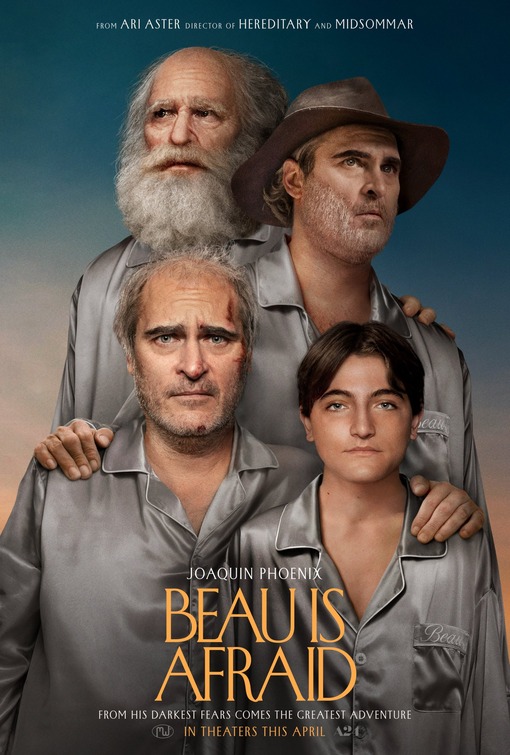
Beau is Afraid is an ominously wacky mixture of Charlie Kaufman and the Zucker Brothers

As the movie's name would imply, the titular character of Beau is Afraid (played by Joaquin Phoenix) is an easily terrified sort. As the feature begins, it’s not hard to see why. Beau lives in an apartment nestled in a city that’s gone to Hell, with violence happening on every street corner. No wonder he lives and breathes anxiety, especially now that he’s planning a trip to visit his mother. His plans for this voyage keep getting messed up, though, thanks to initially small challenges (like his apartment keys getting snatched) before he ends up suffering severe injuries after getting hit by a car. The drivers of that car (a married couple played by Amy Ryan and Nathan Lane) take Beau in to let him rest up. All Beau wants to do is see his mom. So begins an epic journey home for our hero, which will put an easily-scared man through the wringer with every challenge imaginable. 

Writer/director Ari Aster immediately proved his chops for making interesting scary movies with great sound design on Hereditary and Midsommar. That should make it no surprise that Beau is Afraid does a terrific job establishing an uneasy atmosphere relying heavily on every creak in the floorboards or distant shout. Everything near and far only furthers Beau’s fear of the wider world, a psychological condition that’s a perfect fit for Aster’s sensibilities. However, this section of Beau is Afraid also excels by leaning heavily on zany dark comedy. The brief bursts of humor in Aster’s previous works (like Will Poulter initially being paranoid during a drug trip in Midsommar) are here much more in the foreground. Moments like a news report on a figure known as the Birthday Boy Stab Man feel like they belong in an I Think You Should Leave sketch more than anything else.

It's all quite amusing stuff, especially since Aster is willing to go extremely heightened with cartoonish beats that wouldn't be out of place in a Zucker Brothers comedy like Airplane! Visual gags like Beau nonchalantly using his desktop even after it’s been damaged especially feel like they belong to this style of levity. There are laughs a-plenty in this stretch of Beau is Afraid, but it also works beautifully in capturing how overwhelming the word is from Beau’s point of view. Living with anxiety often means being at the mercy of worries or feelings of paranoia that doesn’t make any sense outside of your brain. The maximalist absurdist comedy of Beau is Afraid is a great way of capturing that phenomenon. Through stylized tendencies, recognizable truth is uncovered.

Once Beau ventures forth into the outside world, our hero starts to encounter an eclectic bunch of people and esoteric stretches of storytelling meant to function as larger metaphors for his psychological distress. This is when Beau is Afraid tries to channel its inner Synecdoche, New York, but can't measure up anywhere near that Charlie Kaufman masterpiece. Instead, this Ari Aster feature finds itself getting too lost in the weeds for its own good.  Aster's script just works so well as a preposterous comedy with eerie overtones. One can interpret so much larger meaning in the bumbling chaos of Beau's city life. Once it tries to poke you in the ribs with overly obvious visual metaphors and esoteric imagery (including a lengthy play sequence that leans too heavily on narration), it's just not quite as interesting. Beau is Afraid comes off as more compelling when its weightier qualities seem incidental. When the underlying meaning of its comedic madness sneaks up on you, the movie proves impactful. When everything on-screen is trying so hard to be weighty symbolism, that's when it stumbles.

Even in its most heavy-handed moments, though, Beau is Afraid still provides stirring imagery. Moments blending together a live-action Beau with an assortment of animated techniques, for instance, are gorgeously realized under the guidance of animation directors Cristobal León & Joaquín Cociña (who previously helmed the haunting 2020 feature The Wolf House). Production designer Fiona Crombie also keeps conjuring up such evocative sets for Beau to traipse into. These assorted environments are all painted with memorably vibrant hues that are pleasing to the eye and show a lot of visual confidence. While countless films drain away their color scheme to come off as "meditative," Crombie makes sure that Beau is Afraid is never afraid of a dash of color. This is a film with lots on its mind that also embraces crisp colors.

Those sets house a solid ensemble cast that's largely comprised of comedic performers who are wisely giving performances evocative of their most famous pop culture personas. It's fun to see Nathan Lane, for example, play somebody so reminiscent of his quietly slimy characters from movies like Mouse Hunt but with extra subtle ominous traits lurking around the edges. Leaning heavily on these types of personalities lulls the viewer into thinking they know where these characters are going before the movie inevitably heads in more surrealist directions. As for Joaquin Phoenix in the lead role, he's quite effective at portraying the various anxieties of Beau and especially proves capable of handling moments of extremely over-the-top comedy. I did wish certain aspects of his physicality and line deliveries didn't feel so evocative of his prior performances, though. Beau is Afraid often demonstrates a willingness to embrace the unexpected, but Phoenix's generally solid work can lapse into the familiar.

In the weeks leading up to Beau is Afraid's debut, Ari Aster has constantly talked about the wide variety of motion pictures that inspired the creative spirit of his latest directorial effort. Such works range from a variety of decades and different countries of origin. Ironically, though, what Beau is Afraid reminded me most of was an average short film from the FilmCow YouTube channel, the home of Charlie the Unicorn and Llamas with Hats. The combination of ultra-violence, intentionally sophomoric humor, and bursts of darkness rooted in very real psychological turmoil wouldn't be out of place in an episode of Gary and the Horse. Of course, the average FilmCow short runs under five minutes in length for a reason and Beau is Afraid's more obvious impulses in its second half will make you wish this movie had adhered a bit more to the art of brevity. But considering I'm a dum-dum who still laughs at Tricorn: Lord of Fate, it shouldn't be a surprise that I found more to enjoy than criticize within the madcap comedy world of Beau is Afraid.

Saturday, April 8, 2023

The Super Mario Bros. Movie is more generic than exhilaratingly fun

The 1993 feature Super Mario Bros. always inspires aggressive opinions. Perhaps you hate it, perhaps you loved it as a kid, perhaps some parts of it still stick with you. Because it's such a weird and audacious motion picture, something about it constantly resonates with people, even if it's just to inspire angry essays about the way it betrays its source material. By contrast, the 2023 motion picture, The Super Mario Bros. Movie is, like so many Illumination titles, too timid to ever try anything too exciting or unexpected. It rigidly goes through the motion of what fans will expect, always conscious of never going too weird or ambitious. Super Mario Bros. was a fascinating boondoggle that always provoked a response from people who viewed it. The Super Mario Bros. Movie is too generic to ever muster much more than the occasional chuckle.

Mario (Chris Pratt) and Luigi (Charlie Day) are brothers who work as plumbers in Brooklyn, though the duo doesn't get any respect from anyone, not even their own family. An attempt to fix a hazardous leak in their neighborhood leads the pair to a green pipe that takes them to another world. Here, Luigi finds himself trapped in a domain ruled by the evil Bowser (Jack Black), while Mario ends up in the Mushroom Kingdom, which is ruled over by Princess Peach (Anya Taylor-Joy). Mario's only focus is on getting his brother back and he's willing to do anything to save his sibling, including figuring out how to use local mushrooms to give himself superpowers or fighting the powerful ape Donkey Kong (Seth Rogen). Meanwhile, Bowser is amassing a sprawling army to carry out plans that involve a marriage proposal to Peach and conquering every inch of the Mushroom Kingdom.

Screenwriter Matthew Fogel and directors Aaron Horvath and Michael Jelenic pepper The Super Mario Bros. Movie with lots of energy. If there's anything that'll make this movie understandable catnip for the younger set, it's being a short film (Mario runs 92 minutes long with credits) with no real lulls, there's always chaos or action unfolding on-screen. The deluge of mayhem never becomes exhausting or painful necessarily, but it does lack meaningful underlying stakes or real visual panache to give it all energy. The devotion to replicating imagery or moments from classic Mario games is temporarily nifty, but leaning almost exclusively on iconography from the game just didn't compel me, even as somebody whose playing Mario games since I could hold a Game Boy. 

Compare this to last week's Dungeons & Dragons: Honor Among Thieves, a movie based on a property I knew nothing about. That one had fun standalone characters and jokes that could work for newbies and die-hard fans alike. By contrast, The Super Mario Bros. Movie is a parade of familiarity and not just in relation to rehashing Mario lore. Its gags are often derivative of common jokes in other animated kids movies and a barrage of 1980s pop song needle drops are shockingly lacking in imagination. "Thunderstruck" and "Take On Me" have been played to death in movies, why must they show up here? Heck, The Super Mario Bros. Movie is the third movie in the last four weeks (following Shazam! Fury of the Gods and Tetris) to drop "Holding Out For A Hero." I love that song to pieces, but c'mon, enough is enough (especially since Shrek 2 already provided the best possible use of that tune decades ago).

The frustrating reliance on the familiar extends to the animation, which is handsome-looking, especially in how iconic video game character designs have been translated to the confines of a feature film. However, this is yet another modern Western animated movie with cartoony characters inhabiting ultra-realistic-looking environments. Whether Mario and Luigi are in Brooklyn or the Mushroom Kingdom, their surroundings are always rendered with super-lifelike textures, which undercuts the intended sense of uniqueness this more fantastical realm should inspire. In recent years, big-screen American animation has opted for enjoyable deviations from realism, like in Turning Red or The Mitchells vs. The Machines. The Super Mario Bros. Movie, on the other hand, opts for the same visual sensibilities as other recent Illumination movies. It rarely looks bad or offensive, but like so much of the entire feature, it lacks a discernible identity.

Most disappointing of all, though, is the lack of real energy in the voice acting. Props to Jack Black and Keegan-Michael Key for showing up to actually do distinct voices as Bowser and Toad, respectively. They epitomize the creativity missing from so much of this feature’s voice cast. Seth Rogen, Anya Taylor-Joy, Charlie Day, they all just sound like themselves to a distracting degree. None of them are bad, it’s just such an unimaginative route to go for these performances. Chris Pratt especially is forgettable rather than distinctively subpar as Mario, with his only real memorable trait being how his Brooklyn accent occasionally slips into sounding like it came from Minnesota. 

With so many resources at its disposal, it’s a shame that The Super Mario Bros. Movie couldn’t think of anything more to do than just regurgitate old songs, familiar visual trappings,  distractingly recognizable celebrity voice-overs, and a narrative too formulaic to be exhilarating. The core demo of kids will undoubtedly be pleased with what they get here and The Super Mario Bros. Movie is painless enough to make getting too bent out of shape over its shortcomings a bit ludicrous. Still, once it’s over, it’s impossible to escape the feeling that this was an enterprise that played it safe rather than fun or adventurous. It’s not like they needed to bring the de-evolution gun back from the 1993 Mario movie, but a little jolt of unpredictability would’ve livened up the proceedings. The Super Mario Bros. Movie is so slavishly devoted to pop culture of old that it never carves out a personality for itself.

Monday, April 3, 2023

Dungeons & Dragons: Honor Among Thieves is a largely enjoyable fantasy romp

Somehow, I've never played Dungeons & Dragons. That's certainly a weird blindspot for me considering I love fantasy and have often gone under the name "NerdInTheBasement" on the internet...but it's true. All those rolling dice and role-playing opportunities have passed me by. But even though that tabletop game isn't a fixture of my life, I've always admired the way it brought people together and recognized its appeal. So universal and widespread is its prominence that it was inevitable someone would try their hand at making a movie adaptation of the property even after the 2000 boondoggle headlined by Jeremy Irons. Dungeons & Dragons: Honor Among Thieves, hailing from Game Night writer/directors Jonathan Goldstein and John Francis Daley, makes for a rollicking good time and, best of all, resonated as totally accessible to this newcomer to this universe.

As Honor Among Thieves begins, Edgin Darvis (Chris Pine) and barbarian pal Holga Kilgore (Michelle Rodriguez) are in prison. Shackles won't remain on their arms for long, though, because these eccentric thieves (each with tormented backstories) have a score to settle. Darvis wants to get back to his daughter, Kira (Chloe Coleman), and retrieve an artifact that could bring some semblance of happiness back to his life. Unfortunately, both of those elements are being guarded over by former ally turned wealthy lord Forge Fitzwilliam (Hugh Grant), whose also working with the very dangerous Sofina (Daisy Head). To pull off their epic plan, Darvis and Kilgore will need to put together a motley crew, consisting of sorcerer Simon Aumar (Justice Smith) and tiefling Doric (Sophia Lillis). It's time to go on a quest with a ragtag group of fantasy archetypes.

Sometimes, filmmakers graduate from smaller-budgeted films to big-budget blockbusters and lose their distinctive personalities as artists in the process. Happily, Honor Among Thieves registers as very much a spiritual sequel to Daley and Goldstein's delightful Game Night. Just like with that earlier feature, Honor Among Thieves is consistently funny, but the laughs don't come at the expense of actual tension while sharply-realized camerawork abounds. While modern fantasy blockbusters like King Arthur: Legend of the Sword have tried way too hard to inject "gritty" sensibilities into this genre to make it accessible. The vibes of Game Night, meanwhile, are delightfully perfect for making a broadly appealing Dungeons & Dragons movie. Turns out, a feature that's fun to watch and anchored by a great cast can make the world of fantasy cinema feel fresh again.

Welcome surprises abound throughout this production, particularly in terms of the visuals used to realize this universe. Dungeons & Dragons: Honor Among Thieves appears to have been shot primarily on practical locations and deeply-detailed sets, which lend such texture to this universe. Even more exciting is the abundance of animatronics used to realize fantastical creatures like a big fish, a bird-man, and other enjoyably oddball inhabitants of this fantasy realm. What a wonderful way to pay homage to vintage fantasy movies like Labyrinth while creating a fresh new world you feel like you could reach out and touch. This trait is especially good at making newcomers (like me!) feel welcome in this universe. The impressiveness and immersive qualities of these practical effects can be appreciated by anybody, you don't need to have spent hours on a campaign to like cool puppets!

While the visuals are crisp in Honor Among Thieves, its narrative sensibilities fall into some familiar traps of modern blockbusters. Chiefly, this movie runs for over 130 minutes and certainly could've withstood a trim in the editing room. Meanwhile, the backstory for Darvis, particularly his yearning for a deceased wife, is a strangely generic storytelling detail in a film that's often so imaginative. This is an especially subjective grievance, but I also yearned for more of Doric! She's got such a cool powerset and Sophia Lillis is excellent in her performance of the character, but she's often put on the back burner in favor of focusing on Darvis and Simon. I presume this is because her shapeshifting powerset is so powerful (and not dependent on further training or mechanical aid like Simon's sorcerery) that focusing on her too much would inevitably lead to her solving all the problems in the narrative. Still, let's give Doric even more to do, especially in the way of wacky gags, if we get more of these, she's so compelling.

The fact that even grievances with the script of Honor Among Thieves have me yearning for these shortcomings to get addressed in further adventures, rather than inspiring me to give up on this franchise entirely, is a testament to all this title gets right in terms of serving up entertainment. The creative sensibilities of Daley and Goldstein deserve much of the credit for that feat, but so does the stellar cast assembled here. There's really not a dud in the ensemble, which is led by Chris Pine in just the kind of goofy and messy character this guy always excels in playing. Regé Jean-Page leaves a mighty big impression and reaffirms his gift for comic timing as the paladin Xenk while Hugh Grant is an absolute blast as a slimeball antagonist. I'm incredibly here for this era of Grant just showing up and playing maximalist caricatures with such swagger.

A friend of mine dubbed Dungeons & Dragons: Honor Among Thieves a prime example of a "fun popcorn movie" and I'm inclined to agree. It's not a flawless blockbuster, but it delivers most of the goods you'd want out of a funny fantasy feature (even if it goes on too long for its own good). It isn't just basic competency that makes Honor Among Thieves an enjoyable time, but also an infectious level of fun in how it realizes its magical world. Even as someone who'd never rolled the dice on the Dungeons & Dragons tabletop game, I found myself plenty thrilled by sights like a portly dragon that rolls down massive inclines to crush its enemies or the shapeshifting skills of Doric. In other words, I was never lost or felt left out with all the excitement Dungeons & Dragons: Honor Among Thieves conjured up.

Ben Affleck's Air isn't quite a slam-dunk, but still often scores


Between 2007 and 2012, Ben Affleck directed a trio of movies, including eventual Best Picture Oscar winner Argo. Since 2012, Affleck's only directed two features, the 2017 dud Live By Night and now his newest directorial effort, Air. Affleck's time away from the camera can be attributed to an array of factors, some rooted in the film industry and others deeply personal But he's back now as a filmmaker with Air, a crowdpleaser attempting to be a Jerry Maguire yarn about the Nike corporation. The feature is nothing challenging or revolutionary, but its easygoing charms feel like a good way for Affleck to segway back into the director's chair. Plus, there's enough talent going on behind the camera to remind people why Affleck garnered so much buzz for his directorial skills in the first place.

Air begins in 1984, with the Nike corporation decidedly in third place among the big shoe companies. With Adidas and Converse doing circles around Nike, this company needs something big to put it on the map. Sonny Vaccaro (Matt Damon), a key member of Nike's sports division, is determined to do just that, even though his abrasive attitude makes him a nightmare for some of his co-workers. Vaccaro's got drive to spare and he's now using every ounce of his energy to get Nike to sign a sponsorship deal with a rookie player by the name of Michael Jordan. Instead of this shoe company getting endorsements from a bunch of athletes, Vaccaro wants Nike to put all its chips on Jordan. The obstacles here are enormous and include Jordan's agent, David Falk (Chris Messina) not wanting Nike anywhere near his client, while Vaccaro's boss, Phil Knight (Ben Affleck), hates the entire plan. But if Vaccaro can pull this off, he's convinced that both Nike and Jordan could make history.

It's often said that the ending is the most important part of your movie since it's what the audience takes home with them when they leave the theater. That may be true, but nailing your beginning, the part where audiences determine whether or not they want to emotionally invest in your story at all is also crucial. Alex Convery's Air screenplay stumbles in this portion of its plot. These opening sequences, taking place in tiny conference rooms and showing characters like Vaccaro surrounded by dusty cubicles, certainly convey the idea that Nike doesn't have any cash to spare. A later scene with Vaccaro's friend and fellow executive Rob Strasser (Jason Bateman), where this guy pours his heart out about needing money so he can be in his daughter's life, does a much better job of establishing some personal emotional stakes for these characters. Why didn't they lead with elements like Strasser's backstory?

Waiting so long to get to Strasser's motivation speaks to another issue regarding how the Air characters initially feel a bit cold and thinly sketched. Vaccaro, for instance, is mostly defined by just a brief visit to a casino while he's out scouting basketball players and being rude during work meetings. Trying to paint people with hundreds of thousands of dollars as "the little guy" could work if those "little guys" were transfixing, but initially, Air struggles to pull a Moneyball and make number-oriented people as compelling as athletes. However, once the Michael Jordan element comes into play at the half-hour mark, Air picks up speed and keeps on trucking for the rest of its runtime. The more nebulously-defined cash troubles of Nike have been replaced with more exciting concrete forms of conflict like Vaccaro trying to figure out how to communicate to Jordan's family or the enjoyably arch agent Falk throwing up roadblocks against Nike any chance he gets.

The introduction of the Jordan family, and especially mother Deloris Jordan (Viola Davis), also brings an extra jolt of humanity to the movie. Suddenly, the contrast between the offices of Nike and working-class families is more apparent and that emphasizes the urgency of Jordan finding the right people to cooperate with in his basketball career. Convery's dialogue also becomes a lot more engaging in depicting Vaccaro trying to wine and dine potential clients like the Jordan's with his candor. A moment where he impersonates how various Converse and Adidas executives will try to win over Michael Jordan is both extremely humorous and a good way of showing how much experienced Vaccar has in this business.

As the plot gets more and more engaging in Air, Affleck's direction maintains a steady hand. Save for a few moments of showy camerawork (like a conversation between major Nike executives inexplicably told with a camera rotating around them), Affleck and cinematographer Robert Richardson's visual approach here rides a fine line between being unintrusive but also clearly not being on autopilot. Especially nice is the heavy emphasis on natural light at Jordan's residence, even when Deloris is taking a phone call inside there are beams of sunlight pouring in from the windows. Meanwhile, the Nike officers are intentionally captured with all interior lighting and a lot less variety in the color palette. The two locations might be on separate planets, a fact that communicates just how initially detached Nike is from the client its executives crave. That sentiment is nicely communicated in Affleck's direction without sacrificing the grounded visual aims of Air.

Air isn't a movie that rewrites the book on sports films or subverts expectations. Its deluge of 1980s needle drops especially could've used an extra jolt of imagination, as Air goes to the well of vintage tunes that have been used all the time in other period piece features. But it is a feature that eventually had me rooting for its main characters despite such a slow start while some memorable supporting performances (Viola Davis and Matthew Maher are the MVPs of the cast) offer up plenty of entertainment. Being agreeable isn't always a bad thing and that's just what Air resonated as for me, a person with zero basketball or Nike knowledge. I'm sure for dads and basketball geeks everywhere this will play like the first appearance of The Beatles on The Ed Sullivan Show.

Wednesday, March 29, 2023

A Thousand and One is a sprawling narrative that never loses a sense of intimacy

The expansive narrative of A Thousand and One, the feature-length directorial debut of writer/director A.V. Rockwell, begins in the 1990s. Inez de la Paz (Teyana Taylor) has just gotten out of prison and is now looking to make a good life for herself and her son, Terry (played at the age of 6 by Aaron Kingsley Adetola). They initially struggle to make a life for themselves in Harlem, but they eventually land an apartment that keeps a roof over their heads for many years. The depiction of this makeshift family moves forward at two other significant intervals, with the latter capturing Terry at the age of 17 (now played by Josiah Cross). Just as his mom always wanted to give Terry the home she never had in the past, now Terry must contemplate what his future is going to look like.

At one point in Terry's childhood, Inez gets married to her longtime sweetheart Lucky (Will Catlett). During their wedding, Lucky kneels down to Terry to let him know "I'm not going anywhere." Of course, things become much more complicated than that. Nothing sticks around forever. The passage of time comes for all of us. Rich, poor, kings and paupers...we're all living at the mercy of finite existence. Rockwell's filmmaking unearths inspired ways to reinforce the passing of years and specifically what's so tragic about what happened to Harlem across the 1990s and 2000s. Long-standing apartment buildings transform into sleek-looking shopping centers adorned with the logos of recognizable companies. 

It's one thing for the passage of time to result in green leaves turning brown in the autumn. But this visual transformation is something much more intentional and sinister. A Thousand and One poignantly depicts how gentrification intentionally ripped away entire communities and much-needed homes. It's a process that targeted people of color and reinforces the daunting circumstances Inez and Terry are navigating every day. The Harlem we see at the start of A Thousand and One is not the same one we see in the film's final scene. This portion of upper Manhattan is being chipped away and Rockwell's filmmaking lingers on every lived-in patch of this neighborhood to emphasize what's being lost in the process of gentrification. This is not a movie lingering on the woes of what's been lost, but also a subtle celebration of what was and still is. The approach to Harlem within A Thousand and One functions as a way to generate conflict for the main characters, inform the deeply textured camerawork, and provide social commentary. What an incredible multi-faceted aspect of this feature.

A Thousand and One tends to operate like that, with Rockwell's script often juggling so many plates but doing so with such grace and subtlety that you won't even notice. What keeps things so engaging is the character work, with this movie doing such commendable work framing Terry and especially Inez as deeply complicated human beings. Mothers don't often get to be dimensional creatures in cinema narratives. Normally they're just around to be supporting players with the stories of younger characters. Inez is a welcome departure from that norm. She's incredibly messy and someone you sometimes despise. But she's also a deeply troubled human being who can elicit sympathy from the audience moments after potentially alienating moviegoers. All those rough edges make Inez such a believable human being from the get-go. The thoughtfully gradual and small ways she evolves over the years make accentuate the veracity of this figure.

Such characters are brought to life with deftness by A Thousand and One's central cast. Teyana Taylor, in her biggest lead role to date, proves she's more than up for the challenge of simultaneously anchoring an entire motion picture and inhabiting such a complicated character. She's mesmerizing here, particularly in the ways she depicts Inez changing over time but also displaying subtle physical details that remain consistent. Taylor's got the tiniest intricacies down pat with Inez and it's remarkable to watch. Even considering this towering lead performance, though, Josiah Cross may be the standout of A Thousand and One's cast. Tasked with the most emotionally overt moments of the entire movie, Cross doesn't succumb to just going brash. There's restraint in even his most pronounced depictions of Terry navigating challenging emotional situations. His tears ring true and fit right into the naturalistic aesthetic of the rest of the movie. 

With such gripping performance and assured filmmaking, I could've just watched Inez and Terry navigate everyday life for hours on end. It doesn't hurt that there's such a quietly loving quality to the way A.V. Rockwell frames the various apartments and streets of Harlem. Their imperfections are on-screen, but that's also what makes them feel cozy and rooted in reality. A Thousand and One is often transportive in the visuals it uses to depict a mother and her son navigating issues both massively systemic and intimately crushing. It's a story that stretches over a decade yet manages to feel like it's always living in the moment. Combining that narrative feat with the rich visuals of A Thousand and One makes this A.V. Rockwell feature one of the easiest movies to recommend so far in 2023.

Monday, March 27, 2023

It'd take more than blowing on a cartridge to improve Tetris


Video game movies don't have the best track record in terms of overall quality. Tetris, a feature about the creation of this game and the legal logistics behind getting it out to the world, tries to circumvent this issue by making sure it adheres more to a biopic formula than any mold one would associate with Assassin's Creed or Uncharted. In the process, Tetris trades out one frequently flawed storytelling format for another. Tetris has its share of terrific scenes that keep you on the edge of your seat. But, like so many biopics, it's also too stuffed for its own good. Just like you shouldn't cram too many obstacles into one level of a video game, so too should biopics not feel obligated to focus on every single aspect of its central subject matter.

Noah Pink's screenplay for Tetris begins by taking viewers back to the 1980s when Henk Rogers (Taron Edgerton) was selling a video game at a Las Vegas expo where he first came across the video game Tetris. He only had to play with this project for a few minutes to see the potential. Tetris could change the world. The cash-strapped Rogers proceeds to bet everything on working with Robert (Roger Allamn) and Kevin Maxwell (Anthony Boyle) on selling Tetris across various video game formats across the globe. However, to try and secure the handheld video game rights to Tetris just in time for the launch of the Game Boy, Rogers decides to go to the Soviet Union. This is both where Tetris originated and where Rogers hopes to secure the handheld gaming rights from the property's original owners. This journey leads Rogers to discover the creator of Tetris, Alexey Pajitnov (Nikita Yefremov), but also more conspiracies and dangers than he could've ever imagined.

Director Jon S. Baird's greatest visual flourish throughout Tetris is to often render key establishing shots or expository dialogue delivered through 8-bit graphics reminiscent of vintage arcade games. It's a move that echoes Marielle Heller's decision to have A Beautiful Day in the Neighborhood's establishing shots realized through toys and knick-knacks in the vein of establishing shots from Mister Rogers' Neighborhood. In both cases, it's a visually evocative way of bridging the gap between "reality" and the art that in-universe characters are so obsessed with. Baird's recurring use of video game graphics isn't quite as creative as it could be, but it's still a fun flourish, especially in an opening scene where we see the vastness of Las Vegas rendered like an Atari game.

Tetris has some fun with video game references, but it struggles in making the human drama feel either potent or compelling. Put simply, there's just too much going on in this script. In an attempt to capture every nook and cranny of all that Rogers navigated to gain full control of Tetris, Pink's script feels scattered rather than comprehensive. Glimpses into the lead character's domestic life breeze by so quickly that they register as superfluous rather than tragic. Meanwhile, a budding friendship between Rogers and Pajitnov has some cute moments, but it too doesn't feel fleshed out enough in the grand scheme of the story to be emotionally impactful. Even the dangers of the Soviet Union end up feeling muted within the screenplay. Characters constantly talk about how "dangerous" and "impentrable" the country is but Rogers is always slipping in and out of the territory with such ease that there's never as much suspense to his storyline as there should be. Tetris is comprehensive, but what good is being comprehensive if so much of what you assembled feels half-hearted?

Part of the problem is, unfortunately, Rogers as a character. In his depiction here, Rogers just isn't an incredibly compelling character. He's not a horrible-written figure, but there's not much drama to a straightforward guy whose faith in Tetris is unwavering and doesn't have much personality beyond being able to walk into any meeting and wowing people with his showmanship. It doesn't help that there's some dissonance between the writing of Rogers, which is trying to paint him as a quintessentially nice hero in the vein of a 1930s Jimmy Stewart character, while Edgerton's solid performance keeps hinting at darker, even semi-manipulative shades of the character. In others, Rogers is constantly torn between being Steve Rogers and Harold Hill.

The Russian characters in Tetris tend to be the more interesting characters in the script, which isn't surprising since they've got more concrete emotional stakes in their respective storylines. Rogers can waltz in and out of the Soviet Union, but guys like Pajitnov are stuck inside a country that could make him disappear at the drop of a hat. The tension in Tetris briefly gets a new lease on life when the focus shifts to Pajitnov, but he's just not in the movie enough to elevate the entire proceedings. Similarly commendable are enjoyably over-the-top supporting performances like Toby Jones and Igor Gravuzov, the latter of whom has big Michael Stuhlbarg energy playing an unabashedly creepy Russian officer.

Pleasant performances like these and a generally agreeable air make Tetris a painless viewing experience, but once the credits finish rolling, your mind is bound to drift towards thoughts of how the movie could've leaned more into its potential. If only Jon S. Baird's general camerawork had as much life as the scenes rendered in 8-bit graphics or if Lorne Balfe's score had any sense of personality to it. Even just whittling down the scope of Tetris would've improved things immensely. It's difficult to call Tetris "bad", but it's even more challenging to say it levels up into something special. At least it's better than many video game movies?

Tuesday, March 21, 2023

Keanu Reeves and company remain as violently fun as ever in John Wick: Chapter 4


More movies should begin with as dramatic of a bang as John Wick: Chapter 4. No expository narration or inexplicable poorly-edited chase scene here. Instead, the camera cuts back and forth between a fist loudly punching a plank of wood and Laurence Fishburne’s The Bowery King walking through smoke-filled green-tinted tunnels. As he makes his way to his destination, The Bowery King bellows phrases from a passage of Dante Alighieri’s The Divine Comedy, which includes that immortal phrase “abandon all hope Ye who enter here.” It’s true that there is little hope for those who wander into the land of violent vengeance. But John Wick's newest trek into that terrain still provides some undeniably entertaining action movie cinema within John Wick: Chapter 4.

After that bombastic prologue, John Wick: Chapter 4 picks up shortly after the events of its predecessor, which ended with Wick (Keanu Reeves) hankering for some revenge against The High Table, an organization ruling over this world of assassins. As Wick begins to get revenge on the powerful people who've made his life a living nightmare, the Marquis Vincent de Gramont (Bill SkarsgÃ¥rd) grows nervous that this vengeful man could do some real damage. This is when he sends master assassin Caine (Donnie Yen), an old colleague of Wick's, after this loose cannon. If he wants to get out of all of this alive, and maybe even find some shred of closure in the process, Wick won't just need to fight off armies of henchmen. He's also planning to engage in a staple of the oldest of High Table rules and traditions: a mano-a-mano duel.

Four entries in, director Chad Stahleski knows what works in these John Wick movies. This particular production is bigger in scope than prior John Wick installments, but Chapter 4 still delivers all the bullets, lavish get-ups, and violence you’d want out of these movies. The formula and hallmarks of this franchise don’t get subverted here, they’re just expanded in scale. For some franchises, sticking to the hits would be a sign of creative stagnation. In the case of a fourth John Wick film, though that suited me just fine and I'd imagine it'll work like gangbusters for other fans of this franchise. Stahleski still gets so much mileage out of crisply-filmed action sequences draped in brightly-colored neon lighting, who can complain about getting more of a delectable dish? If it ain’t broke, don’t fix it, as they say. 

It helps too that John Wick: Chapter 4 delivers plenty of fun set pieces that don’t just blur together with fistfights and shootouts from earlier movies. A deluge of constant skirmishes in Paris, France during the third act is especially commendable in how they dish up relentless violence without becoming hollow echoes of one another. Leaning into the unique attributes of the backdrops of these fights, even if it’s something as seemingly simple as lots of stairs, helps a bunch in this regard. It’d be one thing if John Wick was fighting people in the same grey hallway for two hours. Instead, Wick gets to dish out violence everywhere from an extravagant hotel to crowded streets to a dance floor and everywhere in between. The imagination in these fight sequences is impressive but also implemented so carefully that you may not even notice that impressive quality while watching John Wick: Chapter 4

A decade into this franchise and it’s still as fun as ever watching Keanu Reeves slicing throats or refusing to go down no matter how many times he gets stabbed. The commanding presence of Reeves undoubtedly plays a role in why these films remain so enjoyable, but Chapter 4's thrills are also aided by the welcome presence of Donnie Yen. This action movie legend has demonstrated his gifts for physicality and stuntwork plenty of times before, but John Wick: Chapter 4 offers him a chance to flex his comedic and acting muscles too. Some action stars are impressive in throwing a punch but struggle a bit in just acting like ordinary humans, but not Donnie Yen. He's just as compelling dropping well-timed one-liners or exhibiting vulnerability as he is beating the heck out of people. In a cast crammed with enjoyably theatrical performances, Donnie Yen handily stands out as the MVP.

John Wick: Chapter 4's extensive runtime of 169 minutes offer audiences plenty of chances to appreciate the skills of Yen and the other artists putting in so much effort to realize all this action-packed mayhem. The second act runs a little too long for sure, but more often than not, the expansive scope of Chapter 4 is much more of a blessing than a curse. We've come so far from the original John Wick all the way back in 2014, which seemed, conceptually, like something meant to mimic a typical low-budget Liam Neeson or Jason Statham vehicle. Nearly a decade later and John Wick: Chapter 4 is more reminiscent of the most recent Mission: Impossible movies than anything else. Thankfully, going big hasn't erased the charms and craft that put this franchise on the map in the first place. In other words, do not "abandon all hope" ye who choose to see John Wick: Chapter 4.

Tuesday, March 14, 2023

Inside has an interesting starting premise, but lackluster execution

Nemo (Willem Dafoe) is stuck. The protagonist of the thriller Inside, Nemo was just trying to snag a couple of high-value paintings from a ritzy New York apartment when things went haywire. He stayed just a few seconds too long and suddenly the door to the place closed in on him. Now he's trapped here in an apartment, which has barely any supplies inside it and whose owner isn't coming back for a long time. There are many survival movies about one person having to brave isolation and extreme conditions. Most take place in the harsh wilderness. Inside is about a single man braving the inside of an apartment that very quickly becomes a suffocating cage.

Armed with a peculiar premise and a restrained scope perfect for filming in the age of COVID-19, director Vasilis Katsoupis and writer Ben Hopkins frustratingly opt for a shockingly straightforward execution on Inside. There's little ambiguity to be found in the plot or visuals, the story follows a decidedly linear path, and the filmmaking is often quite standard in framing Nemo's plight. Other filmmakers like Chantal Akerman let their bold side flourish when utilizing a minimal number of sets, but Inside's imagery stays firmly in the lane of "competent but predictable." Individual shots rarely last too long, which undercuts the claustrophobia of this central premiere, while the hung paintings that surround Nemo are just a bunch of heavy-handed metaphors (we see a painted bird on the wall, representing the "animal" Nemo is becoming in captivity). The only real notable creative flourish is having Nemo be trapped with a refrigerator that plays "Macarena" whenever he opens it. Otherwise, you get what you expect here.

Not every movie needs to reinvent the wheel, but it's frustrating that Inside never utilizes its innately sparse aesthetic for something more. You've got Willem Dafoe, a large apartment, and a conceptually intriguing starting premise, shouldn't there be more meat on the bones of this movie? The primary issue is a simple one. Inside is torn between two impulses. It wants to work as a conventional survival thriller that thrives on only suspense, but it's too slow-paced to make your pulse race. Various forms of conflict our protagonist encounters here, even in the injuries Nemo sustains in his attempts to escape, aren't really that interesting or idiosyncratic. On the other hand, it also has ambitions of being a loftier meditation on art and the nature of free will. Committing to either of these aesthetics would make for a grand o'l time. There are plenty of filmmakers who could've even made Inside work on both levels. Since Inside never flashes much brains or thrills, though, it becomes a chore to get through.

Even the score by Frederik van de Moortel isn't especially interesting, a strange feat given that a movie largely devoid of dialogue like Inside would seem to offer a composer an opportunity for a really interesting score. Alas, van de Moortel mostly just delivers rote compositions that go in one ear and out the other. It's yet another way Inside squanders its potential. By the third act, Inside has got so little going on it resorts to channeling director Pier Paolo Pasolini (though falling far short of that classic filmmaker) in resorting to shock value imagery. By the end of this feature's runtime, you will see Nemo eating dog food and a pile of his feces, each of which got a brief cry of "ewwww!" from the audience I saw Inside with. However, there's no perverse fun or weighty themes being explored in these depictions of severe desperation. Sometimes a pipe is just a pipe and sometimes a pile of feces is just a reflection of a movie grasping at straws to keep its viewers from looking at their phones.

At least we have Willem Dafoe around as our lead character. The always reliable Dafoe, who could lend genuine humanity and heft even to movies like Motherless Brooklyn or Death Note, hits some solid moments in what's basically a one-man show for his talents. The unimaginative approach to realizing the experiences of a man confined to a lavish apartment, however, does leave Dafoe hitting the same note repeatedly. Even he can't salvage something this frustratingly hollow. Given his experience with truly bizarre filmmakers like Lars von Trier or Abel Ferrara, it's puzzling that the creative team behind Inside couldn't think of more engaging and unexpected material to hand Dafoe.

Inside is bound to be the rare movie that unites both arthouse cinema devotees and general moviegoers in their frustration over a film. The former group will find Inside too shallow, while the latter collection of individuals will undoubtedly walk out of the movie after finding it "boring." Neither camp will be necessarily wrong. While being trapped with just Willem Dafoe in one location for 100 minutes sounds like it could be a blast, it turns out even the zestiest garnish cannot save a dish that's been so badly burned. Skip Inside, just stay home and revisit Bo Burnham: Inside instead. Now there's a visually compelling and entertaining project that's confined to just one location!

Saturday, March 11, 2023

Champions is too derivative and outdated to get you cheering


In this remake of the 2018 Spain film Campeones, Champions chronicles basketball coach Marcus (Woody Harrelson), who always had difficulty connecting with other human beings. His penchant for aggression and only caring about basketball has cost him so many jobs and now he's more unemployable than ever thanks to getting arrested for a DUI. His sentencing for this crime is 90 days of community service as the coach of The Friends, a basketball team in Des Moines, Iowa comprised of players with intellectual disabilities. Initially, Marcus is just counting down the days until his community service is finished and crossing his fingers that he can get some kind of new job in the NBA. Eventually, though, he begins to find kinship with the players he's tasked with coaching.

Some of the flaws of Champions are common for subpar hokey inspirational sports movies, but one unexpected shortcoming is how dated it feels. Not necessarily in the language it uses to talk about disabled people, but the whole thing feels like it got shipped in from 2010. The barrage of needle drops all seem to be at least ten or so years past their prime, while an early depiction of a "meme" seems to be straight out of 2013, if not earlier. Most baffling of all, there's a "[Blank] for Dummies" book cover sight gag here. Those jokes were so common in the early 2000s and then just died away after being run into the ground! Why are they now being brought back? What did we do to deserve this resurgence?

It's not a good sign that my primary takeaway from Champions was how it often feels like a 2009 movie you ran into on cable rather than a hot-new theatrical release in 2023. This new directorial effort from Bobby Farrelly just doesn't offer much for one to chew on, why wouldn't your mind race immediately to an inexplicable "[Blank] for Dummies" book cover? It's a project that tragically feels like a TV movie and never lets any of its actors truly embrace their greatest talents. The incredibly funny Kaitlin Olson, especially, is underutilized here as a love interest character that often only functions to bring ham-fisted conflict and exposition into the screenplay. It's truly bizarre to watch Olson go from mastering the anarchic comedy of It's Always Sunny in Philadelphia to engaging in the formulaic writing of Champions.

Most damning of all for Champions is that the sports movie it reminded me of primarily of was not Remember the Titans or Rocky, but rather Million Dollar Arm. That long-forgotten 2014 feature was about a trio of cricket players from India who are brought to America to play as baseball pitchers. Despite those three characters having such an interesting story, the film was focused primarily on their agent, played by Jon Hamm. It was hard to get invested in a sports movie that totally miscalculated who its most interesting characters were. Champions carries on the "proud" tradition of Million Dollar Arm by once again sidelining far more compelling athlete characters in favor of a middle-aged dude and his sex life. No wonder Champions struggles to maintain your interest when it keeps benching its best assets.

It doesn't help that screenwriter Mark Rizzo tells this story with shockingly little life. Sports movies are always going to have familiar elements in them, they're a strain of crowd-pleaser cinema that's all about execution. Within Champions, Rizzo executes stale narrative beats with no panache or passion. If the movie can't get invested in these underdog struggles, why should we? Part of the problem is the character of Marcus, a guy who begins to warm up with The Friends from the first time he talks to the team yet abruptly reverts to his selfish ways throughout the movie to keep drama going. There's no consistency to the guy or any real reason to get invested in him. Champions centers so much of its narrative around this guy that, despite having a talented actor like Harrelson occupying the role, Marcus becomes an anchor weighing down everything.

The only time Champions comes alive is in scenes focusing on the individual Friends team members in their lives. Depicting these athletes as fleshed-out humans and exploring their interior desires has some real substance to it. A scene of player Benny (James Day Keith) rehearsing into a mirror how he'll stand up to an overbearing boss, for instance, is great while anytime the camera focuses on the incredibly-determined player Constentino (Madison Tevlin), things improve dramatically. A sequence where she cuts right to the truth with a frustrated Friends player in a locker room is the highlight of Champions and one that suggests a much more interesting movie focused almost exclusively on these athletes. Unfortunately, Champions is much more interested in sidelining those characters and channeling the spirit of Million Dollar Arm, which leaves this movie feeling like a rerun before its opening logos are even done.

Thursday, March 2, 2023

Aubrey Plaza and Hugh Grant can only do so much to liven up Operation Fortune: Ruse de Guerre

Orson Fortune (Jason Statham) is a master spy. He's also the lead character of the new Guy Ritchie movie Operation Fortune: Ruse de Guerre, highly-skilled in combat, and sharing a name with a pig from the U.S. Acres comic strip. Fortune has been hired by Nathan Jasmine (Cary Elwes) to lead a mission to retrieve an unknown yet decidedly cataclysmic item that has fallen into dangerous hands. Working alongside hacker Sarah Fidel (Aubrey Plaza) and expert sniper J.J. Davies (Bugzy Malone), Fortune is off to save the world, a task that leads him to go head-to-head against eccentric billionaire Greg Simmonds (Hugh Grant). Getting close to this guy will require exploiting his infatuation with celebrities. Time to throw in movie star Danny Francesco (Josh Hartnett) onto Fortune's time. Two thing's are for certain here: this is going to be an unusual mission and Orson Fortune will be beating people up within an inch of their lives if given half a chance.

Operation Fortune: Ruse de Guerre (Jesus, what a clumsy title) is director Guy Ritchie's second foray into espionage following his 2015 film The Man from U.N.C.L.E. That's not the only familiar element of Ritchie's filmography to reappear here, as Statham, Hartnett, Grant, and Eddie Marson are all returning from his earlier works. Ritchie is working on familiar ground with familiar faces here, which might explain why the script (penned by the director alongside Ivan Atkinson and Marn Davies) feels so rudimentary. The film is rarely incompetent, but it's also lacking in surprises, especially compared to Ritchie's detour into much darker territory with his 2021 film Wrath of Man.

Whereas that film suggested Ritchie was expanding his cinematic palette to include grimmer ruminations on the costs of vengeance, Operation Fortune delivers what you'd expect but without much pizazz or excitement. It's a half-hearted cover song of better movies. Part of the issue is that the production gets less glamorous as it goes on. When we first meet Orson Fortune, he's lounging about in a luxurious hotel decked out in blue walls. This indicates that the production design of the whole feature will be taking more cues from Jacques Demy than Paul Greengrass. Alas, by the time third-act arrives, Operation Fortune has devolved to just having Statham beat people up in a silver-colored elevator while a final shootout takes place in a generic office.

There's also not much in the way of cheeky surprises or unexpected flourishes in either the writing or fight choreography. Despite occupying the spy genre, which is famous for its unexpected twists and morally grey allegiances, Operation Fortune goes down all the familiar roads. People who are antagonists in scene one end the story as antagonists, it's all quite predictable. The bog-standard elements are executed with shockingly little vibrancy in either the camerawork or editing. It all just feels way too paint-by-numbers for a movie that wants to be riotous. All of this is compounded by the dreadful lack of tension in the screenplay. Even in the Mission: Impossible movies, Tom Cruise's Ethan Hunt tends to trip, get hit by a car, or run out of oxygen during big action sequences. Here, Orson Fortune always pulls off everything without a hitch it never feels like he's in danger. Why should we be on the edge of our seats if we already know the exact outcome?

Nobody's expecting Jason Statham to get offed in the middle of a Jason Statham movie, but a little bit more vulnerability would've made the plot seem less weightless. That's a key issue here, the lack of real long-term problems. Even Danny Francesco manages to get over his initial fear of being a super-spy in the span of one scene. Other Guy Ritchie movies are brimming with ticking clocks and claustrophic conflict, but Operation Fortune is breezy to a fault. These subpar details mean the production only really comes alive when two of its performers get to chew up the screen. Aubrey Plaza and Hugh Grant are unquestionably having the time of their lives showing up in this film. Plaza's deadpan style of grim humor feels like a unique element in the world of spy cinema (do you remember anyone like her showing up in Tinker Tailor Soldier Spy?) while Grant is just a ball as an unabashedly sleazy guy who loves to brag about all the wicked people he's helped over the years.

Whenever Plaza and Grant get to take center stage, Operation Fortune finds a pulse and functions just fine as easygoing entertainment. Throw in some lovely European locales for this attractive cast to walk around in and there's no denying this is at least better than some other entries in Guy Ritchie's filmography, like King Arthur: Legend of the Sword. Elements like Plaza and Grant's performance, though, deserved a better movie to inhabit. Painless to sit through, Operation Fortune is still an inert movie that needed an extra jolt of creativity and energy. Oh, and also another first name for Orson Fortune, I should not be reminded of U.S. Acres during a spy movie.