Wednesday, December 31, 2025

Five New Year's Resolutions For Movie Studios And Theaters

An iconic New Year's Eve scene from Carol (2015)

Over the December 26-28, 2025 weekend, for the first since July 2018, seven different movies grossed $10+ million each at the domestic box office. Even as Avatar: The Way of Water does gangbusters business worldwide, smaller titles like The Housemaid, Marty Supreme, and Hamnet are bringing people to multiplexes.  Theatrical moviegoing isn't dead. It just needs crowdpleaser titles and a steady stream of new movies to excel. Shocker: when the theatrical marketplace can only rely on Snow White or Tron: Ares to carry the day, people aren't scrambling to go to the movies.

So much of the ongoing problems with the box office in the 2020s are rooted in external industry problems. For starters, corporate consolidation (namely, the elimination of 20th Century Fox) has drastically reduced the number of movies that get theatrical releases each year. Then there are studios refusing to release all kinds of motion pictures in theaters, instead opting to drop many projects (namely comedies and romantic dramas) onto streaming for a quick instant paycheck.

As 2026 prepares to begin, let's continue that time-honored New Year's tradition of "resolutions" and talk about what movie studios can do better in the new year. Here are four New Year's resolutions for the major film studio and one resolution for movie theaters themselves as we look toward the future. December 2025's exciting, bustling box office business is a sign that the world of theatrical moviegoing can be gloriously thriving 24/7/365....if only these resolutions are taken to heart.

Abandon Streaming-Exclusive Movies

Are you in the theatrical film business or not? Lemme put it this way...do you care about giving artists long-term income (via post-theatrical release revenue streams like cable TV residuals) and offering consumers an ability to possess art (via home physical media releases, which streaming-exclusive movies don't get)? If the answers to either is yes (and both should get a resounding yes by anyone), abandon streaming-exclusive movies. Sending features to Paramount+, Disney+, Apple TV, Prime Video, Hulu, HBO Max, or any other streaming platform in 2025/2026 is idiocy. 

It deprives artists of chances to make more income long-term, audiences of more opportunities to experience films, and banishes motion pictures to obscurity.  Yet here comes Disney sending the Searchlight Pictures title In The Blink of An Eye to Hulu in February, or Paramount expelling an Avatar: The Last Airbender movie to Paramount+. Sony's various film divisions (like Columbia Pictures and 3000 Pictures) are still making original films like Beach Read for Netflix. Given how outfits like Netflix are outwardly hostile to the existence of movie theaters, studios like Sony getting into the streaming exclusive movie business is as long-term beneficial as hiring Jason Voorhees to be your personal bodyguard.

Stop this nonsense. It doesn't make any sense to offer exclusive feature-length movies to audiences on streaming in any way, shape, or form. Even in pure monetary terms, these studios are now owned by such big, money-rich corporations that there's no excuse not to send every movie possible into theatrical release. Paramount has $100+ billion stored away to bid on Warner Bros, but not the moolah to promote a Last Airbender movie? Amazon MGM Studios, what're you doing sending The Wrecking Crew and other movies to streaming when your parent company has an obscene amount of money?

2025's box office nadirs were caused by a lack of new movies in theaters. That solution would be automatically solved if Amazon, Disney, Paramount, and other corporations just gave their films normal marketing campaigns and (at least) 45-day theatrical runs. Streaming-exclusive movies, go into the dustbin of history, pleeeease.

Younger Audiences Are The Future

The concept back in early 2021 that older audiences (the first to get the COVID-19 vaccine) would be the ones driving North American theatrical moviegoing turned out to be a bit off the money. Horizon: An American Saga, After the Hunt, The Last Duel, Book Club: The Next Chapter, none of these movies aimed at the 60+ crowd made a box office dent. Meanwhile, younger moviegoers have shown up for everything from Taylor Swift: The Eras Tour to A Minecraft Movie to Demon Slayer: Infinity Castle to Marty Supreme. Instead of handing more money to McG and Brett Ratner, Hollywood needs to pursue younger filmmaking voices under 35 that can deliver movies deeply relevant to the audiences coming out in droves to theaters. Sorry studio executives, but tapping into Running Man and Tron nostalgia isn't where the future of moviegoing is. 

Stop Worrying And Embrace Foreign Langauge Cinema

Demon Slayer: Kimetsu no Yaiba Infinity Castle outgrossed Snow White, Predator: Badlands, Tron: Ares, The Accountant 2, and Ballerina (among many other costlier English-language films) at the domestic box office in 2025. Yes, this project was based around a beloved brand name. Not every random title from outside America will flourish the same financially. Between this feature, Godzilla Minus One, RRR, and The Boy and the Heron, though, the 2020s have been an exceptional time for foreign language cinema at the domestic box office. Younger audiences are clearly open to seeing movies with subtitles. There's a plethora of acclaimed and accessible titles from around the world for studios like Lionsgate, Focus Features, Briarcliff, Vertical Entertainment and other labels to acquire and give major domestic theatrical releases to. A new opportunity to bolster the box office has opened up. Even getting a fraction of Infinity Castle's success from wide release foreign langauge releases would bolster the 2026 box office tremendously.


Counterprogramming Works!

This past July, Jurassic World Rebirth was the only major movie opening over the 4th of July weekend. Similarly, Thunderbolts* was the only big film of note kicking off May 2025. What was this nonsense depriving theaters of motion pictures two years after Barbenheimer proved the marketplace could house multiple hits in one weekend? Heck, The Housemaid and Avatar: Fire and Ash just soared to terrific numbers opening on the same day in December. The dearth of new releases is a major ongoing problem for the box office, as is leaning so many weekends on just one big new wide release. When that title becomes a flop like Tron: Ares, the whole marketplace suffers. Counterprogramming used to be common in the theatrical cinema world. It's time to normalize it once more. In other words, someone cobble together a Colleen Hoover adaptation that can open the same day as Avengers: Doomsday and Dune: Part Three. Or, better yet, make a gay-ass comedy starring Ayo Edebiri and Patti Harrison as wacky mechanics to open the same day as Spider-Man: Brand New Day

Movie Theaters, It's Time To Bring Back National Cinema Day

Hi movie theaters! Here's my one "New Year's resolution" for y'all, directed right at Cinema United, the organization that's dubbed itself "the largest exhibition trade organization in the world". In late summer 2022 and 2023, Cinema United announced a program called National Cinema Day where domestic movie theaters would offer discounted tickets ($3 in 2022, $4 in 2023) for all movies at any showtime. The event was a big hit in boosting attendance, but it vanished in 2024 and 2025. Last year, Cinema United instead announced a quartet of events (like National Popcorn Day) that would offer other "discounts" and events for moviegoers. Half of these events (like Family Day), I don't even remember occuring. 

With the national minimum wage remaining stagnant for 17 years and countless Americans struggling financially, the movie theater, once the go-to affordable option for folks looking for escapism, is now often monetarily out of reach. Perhaps that discounted movie theater ticket day could be a cure for these woes. I say we not only bring back National Cinema Day, but have it occur three times a year. Use this holiday as a way to boost a trio of weekends that're normally dead zones for the box office: the Super Bowl weekend, the final weekend of August, and Halloween weekend. These aren't frames that usually house big blockbusters whose potential $100+ million openings would be affected by lower ticket sales. On the contrary, late August releases could only benefit from being seen as more attractive to audiences if they're cheaper to attend.

These National Cinema Days could even offer exciting opportunities to bolster awareness and excitement for other corners of the cinema world. Offering $5 movie tickets over Saturday, February 7 (the day before the Super Bowl), for instance, could explicitly be advertised as a day where people could catch up on the Best Picture Oscar nominees (which will be announced two weeks earlier). Watching assorted Best Picture contenders on the big screen could get more people invested in what's happening at the 98th Academy Awards, and the show's ratings could prosper. That's just one of the many exciting possibilities of bringing back National Cinema Day throughout 2025 at multiple intervals. 

C'mon Cinema United! Brazil has seven whole days of discounted movie tickets as part of Cinema Week! Let's take a cue from this country and our own National Cinema Day exploits from 2022 and 2023, and give everyone a chance to experience the magic of the movies.

Saturday, December 27, 2025

Why Aren't More Animated Films Released in December?


An image from Delgo, a movie hack fraud James Cameron shamelessly stole from for Avatar

On the same day Avatar: Fire and Ash* hit theaters, a pair of animated family movies debuted hoping to work as counterprogramming against this mighty James Cameron directorial effort. The Christian kid's film David and the TV show adaptation The SpongeBob Movie: The Search for SquarePants were both given heavy promotional campaigns in the hopes of becoming the final animated film hits of 2025. Undoubtedly, the people behind these projects are also hoping they follow in the footsteps of other animated December moneymakers, like Sing, Puss in Boots: The Last Wish, and Migration.

In an age of multiple animated films opening on the same December date, it's hard to remember a time when animated features in this month were scarce. For eons, though, that was the status quo. Before 2016, there had never been an animated film that cracked $105+ million at the domestic box office. Furthermore, studios rarely launched their big animated motion pictures in the Christmastime corridor. What happened here? Why was

Animated cinema has never exclusively been Disney's domain. From the very beginning, Lotte Reninger's The Adventures of Prince Achmed preceded Snow White and the Seven Dwarfs as the first animated film by over a decade! Feature-length Japanese animated cinema dates back to 1945's Momotaro: Sacred Sailors, while Russia, Italy, and China were also producing animated cinema in the 40s. This medium of creative expressions has spanned every country on the planet and names as eclectic as Satoshi Kon, Ralph Bashki, Marjane Satrapi, Naoki Yamada, René Laloux, Nick Park, Cristóbal León & Joaquín Cociña, and so many more.

In mainstream America, though, animated movies have often been referred to as just "Disney," the same way all search engines become "Google" or all streaming services are "Netflix." That dominance and scarcity of major pre-1986 non-Disney animated hits already explains why December is so devoid of animated blockbusters. Hollywood's been producing post-Jaws summer blockbusters longer than all the major studios have had their own animation companies.

Only occasionally (like in the year 2006) have there been a plethora of major animated movies hitting theaters. Super recent year 2012 only had seven new animated films hitting North American movie theaters. Three of them were concentrated in one six-week span across summer 2012. Two more were launched in November. 2015 had only eight major new animated movies (one of them was Strange Magic) and three of them either opened in the summertime or November. The relative scarcity of these movies means, pre-2016, Hollywood wasn't even "forced" to try opening in December. There were other lucrative dates to choose from.

Instead, animated films from Disney and its various competitors typically prefer the Thanksgiving slot over Christmas. An American Tail opened over this November holiday in 1986. Subsequently, Steven Spielberg-produced animated titles for Universal would opt for this launchpad even if new Disney Animation Studios works like Oliver & Company and Beauty & the Beast were simultaneously hitting the marketplace. That's how coveted Thanksgiving was for family movies. In an age of films playing for months in theaters, this late November space was critical. The right title could soar at the box office over Thanksgiving and then leg out through the end of December festivities. In other words, you'd get two holidays to make money from...so long as you didn't instantly bomb over Thanksgiving like The Rescuers Down Under.

Plus, Christmas was often home to a major live-action family movie blockbuster, like 1991's Hook or 1993's Beethoven's 2nd. The latter December housed a rare 20th-century non-Disney animated film, Batman: Mask of the Phantasm. Today critically revered, it bombed in its initial fleeting theatrical run. Two years later, Universal released Balto in late December. This Spielberg-produced film opted to avoid Thanksgiving after Spielberg's last two Amblimation animated features, An American Tail: Fievel Goes West and We're Back! A Dinosaur's Story, flopped over their respective Thanksgiving frames. A shift in the calendar didn't help, and Balto only grossed $11.35 million. Who would want to open an animated film in a month with this dreary of a box office track record?

The answer: former Disney Animation head honcho Jeffrey Katzenberg and his new studio DreamWorks SKG. Their big hand-drawn animated epic The Prince of Egypt debuted on December 18, 1998, albeit more out of necessity than love for the timeframe. Katzenberg originally planned to launch Egypt in the Thanksgiving slot, where so many Disney titles had excelled. Disney scheduling A Bug's Life for Thanksgiving 1998 inspired a month-long postponement. Prince of Egypt narrowly cleared $100 million domestically, but after that, Christmas went right back to housing live-action family films like Stuart Little, Cheaper by the Dozen, and A Series of Unfortunate Events. Only the occasional Emperor's New Groove or Jimmy Neutron: Boy Genius even dared to open in this month before the late 2000s.

The month's standing didn't get any better when Delgo dropped December 12, 2008 and scored the worst wide release opening weekend ever. What is Delgo? Well, it inspired an unintentionally humorous behind-the-scenes featurette (see below). A year later, The Princess and the Frog didn't quite meet financial expectations with a December 11, 2009 drop that ensured it had to contend with Avatar and Alvin and the Chipmunks: The Squeakquel for family moviegoing dollars. Was this month truly cursed for animated fare?


So what changed to give us a world where Puss in Boots: The Last Wish, Migration, and The SpongeBob Movie: Search for SquarePants are all bowing in December? The same element that pushed Katzenberg to drop Prince of Egypt at Christmastime: necessity. There are a lot more animated films being made in America than there were in 1986. They couldn't all debut over Thanksgiving or the most bustling corners of the summer moviegoing season. Thus, in December 2016, hitmaker Illumination launched Sing over Christmas 2016 just five days after Rogue One. With the studio also dropping The Secret Life of Pets five months earlier, there was nowhere else on the calendar to go.

No matter: Sing made over $260 million in North America alone. It even outgrossed Moana domestically, with that film debuting over the Thanksgiving frame. Sing's eye-popping box office haul was a tremendous reminder of one universal truth: movies that audiences want to see can thrive anywhere. Memorial Day weekend couldn't make Tomorrowland into a hit, while audiences shelled out $200+ million to see Bad Boys for Life in January. Similarly, the crowdpleaser movie Sing excelled in a month usually dominated by Balto and Delgo.

Two years later, Spider-Man: Into the Spider-Verse reaffirmed Sing was no fluke with a mighty $191 million domestic cume. The fourth biggest domestic gross** for an animated movie not owned by either Disney or Universal, December was now ripe territory for animated hits. In 2021, a year marked by studios slowly getting back into releasing any theatrical movies, Universal launched Sing 2 over the same Christmastime domain its predecessor dominated. The studio would return to December for the next two years with The Last Wish and Migration, both of which reinforced the month's enduring box office appeal even with COVID turmoil.

That brings us to the modern world. Mufasa: The Lion King in 2024 became the latest animated film to succeed in this month, with its $254 million domestic total only coming in slightly behind Sing as the biggest animated December film ever in North America. In this current December, David opened to $22 million and will probably end its domestic run in the $85-90 million range. Those are strong numbers for something smaller in scale and another indicator that animated cinema is no longer persona non grata in the December box office.

Why weren't more animated films released in December before now if $85+ million performers in this month are now so common? It's a combination of there being fewer animated features in the past and simply Hollywood clinging to silly "rules" for what does and doesn't make a hit. There weren't any non-Prince of Egypt examples of notable animated December moneymakers before 2016. Thus, the film industry thought animated family movies couldn't work here. With Sing and Into the Spider-Verse, though, Hollywood isn't abandoning this month again anytime soon.

The Angry Birds Movie 3 is already scheduled for December 2026. Surely some animation studio will schedule a Sing 3 or some other equivalent project for December 2027. Everything in Hollywood is permanent until it's not. The existence of December animated movie hits is a vibrant reminder of this reality. Not even a flop like Delgo could keep Hollywood from wringing out moneymakers in the "most wonderful time of the year."

* = Yes, it's extra weird that Hollywood has long thought December is a no-go spot for animated movie hits given that James Cameron's Avatar films, which are essentially animated motion pictures, are so lucrative in this month. Hollywood and the general public bizarrely consider them live-action movies, though, so it took until Sing for the stigma around December animated cinema to vanish.

**= Spider-Man: Across the Spider-Verse, The LEGO Movie, and Happy Feet are the only three bigger titles.

Tuesday, December 23, 2025

The Secret Agent is a wondrous work rich in both unforgettable visuals and performances

As The Secret Agent begins, Marcelo (Wagner Moura) stops for gas in his car and encounters a corpse. Just outside the gas station, a man's body has been lying in the sun (covered in cardboard) for days. The cops haven't shown up like they said they would to help with this matter. When the police show up, they only appear to harass Marcelo and then pressure him for "a donation", A.K.A. a bribe. 

This unnamed corpse establishes writer/director Kleber Mendonça Filho's fixation on memory and people's identities throughout The Secret Agent. Marcelo and the other characters are scrambling for information on erased souls (like Marcelo's mother) or being deemed less than human by Brazil's military dictatorship. Which existences endure under these conditions? How do lives reverberate into the future in these challenging eras? How do they not become just lost, unnamed individuals sizzling in the sun?

This is the compelling crux of The Secret Agent, which follows Marcelo reaching the city of Recife. This is where Dona Sebastiana (Tânia Maria) gives him shelter, along with other "refugees" and societal outcasts. While Marcelo tries sharing his story (and specifically how he and other former teachers were demonized by the government) with select people and searching for details on his mother, trouble brews. In this "time of mischief" (as opening on-screen text describes Brazil circa. 1977), a pair of assassins has been hired to kill Marcelo.

In his breakdown of Ralph Bashki's Lord of the Rings movie, film critic Dan Olson remarks that one great element of Peter Jackson's Lord of the Rings films was how they emphasized the beauty of Middle-Earth. This made the central mission to save the realm extra urgent because, as Olson puts it, "the world is beautiful and worth fighting for."  

I got that kind of vibe again in The Secret Agent when Marcello sits down at a window in his father-in-law's movie theater (where his deceased wife Fatima "loved to sit") and observes the city of Recife just bustling and existing. Director Kleber Mendonça Filho lingers on this quiet image to signify the gloriousness of this locale and all the memories Marcello has intertwined in this locale. The wonders and people of this city are why it's essential to fight authoritarianism. 

Surprising nobody, Bacurau and Neighboring Sounds director Kleber Mendonça Filho has delivered another all-time banger with The Secret Agent. Here is a sumptuous feast of a movie so rich in artistic virtues I don't even know where to begin in extolling its virtues. How about Wagner Moura's richly lived-in performance? Just in his eyes, there's so much more depth and tangible humanity than 95% of 2025 leading men. How fitting this film is set in 1977, since he evokes 70s American movie stars like Al Pacino and John Cazale in the transfixing, lived-in reality he exudes.

How about the film's emphasis on the humanity and intricate personalities of the various "refugees" struggling to survive under a dictatorship? Filho's narrative emphasizes quiet scenes of characters like Marcelo, an Angolan couple, Thereza Vitória (Isabél Zuaa) and Antonio (Licínio Januário), and Clóvis (Robson Andrade) just listening to music and chatting. The vibrant personalities the dictatorship seeks to squash are vibrantly alive in these engaging dialogue-heavy sequences. Compare this tender, intimate approach to Angelina Jolie's trauma-exclusive depiction of working-class people enduring the Bosnian War in In the Land of Blood and Honey. One of these films sees its central subjects as people, another sees them as just punching bags for torment. 

How about the fact that The Secret Agent builds a propulsive chase scene around flute music? I was practically kicking my feet up in glee at those kinds of inspired musical cues! Ditto any uses of split-diopter shots, Brian de Palma would be proud. Oh, and let's not forget about the exquisite non-linear storytelling. I had no clue prior to watching Agent that this saga occasionally jumps forward to 2025. Here, a pair of adult women is analyzing Marcelo-centric audio files and newspaper clippings. This bold storytelling elements both keeps viewers on their toes (you truly never know where this film is going next) and shows how the horror of oppression lingers forever and ever, including into the modern world.

The Secret Agent is full of bold choices like that. Just look at the unnerving editing in a late nightmare sequence, one key interview scene where Filho's script travels across three different points in time, or even that flute-oriented chase sequence music. Though clearly homaging classic political thrillers, these idiosyncratic flourishes give The Secret Agent a compelling life of its own. This is a motion picture so confident in itself that it can heavily evoke Jaws without leaving viewers just wishing they were watching Jaws instead. All this ceaseless creativity creates a perfectly unpredictable artistic form for a story about people navigating the chaos of existence under authoritarianism. It also just makes for magnificently absorbing cinema. 

Oh! And those colors! I won't soon forget cinematographer Evgenia Alexandrova's name, she does magnificent work with Secret Agent's camerawork and color scheme. I love how every room, costume, and car in this movie is covered in bright hues that just pop off the screen. Folks like production designer Thales Junqueira and costume designer Rita Azevedo's work is so vibrant without diluting the film's intensity. With this visual approach, The Secret Agent carves out a distinct identity compared to other political thrillers with its backdrops evoking Jacques Demy more than Alan J. Pakula. Other movies shot digitally, take note of The Secret Agent's radiant color scheme and period-appropriate lived-in look. 

Even the fun scene transition wipes radiate personality. Equally entertaining are the displays of working-class people working together in the shadows, which effectively evoke similar scenes from classics like Hangmen Also Die! Performers like Tânia Maria (she's such a hoot as a 77-year-old whose been "smoking for 60 years!") lend countless transfixing qualities to these members of the proletariat. Carlos Francisco as Sr. Alexandre is another standout in the ensemble cast. I just got so invested in this kindhearted fellow, and Francisco absolutely nails a quiet scene where Sr. Alexandre inquires about a personal detail in Marcelo's story. 

Speaking of great Secret Agent performance, Alica Carvalho crushes it in her one big scene as Fátima, Marcelo's deceased wife. If there's anything better in cinema than women yelling at corrupt men and putting them in their place, I've yet to find it. Carvalho's commanding screen presence and dynamic line deliveries left me spellbound. All the roses for Alica Carvalho and all the other Secret Agent cast members seared into my memory even with minimal screentime.

All my babblings should make it clear: there's so much to marinate in during this outstanding work. This title excels as a meditation on memory as well as how and what stories and people endure throughout history. It's also a bravura political thriller full of audacious touches befitting of a man who brought the world Bacurau (just look at a sequence involving the antics of a disembodied leg). Everything works here on so many levels, and it's truly wondrous to witness. Experience The Secret Agent on a big screen ASAP and soak in a movie as beautiful as Marcello's view of Recife in that window. 

P.S. What a wonderful birthday gift (I saw Secret Agent on my 30th birthday, December 19th) to see one last iconic Udo Kier performance on the big screen. Reuniting with Kleber Mendonça Filho after their electric work together on Bacurau, Kier's one-scene appearance reaffirms how he was the king of making the most of even scant screentime. Here, he portrays a Jewish survivor of World War II (tormented by a corrupt police captain) who reflects how pervasive fascism and dehumanization are throughout history. Kier lends each of his lines such potent impact, while he brilliantly communicates his character's strained, contemptuous relationship with that law enforcement officer through the most restrained of body language. 

Rest in peace Udo Kier. Your amazing Secret Agent performance is yet another reminder that the world of cinema will be a little less magical without you in it.


Friday, December 19, 2025

Well, I'm 30 Years Old


Well, here it is. My 30th birthday. 


I’m sitting here in an Uber, typing this out as that day is only a few hours away. Naturally, this imminent occasion inspires my wistful self to largely think of the past. Specifically, I’m thinking of people I wish were here. My Uncle Doug. My grandma. My cousin Mickey. Friends who were taken too soon. I wish I could hug them today. Shoot them a text to say hi. I’d give anything to talk about Broadway shows with Uncle Doug or do a puzzle with grandma one more time  I yearn for that on so many days, but especially times like these. 


Life is finite. The people who we think will be there forever (after all, they’ve been there ever since we were born) are as susceptible to this reality as anyone. As I get older, this seemingly obvious part of reality grows increasingly tangible.


Despite my tendency to reminiscence, I’m not one of those people who thinks their best years were only in the past. You couldn’t pay me to relive one day of being 16 or any other age before I started estrogen or realized I was trans. So much discomfort I couldn’t put into words. So much pain I couldn’t articulate. So much obliviousness over what glorious social connections were waiting for me once I realized I shouldn’t self-hate my autism or ignore my transness. Yesteryear is not where my joy lies. I dearly miss figures from those eras of my life, but not the eras themselves.


These are some of the realities running through my brain as 30 fast approaches. Man, that’s an age I never thought I’d get to when I was younger. Existence itself was so tumultuous in, say, my teenage years that just getting to the end of a day felt like an accomplishment. “There was no way I’ll live to be [insert age here]” I’d contemplate as I focused on surviving another day of 11th grade. Now I’m here, at an age that once seemed like it would elude me. What a weird experience, making what was impossible for your younger self potent reality.


I’m closing my eyes now in this silver-colored Uber, letting the glistening street lamps beam down on this metallic chariot at it guides me home. A small smile creeps upon my face remembering all the songs I associate with various parts of my life. 60s/70s tunes like “Love Grows Where My Rosemary Goes” that my mom played for me endlessly when I was eight. Scrambling to finish homework in 10th grade while Eric Church’s “Springstreen” blared in my headphones. Tapping my toes to “My Big French Boyfriend” while me and Uncle Doug watch the Toxic Avenger stage musical. Clinging to the Anna & the Apocalypse and Stop Making Sense soundtracks in the earliest weeks of COVID-19. 


Right now, Ida Maria’s “Dirty Money” is coursing through my ears. Soon, it too shall intertwine with this moment in my mind. Perhaps in the future I won’t be able to listen to this tune without catching a hint of the lavender scent permeating this Uber. Time moves forward, but there are ways the past permanently sticks with us. Like the kindness of people like Uncle Doug. Or a catchy tune informing some of your most impactful memories. These elements let flickers of yesterday burn bright into today and tomorrow.


Eventually, my Uber drops me off at my friend's and we head out to our eventual destination: a sapphic and lesbian trivia night. Nearly everyone here is a stranger, yet we quickly acclimate to some new dyke, non-binary, and gay af pals. This is the kind of local social endeavor I spent the first 24 years of my life thinking I'd never engage in. I had resigned myself to being alone (save for my internet chums) up to that point. In June 2021, when social plans with some local online queer folks went awry and I was left holding back tears in Denny's, I was further convinced these kinds of outings were not meant for me. Better to go home, shut the door, and never leave my home rather than risk ever again being so distraught while crunching on a Denny's burger.


Yet, I kept on pursuing social events. That led me to discover the closest friends in my life over the following two years. Meanwhile, over so many of these social events, I've uncovered so many fascinating people with engrossing passions. You never know who you'll encounter when you exit your door. A former star of The Real Housewives of Dallas. A manager of an electronics recycling store. A playwright. Another person who loves Titane and Possession with all their heart. Leaving my apartments means I could encounter groping and predatory men, which is terrifying. Maybe I'll end up dabbing away tears in a Denny's again. However, the allure of being privy to the gloriousness of other kind people (not to mention my extroverted tendencies) ensures I don't just stay within my own four walls.


There's always something amazing out there to experience. Even in an overstimulating multi-level eatery inexplicably doing Harry Potter trivia night (an event that this social gathering's organizers didn't realize was happening, they thought it was general trivia), the elation of meeting new faces endures. That's one of the best parts of existence. It also mirrors another passion of mine I may have mentioned once or twice before: movies.


One way I calmed myself down as a kid was reciting the schedule of upcoming movies (which I'd recited by heart) to myself. Thinking about all the motion pictures penciled in for release in the "far away" realms of 2010 and 2011. There's always something new to experience in the cinema world and not just with fresh releases. I couldn't begin to count the days where I stumbled onto an acclaimed movie I'd somehow never heard of before. How wonderful to uncover gems like Fail Safe and About Elly that I didn't know about this time last year and have their outstanding filmmaking forever carve an impression on my brain. 


These are the films that reaffirm why I love this artform. Honestly, even just going to the theater itself is an act that reaffirms that passion too. Just sitting in a darkened room, detached from the outside world for a few hours (wooo, no phones!), and sharing a communal experience with strangers, it hasn't lost its luster over 30 years. 


You have to discover miracles like theatrical moviegoing or the joys of meeting new queer souls to get through life. Existence is challenging and good God, was 2025 no exception for me on that front. Countless were the days I felt so groggy that I could barely move. Equally immeasurable were the nights when the clutches of imposter syndrome and dysphoria gripped me. Oh, and there's also that fascist government spreading hate for every marginalized group possible, including trans and autistic folks (hey, that's me!). It's all so overwhelming that it's often impossible to comprehend.


In the face of my mental health struggles and real-world horrors, I choose to cling to hope, optimism, and the joys found in everyday life. To quote a wise Raymond Wang, "When I choose to see the good side of things, I'm not being naive. It is strategic and necessary. It's how I've learned to survive through everything." It's been a long road to get to 30 years old. The kindness of friends and fleetingly seen souls alike is a key reason I'm still here, finishing this essay up on my birthday morning. Despite my struggles with absorbing compliments and being kind to myself, right now, I'm also feeling a little bit of pride over what I've accomplished in my life.


Ten years ago, I never could've imagined I'd eventually take a plane ride all alone to New York City to meet online queer chums in person for the first time.


Five years ago, I never thought I'd start taking estrogen.


Four years ago, I thought it was impossible that I'd ever live independently.


Ten years and one month ago, I'd never seen movies like Yojimbo, The Gleaners And I, Carol, Kokomo City, and Lady Bird that would forever change my life.


Four years ago, I'd never spent an hour strolling down a walking trail with one of my best pals, laughing my head off as we traded Smiling Friends quotes back-and-forth.


Three years ago, I never had this beautiful moment from last night that started with me standing with my head down in front of my bathroom mirror wearing a pink dress (with pockets!!!) and foundation and concealer on my face. Suddenly, I just looked up, saw my reflection in the mirror, and my brain instinctively thought, "who is that lady?"


That's me. The lady who has survived a lot over 30 years of life. The lady who will survive a lot more. The lady immensely grateful for the kind people in her life, good movies, and the everyday joys making existence bearable.


Now, if you'll excuse me, I've got to prepare for my screening of The Secret Agent tonight. OMG I get to see a Kleber Mendonça Filho film on the big screen for the first time, now there's a birthday gift.


Tuesday, December 16, 2025

Tedious familiarity burns down the grand potential of Avatar: Fire and Ash


compared to the first, claustrophobic Alien movie. Terminator 2: Judgement Day turned an evil cyborg into a little boy’s hero. It’s doubtful that anyone imagined an Avatar follow-up would focus so heavily on space whales. Heck, even his directorial debut Piranha II: The Spawning ensured audiences saw soaring piranha on screen for the first time.

Avatar: Fire and Ash is a deviation from Cameron’s other follow-ups in its inescapable familiarity. Rather than channeling the strengths of Judgement Day and Aliens, Cameron's given the Avatar saga its own Star Trek Into Darkness/Jurassic World Dominion/Ghostbusters: Frozen Empire. Callbacks and rehashes of prior action sequences abound. Pandora is now a planet with a “been there/done that” feeling devoid of pulpy excitement.

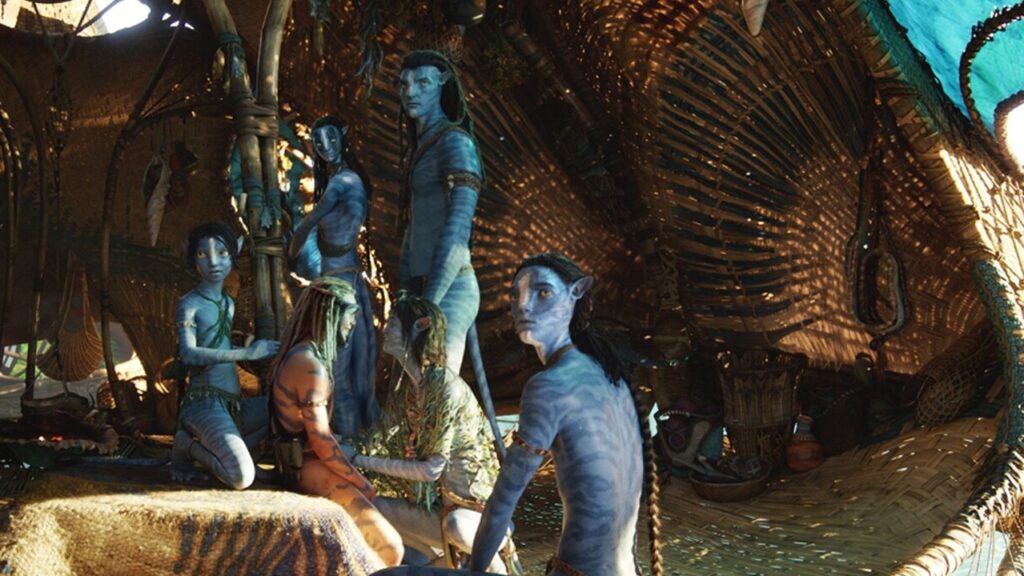
Neteyam was dead: to begin with. Jake Sully's (Sam Worthington) eldest child perished at the end of Avatar: The Way of Water. That loss informs much of Fire and Ash. Sully and wife Neytiri (Zoe Saldana) have taken to stuffing down their feelings, with the latter character stewing in anti-human hatred. Lo'ak (Britain Dalton), who now narrates these movies instead of his father, struggles with guilt over feeling that he caused Neteyam's passing. Adolescent Kiri (Sigourney Weaver) continues percieving herself as a Pandora outcast. Human youngster Spider (Jake Champion) yearns to be more like the Na'vi he loves so much. The youngest Sully kid, Tuk (Trinity Jo-Li Bliss), also exists.

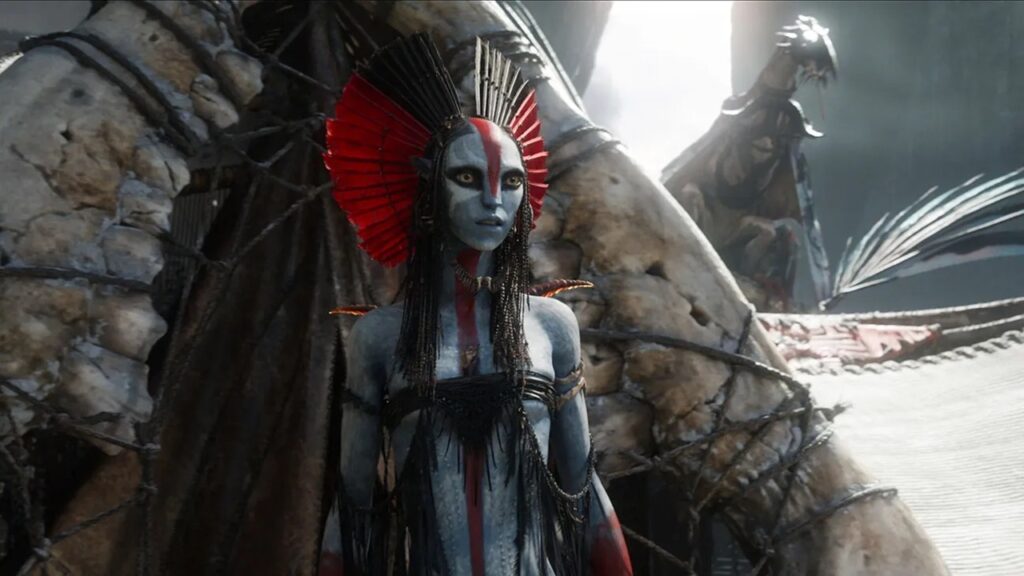
Go-to Avatar baddie Quaritch (Stephen Lang) is still out there in his Avatar body hankering for some revenge against Jake Sully. He's not the only enemy out there for this installment, though. Varang (Oona Chaplin) and her fire-fixated Na'vi people are vicious warriors bent on spreading their flame across every inch of Pandora. An unlikely union forms between Quaritch and Varang over their shared hatred for Sully. The Sully’s are a powerful family. But can they stand firm against these villainous forces and lingering sadness over Neteyam’s demise?

Midway through Fire and Ash, Sully and Spider scramble around a manmade Pandora city/compound. Their surroundings are indistinguishable grey backdrops radiating sterility. That certainly fits the aesthetic of the greedy human characters. However, the only other major new domain explored here is the drably colored, lava-decimated desert Varang and her people call home. Screenwriters Cameron, Rick Jaffa, and Amanda Silver don't dazzle the eyes with these new tableaus. All the luscious possibilities of an alien planet result in forgettable spaces littered with dim hues.

Such imagery reflects how Fire and Ash is the mopiest Avatar adventure yet. Teenage characters point gun muzzles at the bottom of their faces while in distress. Immense screentime centers on Jake and Neytiri contemplating whether or not they should kill Spider. Cameron, Jaffa, and Silver also focus several sequences on domestic squabbles between various Sully family members. These only reinforce that intimate dialogue has never been Cameron’s strongest suit. Plus, Worthington and Champion are not actors you entrust with material evoking Who’s Afraid of Virginia Woolf? or Of Mice and Men.

Courtesy of 20th Century Studios

Going darker isn’t inherently a bad thing, especially given the loss informing The Way of Water’s ending. However, Fire and Ash’s execution of that tone is extremely uninvolving. Adding insult to injury, all this morose material just leads to Cameron remixing memorable moments from the prior two Avatar movies. The orange-colored Great Leonopteryx from the first Avatar returns in this film's third act. That stretch of the story also features a near beat-for-beat remake of Jake Sully uniting the various Pandora clans in the inaugural Avatar feature.

A climactic sea-set battle simply rehashes The Way of Water’s conclusion. The only difference is that this barrage of aquatic warfare largely occurs in eclipse-induced darkness, further accentuating Fire and Ash’s diluted color palette. Even the musical leitmotifs dropped throughout Fire and Ash’s finale feel like Cameron checking off the boxes for what a requisite Avatar climax “must” provide. The epitome of this rampant familiarity is in the dearth of new critters. The Way of Water’s aquatic Na’vi brought with them countless space whales and cosmic underwater creatures to dazzle the senses. Varang and her cohorts, meanwhile, just ride slightly more menacing-looking Banshees. Why couldn’t they have nifty iguanas and flamingos to ride into battle?

This third Avatar entry certainly overwhelms audiences with eye candy, but so much of its drably colored or too evocative of Pandora’s past. The movie’s high points center around something distinctly new: Varang and Quaritch’s unexpected bond. Just look at a scene where Varang forces Quaritch into a drug trip. The trippy colors and woozy camerawork finally shake up the visual status quo of this franchise. Fire and Ash truly comes alive when these villains are getting chummy or sneaking off for some outer space boning.

Unfortunately, the unexpected is frustratingly scarce in Avatar: Fire and Ash. Familiar faults even materialize through the return of Cameron’s dreadful deployment of High Frame Rate imagery from The Way of Water. Typical movies are projected at 24 frames per second. In premium format (IMAX, Dolby Vision, Cinemark XD, etc.) Fire and Ash screenings, random moments are suddenly projected in 48 frames per second before returning to the default 24 fps format. This isn’t like certain IMAX movies giving viewers lengthy sequences in one aspect ratio and then shifting back after a few minutes. Fire and Ash hops back-and-forth between frame rates constantly.

This process hasn’t gotten any better since The Way of Water three years ago. High Frame Rate doesn’t immerse viewers into Pandora’s world. Instead, the 48 fps moments trap the Sully clan in motion smoothing hell. The 24 fps segments following these sped-up images, meanwhile, take on an immediately discernible janky appearance. A gigantic blockbuster on a massive movie theater screen shouldn’t look like it’s buffering. Cameron’s deployment of these varying frame rats indicates no precision or thoughtfulness. It’s just deployed so randomly that it kept forcing me out of the movie. All that money spent on visual effects work ruined by hideous High Frame Rate projection. What a staggering folly.

Courtesy of 20th Century Studios

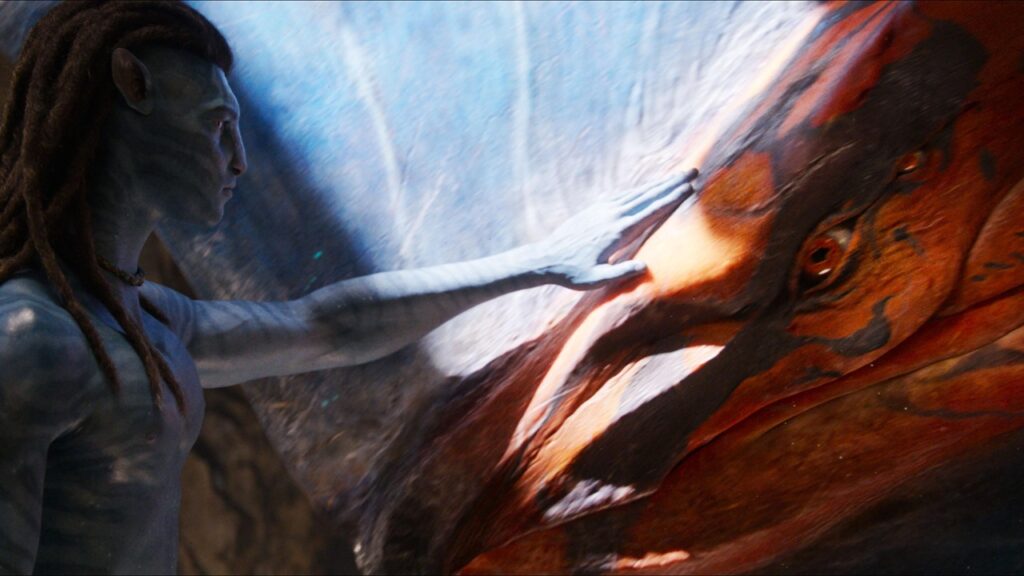
Fire and Ash pairs up these visual defects with eyeroll-worthy dialogue like “well, this is awkward” and tremendously familiar narrative beats like reducing Neytiri to a damsel-in-distress for much of the finale. These overwhelming problems are so distracting it’s hard to appreciate the elements that do work. Sigourney Weaver as Kiri, for instance, continues being sublime. An early set piece of the Sully family traveling through the sky with Pandora’s “Wind Traders”, meanwhile, is the one Fire and Ash set piece exuding tangible beauty. This planet’s various underwater critters remain utterly delightful, particularly Avatar franchise MVP Payakan. Some adorable alien otters (which I don’t remember seeing in The Way of Water) are incredibly cute.

What good are fleetingly seen cuddly animals, though, if the movie they inhabit is so unengaging? Whether it’s drastically overestimating how engrossing Spider is as a character, the weird racial politics (God knows the Avatar movies have always struggled in this field), or the drab color scheme, Fire and Ash is a barrage of tedious creative missteps. "Sometimes your whole life boils down to one insane move," Jake Sully once intoned. How ironic, then, that he’d eventually headline a movie playing it so safe. With this sequel, the Avatar saga gets trapped in a cesspool of callbacks from which only flickers of creativity can escape.

Friday, December 12, 2025

Lisa Laman's 25 Favorite Movies of 2025

The last few weeks of 2025 have been chock-full of dreadful news related to AI companies and media consolidation. It all makes me feel despair-ridden and keeps me up at night. However, as the year draws to a close, I refuse to let these billionaire wackos ruin my perception of the year's cinema. We must be conscious of these evils, but not let them overwhelm or erase the exciting elements in 2025's cinema scene. The deeply human and communal joys tech companies yearn to erase, that's what these past 12 months of cinematic storytelling have been all about.

God knows how grateful I am that I got to experience multiple films in the IMAX 70mm format and with some of my dearest friends. Witnessing those glorious images on a towering screen with my favorite people produced memories I'll treasure forever. Also thrilling were the exchanges and conversations I shared with various souls in between screenings at events like the Austin Film Festival or Oak Cliff Film Festival. Oh! And visiting Atlanta, Georgia's Plaza Theatre, what a treat! The interior decor there was to die for.

Cinema brings people together. It's a medium containing stories, images, emotions, and so much more that you just can't get in any other form of creative expression. Even after all the trials and tribulations the 2020s have brought the filmmaking artform, 2025 still delivered so many great movies that reminded me why I live and breathe cinema. Now, it's time to explore the peak of this year in my top 25 favorite movies of 2025 list. It was so hard to whittle down my favorites of the year into a top 25 (countless sublime features just missed the cut), but these entries do paint an exciting and eclectic portrait of all that 2025's cinema scene offered. 

These are the works that instill hope against all the madness and chaos. Never lose that hope or your compassion for others, dear reader. 

Before the proper top 25, a pair of honorable mentions!

Kill Bill: The Whole Bloody Affair (dir. Quentin Tarantino)

Quentin Tarantino's a blowhard in the modern world, as that deeply cursed Kill Bill Fortnite short exemplified. However, I can't act like getting to watch both Kill Bill movies in one theatrical setting wasn't a glorious, borderline religious experience. I'm keeping my top 25 list solely for new movies released in 2025, but spending 260+ minutes with The Bride's saga in a movie theater setting was one of the year's great filmmaking highlights. Uma Thurman's performance, Sally Menke's editing, the incredible sound design, it all comes alive both in an unbroken narrative structure and theatrical environment. What a shame about that Fortnite short playing after the credits...

Fucktoys (dir. Annapurna Sriram)

This hasn't secured U.S. distribution or a proper general release yet (it's still playing on the festival circuit), but oh God, I cannot wait for everyone to experience Fucktoys. It's hard to describe writer/director/star Annapurna Sriram's unhinged creative vision for this feature. It's apocalyptic. But it's also deeply sexy. Grimly funny. Shockingly moving in its depiction of solidarity between sex workers. Beautiful to look at, especially since everything is shot on profoundly tactile film. It's a blisteringly original and provocative work thumbing its nose at the 1% and buttoned-up concepts of "good taste". This is a ribald and wildly fun ride unlike anything else I've seen this year or any other year. Congrats to Annapurna Sriram for joining Aimee Kuge and Vera Drew in the pantheon of exceedingly talented modern filmmakers keeping sublime trashy cinema vibes alive in the modern world.

On to the proper top 25 list! Starting with...

USE GIMP TO CREATE SPECIAL HEADER IMAGE

H

25. Companion (dir. Drew Hancock)

The moment Companion protagonist Iris (Sophie Thatcher) lamented, “I’m so worried I’m gonna say something stupid in front of your friends,” to her toxic boyfriend, my autistic super self-conscious heart went out to her. I was hooked on whatever happened next to this woman. Luckily for me, writer/director Drew Hancock has Iris anchoring a terrifically fun movie full of lively performances and creative suspense sequences. Thatcher's an absolute riot the entire runtime as the automaton Iris, particularly in an unforgettable scene involving her character speaking German. Companion's a wild ride and just the sort of cheer-worthy movie you want to watch with a crowd.

24. Hedda (dir. Nia DaCosta)

How can I resist a movie where Tessa Thompson and Nina Hoss play messy lesbians who unleash treachery at every possible opportunity? Hedda isn't just Nia DaCosta's new vision of Henrik Ibsen's play Hedda Gabler. It's also a riveting romp full of spiraling bad behavior you just can't look away from. Rather than rigidly reciting a familiar text, DaCosta imbues this story with an unpredictable verve perfect for its chaotic titular lead. This filmmaker's visual chops are more refined than ever with this film's lavish, sprawling backdrops. Thompson and Hoss had me gasping and clapping my hands with glee in equal measures over their go-for-broke performances. Any movie delivering all that, a crumbling chandelier, and another magnificent Hildur Guðnadóttir score is one worth applauding. Needless to say, the Little Woods auteur has done it again!

23. The Chronology of Water (dir. Kristen Stewart)

For her feature-length directorial debut, Kristen Stewart leaves it all on the floor with The Chronology of Water. The whole project fascinatingly leans into the "imperfect", from truncated music cues to the profoundly lived-in 16mm imagery (right down to the frayed edges of every frame) to the editing jostling viewers across so many different time periods. This woman's tormented mind and existence come to transfixing, nightmarish life in Stewart's bravura filmmaking and Poots' equally gusto performance. Regret, messiness, trauma, it's all here in a cocktail of psychological misery. All of these tremendous visual and atmospheric impulses weave a ballad of potent anguish that's impossible to shake. The Chronology of Water may just kick off an amazing directorial filmography for Stewart, but for now, it's still a remarkably evocative and visually subversive work.

22. Marty Supreme (dir. Josh Safdie)


Go! Go! Go! Propulsive energy fuels Marty Supreme, as its titular lead (played by Timothee Chalamet) pursues his ping-pong champion dreams at all costs. Prior Josh Safdie directorial efforts like Good Time and Uncut Gems echo throughout Marty Supreme's aesthetic, but this is no cinematic rerun. This project's got plenty of outstanding cinematography and darkly humorous beats to firmly establish its own identity. Plus, Chalamet's one-of-a-kind performance is a magnificent fusion of sweaty desperation and confident temerity. His Marty Mausr is often so pathetic, yet he keeps us glued to his every move. The evocative cinematography and editing also Mauser's journey so transfixing. The riveting offspring of a screwball comedy, a warped underdog sports drama, and a distinctly Josh Safdie atmosphere, Marty Supreme is enthralling entertainment. 

21. Black Bag (dir. Steven Soderbergh)


Sometimes, all a movie needs to solidify itself as an all-timer is a great score. Steven Soderbergh's spy movie Black Bag certainly delivered on that front with a slew of unforgettable compositions from David Holmes. Juxtaposing the world of espionage with a sonic landscape full of jazz music, clanking noises, and Güiro playing creates a spy movie soundtrack like none I've ever heard before. To boot, all those compositions serve an incredibly fun, suspenseful thriller that makes such great use of its stacked cast. Black Bag's got a dynamite, sexy cast and a score that pleases the ears... what more do you need?

20. The Life of Chuck (dir. Mike Flanagan)


So much of The Life of Chuck sounds like it should be insufferable. Maybe it is to many moviegoers. I was enchanted, though, by writer/director Mike Flanagan's adaptation of the Stephen King short story of the same name. Tender beauty permeates this whole film, which oscillates across its three segments between a bittersweet, apocalyptic yarn, a tale of uncovering everyday joys, and a domestic horror drama. Across these various impulses, insightfulness and poignancy seep into The Life of Chuck's smallest moments. That is, after all, where the most profound bits of existence lie in wait. A teacher "who won't last long in public education" can still immensely affect a student's life for the better. Dancing with a stranger can lift up so many different souls at once. Random kindness can still matter in a chaotic world. In both its big and small elements, The Life of Chuck taps a richly moving vein.

19. The Mastermind (dir Kelly Reichardt)


After subverting the standards for what Westerns "look like" with First Cow and Meek's Cutoff, writer/director extraordinaire Kelly Reichardt upends the heist movie with The Mastermind. With her trademark clinical and unblinking images, Reichardt emphasizes the patheticness of Danny Ocean-wannabe James Blaine "J.B." Mooney (Josh O'Connor). Even when he's just hiding away stolen paintings, this filmmaker's camera captures Mooney stumbling around and struggling to accomplish the simplest tasks. It's all quietly darkly humorous while Reichardt's very real handling of the consequences of Mooney's thievery informs several gripping, tense set pieces. The real mastermind here is Kelly Reichardt and her continued ingenious contortions of distinctly American movie genres.

18. Put Your Soul On Your Hand And Walk (dir. Sepideh Farsi)

Starting around 2020 with titles like Boys' State, I began noticing more high-profile documentaries being shot like traditional narrative movies. There's nothing wrong with that approach, but the documentary Put Your Soul On Your Hand And Walk was a devastating reminder of the staggering power of stripped-down fillmmaking approaches in this domain In this feature, director Sedpieh Farsi uses a camera to chronicle her video chats with Gaza resident Fatima Hassouna as Palestine is being invaded by Israeli forces. Keeping Put Your Soul on Your Hand and Walk so streamlined in form allows Hassouna's testimony to come through loud and clear. As she and her people are being wiped off the planet, these video calls reinforce the nuances and humanity of Hassouna, her family, and neighbors. That's all communicated via a camera recording imagery on a cell phone. All the streaming platform money in the world cannot guarantee a documentary this agonizingly heartbreaking and richly human.

17. Weapons (dir. Zach Cregger)

Weapons is a blast. It's the optimal version of a riveting campfire story with all the fun and chills that entails. Writer/director Zach Cregger lends immense craftsmanship to enjoyably macabre cinema with his measured single-take shots, the subtle ways individual stories intertwine, and a splendidly varied score (I love how each character's storyline has such a distinctly different sound). To boot, the proceedings also work as an achingly relevant story about how tragedies inspire people to look for a scapegoat, not opportunities to unite. All of that plus the endless entertainment of Amy Madigan chewing all of the scenery as Aunt Gladys or Austin Abrams killing it as James ("I can't come to the police station because I'm...phobic"). Weapons is entertaining horror cinema done oh so right.


16. Friendship (dir. Andrew DeYoung)

Huzzah I Think You Should Leave fans, Tim Robinson can indeed sustain his brand of cringe comedy for an entire movie. Friendship proved that to hysterical results this past summer, partially by deploying very unique visual traits compared to past Robinson productions. Take the visual cues emphasizing the perspective of his character's wife (stealthily played so well by Kate Mara). Or ingenious sequences like a subversion of the typical comedy movie "drug trip" set piece. These qualities make sure this isn't just a feature-length rehash of the hot dog suit man sketch. Robinson's ability to deliver belly-laughs remains intact, but DeYoung imbues plenty of new traits in here too, including a wintery backdrop nicely accentuating the desperation underpinning Friendship's protagonist. Also, Connor O'Malley has maybe the funniest line of the year with his declaration "we should still be in Afghanistan."

15. Blue Moon (dir. Richard Linklater)

Rare is the historical drama that begins with its titular lead drunkenly stumbling around in an alleyway before perishing. That opening sequence of Blue Moon establishes screenwriter Robert Kaplow and director Richard Linklater's melancholy ambiance as they chronicle one night in the life of lyricist Lorenz Hart. The whole feature takes place in one bar, yet Linklater, being the king of the hangout movie, makes a limited scope a virtue, not a shortcoming. Plus, this intimacy lets audience spend more time with Ethan Hawke's transformative turn as Hart. Kaplow's script gives Hawke so much riotously juicy dialogue ("cornstalks as high as an elephant's eye...it's just an unpleasant visual!") to sink his teeth into. Hawke's Hart is a motormouth know-it-all whose tangible romantic yearning and sorrow is heartbreaking. This richly nuanced incarnation of Hart is a privilege to spend two hours with, especially with Blue Moon's remarkable ensemble cast (Andrew Scott is so memorable here) and Linklater being at the top of his game. 

14. I'm Still Here (dir. Walter Salles)

A man is disappeared early on in I'm Still Here. This individual is one of many souls whisked off the street and erased from existence during the Brazil's military dictatorship. When Rubens Paiva is gone, though, his wife, Eunice (Fernanda Torres), and kids remain. And they won't stay silent. Director Walter Salles achingly portrays what it's like to exist, rebel, and advocate against injustice during unspeakable circumstances. Suffocating tension is palpable through every inch of the runtime and Torres conveys the sheer weight of these harrowing circumstances through the subtlest expressions. I'm Still Here is already a masterpiece before its series of epilogues that heartbreakingly depict how fascism's horrors reverberate for generations afterwards. Here is a movie whose scope, filmmaking, and stirring performances reduced me to a puddle of tears by the time the credits began rolling.

13. Eephus (dir. Carson Lund)


Contemplating the inevitability of growing old and things ending has rarely been as amusing as it is in Carson Lund's Eephus. This film follows two baseball teams (largely made up of middle-aged men) congregating on their beloved field for one last game before the diamond is bulldozed. Amusing lines are all over the place in this feature (I'm partial to a back-and-forth exchange related to pizza toppings) while the richly lived-in dynamic between the performers makes it feel like you've stumbled into a real baseball game. Life's finite nature keeps creeping into the margins of Eephus and fascinatingly informs a motion picture that already works like gangbusters as a hilarious hangout film. Lund's assuredness behind the camera in his directorial debut is outstanding, while Cliff Blake's endearing turn as Franny stands out as unforgettable in a cast stacked with great performances.

12. On Becoming a Guinea Fowl (dir. Rungano Nyoni)

“There are some things you cannot challenge.” This is one of many dehumanizing statements Shula (Susan Chardy) hears daily in writer/director Rungano Nyoni’s excellent On Becoming a Guinea Fowl. Nyoni’s filmmaking reaffirms the complicated psyches of women (like Shula) impacted by societally mandated ostracization of both women and sexual abuse survivors. Her visual reflections of these mindsets is stunning and makes use of everything from beaming red lights to ominous pools of water. On Becoming a Guinea Fowl has creative visuals to spare that lend such vivid insight into often silenced souls like Shula.

11. April (dir. Déa Kulumbegashvili)


Writer/director Déa Kulumbegashvili’s default filming approach to April is fascinating. Typically, she opts for extended unblinking shots that have no principal characters in the frame. Even when the script is focused on key figures in cramped indoor spaces, their faces are just cut off by the camera’s position. This creates bold images, but it’s also a perfect visual feat for reminding viewers of the larger world beyond lead character Nina (Ia Sukhitashvili). While she exists in a world where people often dismiss the humanity of those needing healthcare like abortions, April’s often expansive and unorthodox camerawork forces audiences to consider the grandness of existence. This is one of the many extraordinary concepts communicated by April’s one-of-a-kind visual impulses. To say Déa Kulumbegashvili’s understated work is extraordinary is an understatement. Like Eephus, April is a directorial debut radiating the energy of a cinema master.

10. If I Had Legs I'd Kick You (dir. Mary Bronstein)


Mary Bronstein’s relentlessly intense If I Had Legs I’d Kick You often left me chuckling as often it inspired my teeth to clench or nails to dig into my armrest. The madness of juggling so much in everyday existence is so absurdly towering that it loops back right into dark comedy. Bronstein deftly captures that reality in extremely memorable sequences like Linda (Rose Byrne) and her daughter realizing the hamster they’ve purchased is feral. Balancing that bleak comedy with a suffocating, anxiety-inducing atmosphere comes so naturally to Bronstein. Her filmmaking brings out career-best work in Byrne, who sheds any trace of her prior characters in her mesmerizing work as Linda. You can’t take your eyes off her bravura work. Also, who knew Conan O’Brien had a great character actor turn like his Legs performance (as an emotionally elusive therapist) in him?

9. The Alabama Solution (dir. Andrew Jarecki and Charlotte Kaufman)


Heartbreaking. That was the only word floating around in my mind as The Alabama Solution ended. To witness not only the brutality normalized in the American prison system, but also the rhetoric of powerful politicians like Alabama Attorney General Steve Marshall, who don't see prisoners as human beings...it makes one's soul ache. This documentary sharply rebukes those norms by letting various Alabama prisoners (providing testimonies through secretly filmed iPhone video calls) talk about their experiences and how they're challenging life-threatening structures. This production is already a magnificent accomplishment even before its final 35 minutes deliver an extra transfixing prisoner strike narrative thread. Documentary legend Barbara Kaplan would be proud of Solution's depiction of striking workers standing up against impossible odds. The Alabama Solution unflinchingly gazes upon American agony, but is equally relentless in its commitment to emphasizing the humanity of human beings enduring that agony.

8. Hamnet (dir. Chloe Zhao)


Chloe Zhao has a gift for creating immediately wistful images. Any frame from one of her features feels like a bittersweet memory from your own mind. That gift is excellently applied to Hamnet and the saga of William Shakespeare’s (Paul Mescal) wife, Agnes (Jessie Buckley). Even with countless movies about The Bard out there, few have felt as emotionally impactful or poignantly palpable as Hamnet. In Zhao’s hands, Agnes and her family do not come off as future historical icons. They’re just ordinary souls navigating the emotional anguish of everyday reality. That everyday nature aided by Buckley’s gut-wrenching lead performance. Whether she’s wailing in agony or silently gazing up to the sky, Buckley’s a marvel and full of deeply specific humanity. Zhao’s brand of bittersweet filmmaking is in especially rare form in the tremendously moving triumph that is Hamnet.

7. The Ugly Stepsister (dir. Emilie Blichfeldt)

Writer/director Emilie Blichfeldt's The Ugly Stepsister is a warped vision of the Cinderella story that could only come from a deranged mind. I mean that as the highest compliment! Bilchfeldt's penchant for imaginative stomach-churning imagery is such a refreshing contrast to so many modern horror films that're too buttoned up for their own good. The gag-inducing sights of chisels entering nostrils and lengthy tapeworms all serve a thought-provoking exploration of how ladies perceive their bodies and the creepy commodification of women. Tickling the brain and gag reflex in equal measure, The Ugly Stepsister is also full of thrilling visual flourishes, including terrific period-appropriate costumes. Like if Jacques Demy and Brian Yauza had a maniacal child, The Ugly Stepsister is an exquisitely demented trip. More cinema like this, please!

6. No Other Choice (dir. Park Chan-wook)

Speaking of freaky cinema, leave it to The Handmaiden and Decision to Leave director Park Chan-wook to make the perfect movie crystallizing the madness of finding a job in 2025. In age of LinkedIn scams, A.I. slop, and unchecked corporate consolidation, only the man who executed Oldboy's twist ending can make the ideal dark comedy reflection of this insane era. Chan-wook's chops are in top-notch form realizing this story about an ordinary man (Lee Byung-hun) who, desperate for a job, turns to murdering other people contending for the same job. The endlessly talented Byung-hun proves divine in handling bumbling comedy. Meanwhile, Choice's adaptation of Donald Westlake's novel The Ax keeps the engrossing twists coming at a steady clip. The darkly hysterical bloodshed and deeply human slip-ups are already fun on their own, but then Park Chan-wook drops the mic with No Other Choice's outstanding ending that echoes, of all things, The Irishman's final shot. This filmmaker's bravura madness has always been enthralling, but distinctly 2020s anguish ensures No Other Choice has Park Chan-wook working in an especially masterful mode.

4. The Voice of Hind Rajab (dir. Kaouther Ben Hania)

Jia Zhangke and Abbas Kiarostami's legacies of merging scripted dramatizations with material ripped from the real world is alive and well in writer/director Kaouther Ben Hania's The Voice of Hind Rajab. This motion picture follows Red Crescent volunteers answering an emergency call from Hind Rajab, who is trapped in a car in a Gaza warzone.  Actual audio of six-year-old Hind Rajab on that fateful January 2024 day is where The Voice of Hind Rajab's deployment of reality comes in. Her anguish and pleas for help devastate your heart, while the film around her carries an appropriate sense of grueling gravity. Meanwhile, Ben Hania's screenplay deftly illustrates how the endless injustices keeping aid from reaching Hind Rajab are a microcosm of a larger dehumanization of Palestinian lives. Such lives are given such vivid life through elements like Saja Kilani's performance as Rana. Though often framed only from the shoulders up, she's captivating portraying a woman who grows increasingly invested in Rajab's safety. The Voice of Hind Rajab is a filmmaking masterclass in so many ways, including its fusion of scripted material and gruelingly real examples of a modern genocide.

4. One Battle After Another (dir. Paul Thomas Anderson)

Like Lee Byung-hun, Leonardo DiCaprio spent 2025 proving that handsome actors often make the best goofballs on-screen. As Bob Ferguson in One Battle After Another, the former Titanic leading man hysterically channels Tim Robinson more than his suave huckster from Catch Me If You Can. Shockingly, he's not even the best performance in this Paul Thomas Anderson-directed masterpiece, a testament to how stacked this exemplary cast is. Every inch of this epic tome works like gangbusters, from Chase Infiniti's star-making lead turn to the awe-inspiring camerawork (watching this film in 70mm IMAX is a religious experience), to a script that gave the world phrases like "a semon demon" and "life, man...LIFE!", and a finale that ensured I'll never look at hills the same way again. Why can't every big-budget American movie be this endlessly fun and well-made? Viva la revolution indeed, and viva movies as excellent as One Battle After Another.


3. Sorry, Baby (dir. Eva Victor)

An unintentional recurring thread across some of 2025's greatest movies was how they allowed viewers to process the most harrowing parts of modern reality in cinematic confines. Whether it was an ongoing genocide in The Voice of Hind Rajab or No Other Choice depicting how late capitalism turns working-class people against each other, 2025's most overwhelming facets informed the year's most incredible motion pictures. Eva Victor's Sorry, Baby very much operated in that mold with its non-linear exploration of coping with sexual assault trauma. It's staggering how Victor excels in every area of Sorry, Baby, from their direction to their writing to their lead performance. Their craftsmanship informs a movie beautifully capturing the complexities of existing after the unthinkable. And that ending? I'm getting misty-eyed just thinking about it. Sorry, Baby is an extraordinary accomplishment from start to finish.

2. Sinners (dir Ryan Coogler)

Sinners is one of those movies so enthralling that I want to drop all pretense of being "professional" and just blabber in short phrases about its many virtues. That "I Lied to You" sequence that made my musical cinema geek heart soar. All the great dialogue, like "but you won't steal this pussy?" or the frequent villainous utterances of "SAMMY!" Don't forget that Irish jig sequence, the way aspect ratios shift in IMAX 70mm screenings, or Delroy Lindo as Delta Slim reminding everyone why he's an all-time great talent. I could go on and on...so allow me to also praise that scene where Sinners slows down for a quiet rendition of "Wild Mountain Thyme" and Wunmi Mosaku's vital work as Annie. Everything here doesn't just work. It all radiates showmanship that so many modern blockbusters lack. Sinners refused to skimp on the toe-tapping thrills, bloodshed, or pathos, and 2025's cinema scene was all the richer for it. Now if you'll excuse me, I'm going to listen to "I Lied to You" for the umpteenth time.

1. It Was Just An Accident (dir. Jafar Panahi)

Just like a great score, a single scene can sometimes solidify a movie as a masterpiece. Jafar Panahi's It Was Just an Accident has such a scene towards the end of its runtime in which Shiva (Mariam Afshari) confronts a man who may have previously tortured her. "You said I want your screams to etch the halls," Shiva announces, "Now I want yours to etch this Earth." I couldn't tear away from this scene (which is almost exclusively rendered in one unbroken take). Both Afshari's performance and writer/director Jafar Panahi's weave such a heartbreaking and transfixing portrait of the past and present colliding. Even before this scene, though, It Was Just an Accident is very much an extraordinary accomplishment. Panahi's depiction of how various torture survivors cope and respond to the idea of "revenge" makes for engrossing drama, especially since the camerawork and editing are so superb at keeping viewers uncertain where the proceedings are going next. Once Mariam Afshari nails her big climactic scene, there's just no way of avoiding how outstanding It Was Just an Accident truly is. Though carrying over many themes and Iran-specific events populating Panahi's prior classics like Taxi and No Bears, It Was Just an Accident is its own astonishing and haunting masterpiece.